
Table of Contents
Races | Economy | Buildings & Organizations
TRADE GUILD OF NEW KOUROU
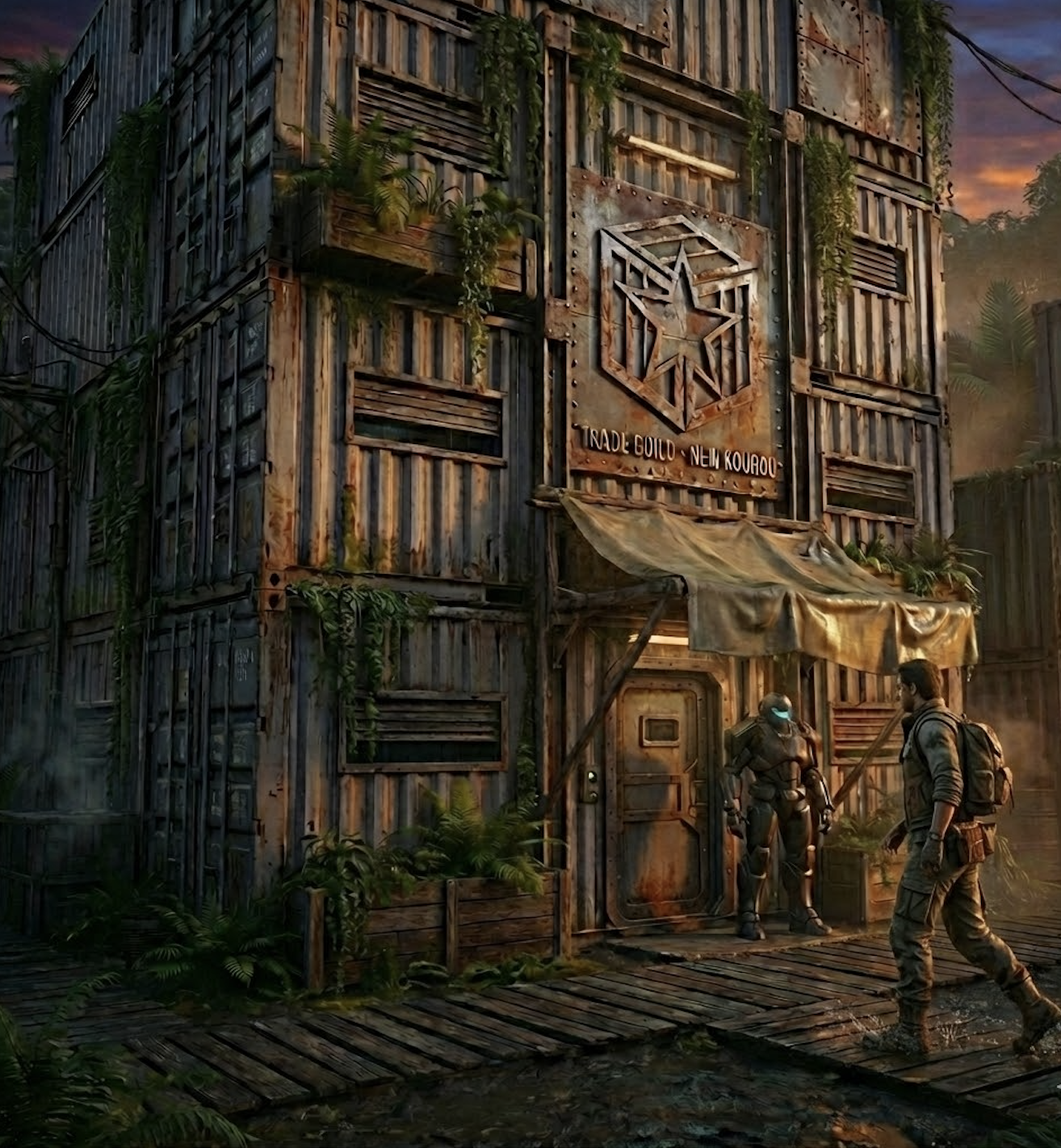
Overview
- Founding Year: 2625
- Headquarters: Headquarters of the Trade Guild of New Kourou, New Kourou
- Original Purpose: Foster free trade through lobbyism within the Free State of Settlers, provide financial support and offer common infrastructural services for members such as the New Kourou Courier Service.
The Trade Guild of New Kourou was the most powerful exohuman trade organization within the Free State of Settlers, acting as a stabilizing force in an otherwise volatile frontier economy. Consisting of local merchants, supraregional trade organizations, and entrepreneurs, the guild regulated commerce, maintained supply chain stability, and organized trade logistics — including operating its own Courier Service.
Although not an official government body, the Trade Guild held immense social and political influence, often regarded by settlers as the real leadership of the Free State of Settlers. Guild members commanded public trust far more than politicians or former government figures.
The guild was led by an elected Chairman, chosen annually among merchants or entrepreneurs.
History
The Early Years (2625–2626)
- Founding & Trade Route: June 2625 — demanded and underwrote construction of the paved Trade Route linking New Kourou with Hope and Morningstar, in exchange for a ten-year Courier Service monopoly.
- Energy Ambition: Early 2627 — financed, built, and operated Firetown’s 10 MW Geothermal Power Plant, ensuring reliable district heat and full-flux charging capacity for Firetown's Tier-1 Energy Redistribution Node.
- Resource Expeditions: Launched surveys into the Asari and Ralar Regions to secure timber, ore, and freshwater, and sponsored the ill-fated Fisherpoint settlement
- Battle of Fisherpoint: The Guild’s involvement in founding Fisherpoint directly contributed to the Battle of Fisherpoint, where 1,000 Orlanda warriors overwhelmed the 90 lightly defended settlers. This devastating loss marked a major escalation toward full-scale conflict on VOI 700 D.
Role During the Great War (2628–2630)
- Aligned with the Volunteer Army of Man and Guarding Troopers, funding propaganda and logistics to secure human‐dominant outcomes.
Post-War Transition and Federalization (2631–Present)
- Nationalization: 2631 — following the Peace Treaty and rise of Communardism, the Federal Council dissolved the Guild; its energy and transport assets (including the Geothermal Plant and Courier Service) were transferred to the Federal Allotment Agency and the Federal Courier Service.
- Individualist Part: Former Guild members, many embittered by the loss of their influence and enterprises, became key supporters of the Individualist Party, advocating for a return to a more capitalist, human-centric society.
Courier Service
The Trade Guild’s New Kourou Courier Service (NKCS) was one of the first large-scale logistical operations on VOI 700 D. It operated exclusively along the paved Trade Route connecting New Kourou, the Hope Region farms, and Morningstar.
Due to the settlers’ limited access to energy resources after the crash of the Last Frontier, the NKCS relied on traditional transportation methods, using Hoos as mount animals to pull carts instead of automotive vehicles or planes. This approach allowed the Courier Service to function efficiently without draining valuable power reserves needed for life support and settlement infrastructure.
After the construction of the Trade Route, the NKCS was granted the exclusive license for transportation along the paved road, a privilege secured through agreements with the Settler's Council. While this monopoly helped stabilize early commerce, it also created tensions: merchants outside the Trade Guild of New Kourou, as well as governmental institutions, were forced to pay high fees for transportation services, often leading to friction and disputes over access and fairness.
To support travelers, caravan workers, and NKCS staff along this increasingly vital artery, the Trade Guild founded and operated a chain of Asari Inns — standardized, container-built lodgings providing minimal but reliable accommodations in New Kourou, Hope, and Morningstar. These Inns became a defining feature of frontier travel: inexpensive cabins, shared facilities, automated Butler Bot service, and round-the-clock availability. Though lacking any comfort or luxury, the Asari Inns ensured that couriers, settlers, and merchants could rest safely between the young colonies without straining local resources.
In response to the NKCS’s high transportation fees, the Free State eventually began operating a loose network of freelance Courier Riders, who transported goods and mail across rough, offroad routes outside the paved Trade Route. Although slower and more dangerous, these independent riders became a vital alternative for settlers unwilling or unable to afford NKCS rates.
The NKCS was phased out after nationalization in 2631, as part of the Federal Confederation's broader effort to replace private logistics with the Federal Courier Service.
Trade Infrastructure and Expeditions
The Trade Guild of New Kourou didn't limit itself to local commerce but actively worked on expanding settlement zones and resource acquisition:
- Trade Route Construction: A paved Trade Route between New Kourou, Hope Region, and Morningstar, built with Guild funds and labor.
- Resource Expeditions: Expeditions into the Asari and Ralar Regions to identify and secure new resource sites, including forests, ore deposits, and freshwater sources.
- Settlement Sponsorship: Sponsored settlements like Fisherpoint aimed at expanding the Exohuman presence but also increasing tensions with Native Tribes.
These projects laid early foundations for Exohuman territorial expansion but also sowed seeds for later conflicts.
Legacy and Impact
- Economic Stabilization: The Guild stabilized the early Free State economy, preventing famine and material shortages.
- Political Influence: It became a major power broker, often overshadowing the elected government.
- Controversial Expansionism: While the Guild’s ventures expanded human settlement, they also contributed to worsening relations with Native Tribes.
- Cultural Divide: In the Gamma Age, the Guild is viewed with mixed feelings — admired for its entrepreneurial spirit by the Individualists, but criticized for its colonialist attitudes by the Communards.
Tactical Advice for Dungeon Masters
- Building the Trade Network: Players might help survey, protect, or expand the Trade Route during its initial construction, facing wildlife and bandit threats.
- Trade Guild Missions: During the Beta Age, players could be hired for expeditions into uncharted territory or for protecting valuable cargo against attacks.
- Uncovering the Past: In the Gamma Age, players could uncover hidden Trade Guild archives, revealing lost hidden treasures, or dark secrets about early settler-Native relations.