
Table of Contents
Races | Culture | Institutions
FREE STATE OF SETTLERS
Overview
The Free State of Settlers was the first state system established by Exohuman settlers on the planet VOI 700 D, marking a pivotal moment in the ExoHuman Beta Age. Officially founded on April 15, 2625, it emerged following the ratification of the First Constitution by the majority of adult settlers, symbolizing their collective desire for freedom and self-governance.
The Free State spanned a territory from New Kourou in the southwest of the Asari Region in the Eastern Equator Section of the Habitual Belt to Morningstar in the northeast and Firetown, the easternmost city and the only settlement located in the Ralar Region on the Dark Side. The capital of the Free State was New Kourou, serving as the political, cultural, and economic heart of the settlers’ society.
The Great War (June 17, 2629 – April 8, 2631) brought an end to the Free State of Settlers. Following the surrender of the Volunteer Army of Man and the rise of the Anti-War Movement, the Free State dissolved, giving way to the Federal Confederation established through the Peace Treaty.
During its existence, the Free State was never recognized by the Native Tribes.
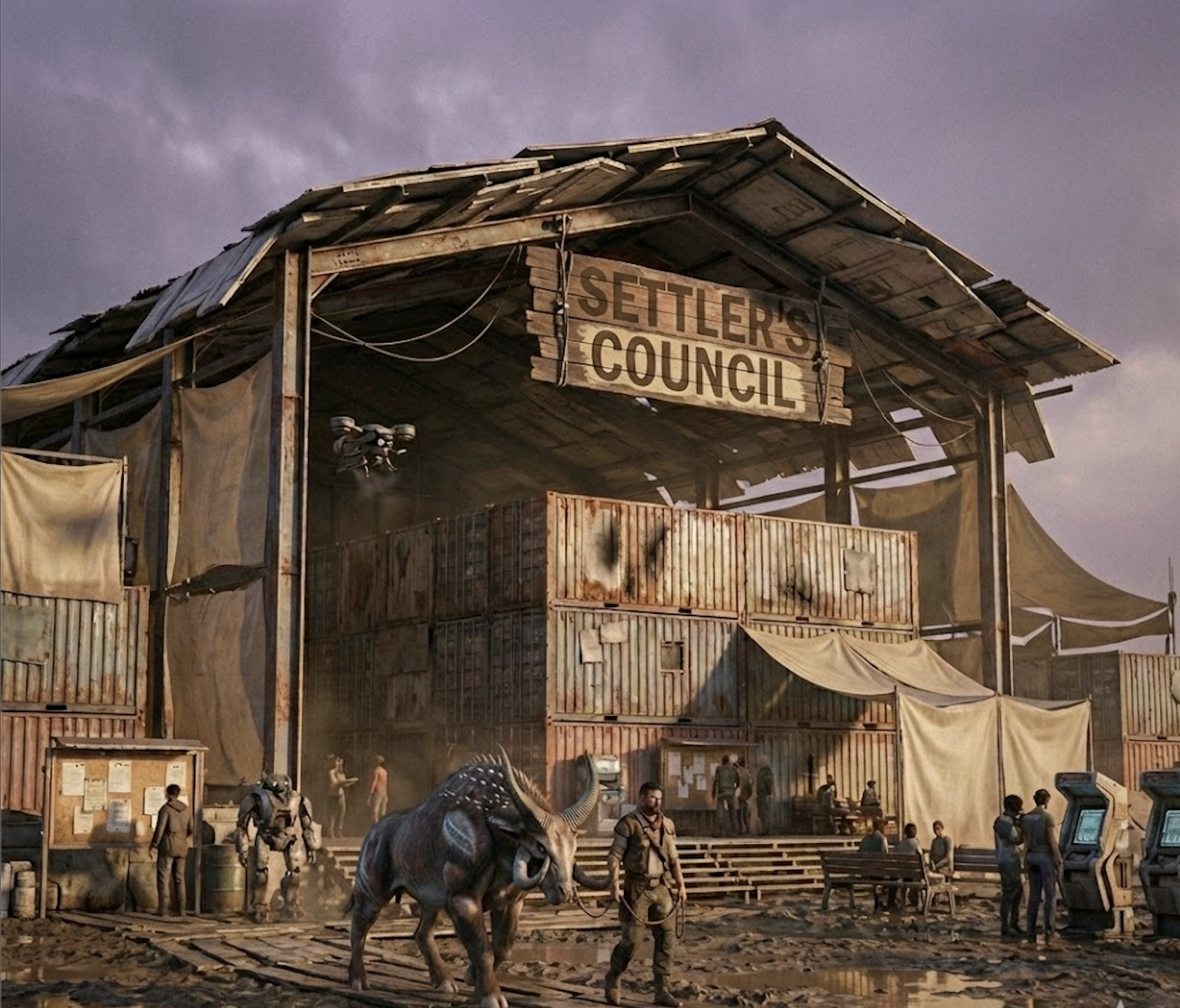
The Settler’s Council

At the core of the Free State of Settlers was the Settler’s Council, established as the legislative, judicial, and executive body. Operating from New Kourou, the council comprised five elected members:
- Election Cycle: The council was elected every two years by all adult settlers through direct voting.
- Legislative Authority: The council transformed the will of the majority into laws. All laws required approval through referendums, ensuring the populace's direct involvement.
- Judicial and Executive Powers: The council acted as the highest court of law, ensuring compliance with passed laws. It had the authority to enforce legal decisions, balancing governance with justice.
The Settler’s Council embodied the Free State’s democratic ideals, prioritizing collective decision-making and transparency.
Role of the Contact Person
Each settlement elected a Contact Person, a unique position that reflected the Free State's early grassroots leadership:
- Election and Tenure: Contact Persons were elected annually by the adult population of each settlement.
- Non-Professional Role: Contact Persons were not professional politicians but settlers chosen for their leadership qualities, often balancing their governance duties with other personal responsibilities.
Responsibilities:
- Representing the settlement in discussions with other communities and the Settler’s Council.
- Mediating disputes among settlers and organizing local activities.
- Ensuring communication between settlements and providing updates on council decisions.
The Contact Person system laid the groundwork for the more formalized roles seen in the Gamma Age governance structure.
The Legal Framework: Constitution, Civil Code, and Criminal Code
The governance of the Free State was grounded in a simple yet robust legal structure:
The First Constitution
Ratified on October 31, 2625, the First Constitution emphasized freedom and equality:
- §1 All citizens are equal before the law.
- §2 All citizens have a right to the greatest possible individual freedom - as long as their free actions do not restrict the individual freedom of other citizens.
- §3 Everyone has the right to freely choose, practice, and change his or her religion or belief.
- §4 We are a peaceful community. But when our peace is disturbed, we as adult citizens have a duty to defend it.
- §5 Every citizen has the right to a fair and public trial before an independent and neutral court.
The Civil Code
Focused on resolving disputes over property and contracts, the Civil Code ensured fairness and simplicity in private matters. Its rules were concise, requiring minimal legal interpretation and emphasizing direct resolutions.
The Criminal Code
Designed to deter crime with harsh and visible consequences, the Criminal Code operated on the principle of “high price for violations.” Key features included:
- Mark of Shame: Tattoos under the left eye to symbolize crimes (e.g., a circle for theft, a slash for violence), crossed out after sentence completion but never removed.
- Death Penalty: Reserved for murder and severe violence, carried out through public hangings.
- Public Humiliation: For theft and fraud, offenders faced the Grease and Ember Ritual, which involved coating them in plant resin and bioluminescent moss.
- Penal Labor: Criminals worked on essential infrastructure projects like the Trade Route or the Copper Mine, supervised by the Guarding Troopers in mobile prison units.
This blend of deterrence and practicality minimized administration while maintaining societal order.
Remains of the Free State of Settlers in the Gamma Age
Although the Free State of Settlers dissolved in 2631, its legacy persists in the Gamma Age:
- Democratic Foundations: The democratic systems of the Free State, such as referendums and elected councils, influenced the structure of the Federal Confederation.
- The Mayor’s Office: The role of the Contact Person evolved into the more formalized Mayor’s Office, blending the Free State’s localized leadership with the Federal Confederation’s centralized governance.
- Legal Influences: Many principles from the First Constitution, such as equality before the law and the right to a fair trial, are reflected in the Federal Confederation’s legal system.
- Federal Council Building in New Kourou: The original building of the Settler’s Council served as the Federal Council’s headquarters after the establishment of the Federal Confederation in 2631. In 2634, the Federal Council resolved to construct a new council building at the same location, symbolizing a new era of governance. The structure, built with mycel blocks, remains under construction, with completion expected in 2638.
- The Individualist Party’s Revival Efforts: The Individualist Party, one of the prominent political factions in the Gamma Age, idealizes the Free State of Settlers. They often invoke its principles of decentralized governance and individual freedom, viewing it as a model for future reforms. The party has pledged to re-establish elements of the Free State’s core structure should they gain majority control, framing their platform as a return to the settlers' democratic and independent roots.
Tactical Advice for Dungeon Masters
The Free State of Settlers is especially rich for adventures set in the Beta Age, but it also offers compelling material for flashbacks and legacies during the Gamma Age. Use it to:
- Portray Early-Stage Settlement Tensions: Let players take part in the founding of new communities, settle disputes through referendums, or experience the weight of justice under the original criminal code.
- Explore Moral Dilemmas in Law Enforcement: Feature trials, punishment rituals, or penal labor scenes to immerse players in the stark yet principled legal world of the Free State.
- Run Stories of Frontier Governance: Use elections for Contact Persons or council members as core plots—introducing political rivalries, campaign sabotage, or populist uprisings.
Related Pages and Further Information:
- Federal Confederation (successor in the Gamma Age)