
Table of Contents
Major Planetary Zones | (Twin) Sections of the Habitual Belt | Regions | Settlements
MORNINGSTAR
Overview
Morningstar is an ExoHuman settlement in the Asari Region (Eastern Equatorial Section) of the Habitual Belt on VOI 700 D. Founded on June 15 2626 during the Beta Age under the Human Settlement Plan (HSP), it was conceived as the primary timber hub for the nascent colonies.
- Population (2635 census): 3 000
- Timber output before the Great War: 3 000 ha harvested / 15 000 ha managed forest
- Timber output after the Peace Treaty: 1 500 ha harvested / 7 500 ha managed forest
In the Beta Age Morningstar ranked as the second-smallest ExoHuman settlement. Following the destruction of Arla Town during the Great War, it is the smallest member of the Federal Confederation.
Geographical Position & Microclimate
Morningstar perches at 300 m in the lower Atrana Mountains, roughly 100 km north of Hope. Towering 4 700 m peaks deflect both the frigid katabatic winds of the Dark Side and the desiccating blasts of the Desert Side, while warm equatorial air masses generate year-round rainfall. Humid lower slopes wrap the town in persistent mist; higher ridges see seasonal snowfall and glacial melt that feed mountain streams.
Social Composition of Morningstar
Beta Age (2626–2630)
Morningstar functioned as a small but settled timber town rather than a transient work camp. Population rose and fell with harvest seasons and road conditions, yet a core of year-round households anchored the place.
- Households & Children: Not planned around families, but some made it home. Only a small share of children lived here (low single-digit %). Schooling existed but was modest (a combined, often understaffed primary/high room) and apprenticeships were common. The town felt like a tough, new-frontier logging camp first, community second.
- Gender & Tenure: Mixed but work-skewed toward physically demanding forestry roles. Many lumber crews rotated by season, while millwrights, medics, teachers, and traders tended to hold multi-year posts.
- Workforce Mix: Dominated by forestry and sawmilling (logging crews, sawyers, carpenters), with smaller layers of transport/outfitting, local trade, and a lean administrative core. Hunters and trappers were present in this era.
- Automation Footprint: Manual Labor Bots and maintenance units assisted felling, yarding, and mill handling; chainsaws and bot-hauls were common on the slopes.
Gamma Age (2631– )
- Households & Children: Morningstar remains child-permitted in the Gamma Age. It still isn’t “family-first,” but families can—and do—settle in longhouse apartments. Schools run continuously under standardized curricula, while GAIA assigns housing and rations to keep cohorts stable in a work-led, forestry town.
- Gender & Tenure: Assignments are longer and steadier than in the Beta Age, though quota shifts still prompt periodic rotations. Workforce is broadly mixed, with fewer pure logging posts.
- Workforce Mix: Forestry is downsized by treaty quotas; employment pivots toward the Federal Wood Plant, composite fabrication, regulated services (canteen, hostel & saloon, sewing, funeral), and civic roles (library, sheriff’s office, allotment center).
- Automation Footprint: High-draw bots retired; low-energy hand tools, mechanical assists, and myco-composite processes replace most powered forestry equipment.
Political Orientation
Political Orientation in the Beta Age
Formal parties hadn’t taken root. Morningstar’s civic life unfolded in a timber hall where shipwreck survivors—with memories of polished corridors and of the crash that remade them — argued, planned, and volunteered. The mood was frontier-optimistic and mountain-pragmatic: safety on the slopes first, roads and bridges second, mill uptime third. Decisions were made by those willing to shoulder the next task—trail foremen, sawyers, teachers, med-techs—hashing out priorities until there was enough consensus to get moving. It felt less like ideology and more like keeping a small town alive in the rain and fog: fix what’s broken, share what you have, and be ready when the weather turns.
Political Orientation in the Gamma Age
Morningstar is a steadfast Communard Party bastion. Communard candidates have dominated every ballot since the Confederation’s founding, with Individualist hopefuls drawing only token support.
Local Governance
In the Beta Age
- Local government: Annually elected Contact Person of Morningstar
- Local law enforcement: Local Guarding Troopers Station of Morningstar
The Contact Person mediated disputes and spoke for Morningstar before New Kourou’s Settler’s Council. Guarding Troopers patrolled the rings and manned the watchtowers.
In the Gamma Age
- Local government: Mayor of Morningstar
- Local law enforcement: Local Sheriff’s Office of Morningstar
Look and Feel
In the Beta Age
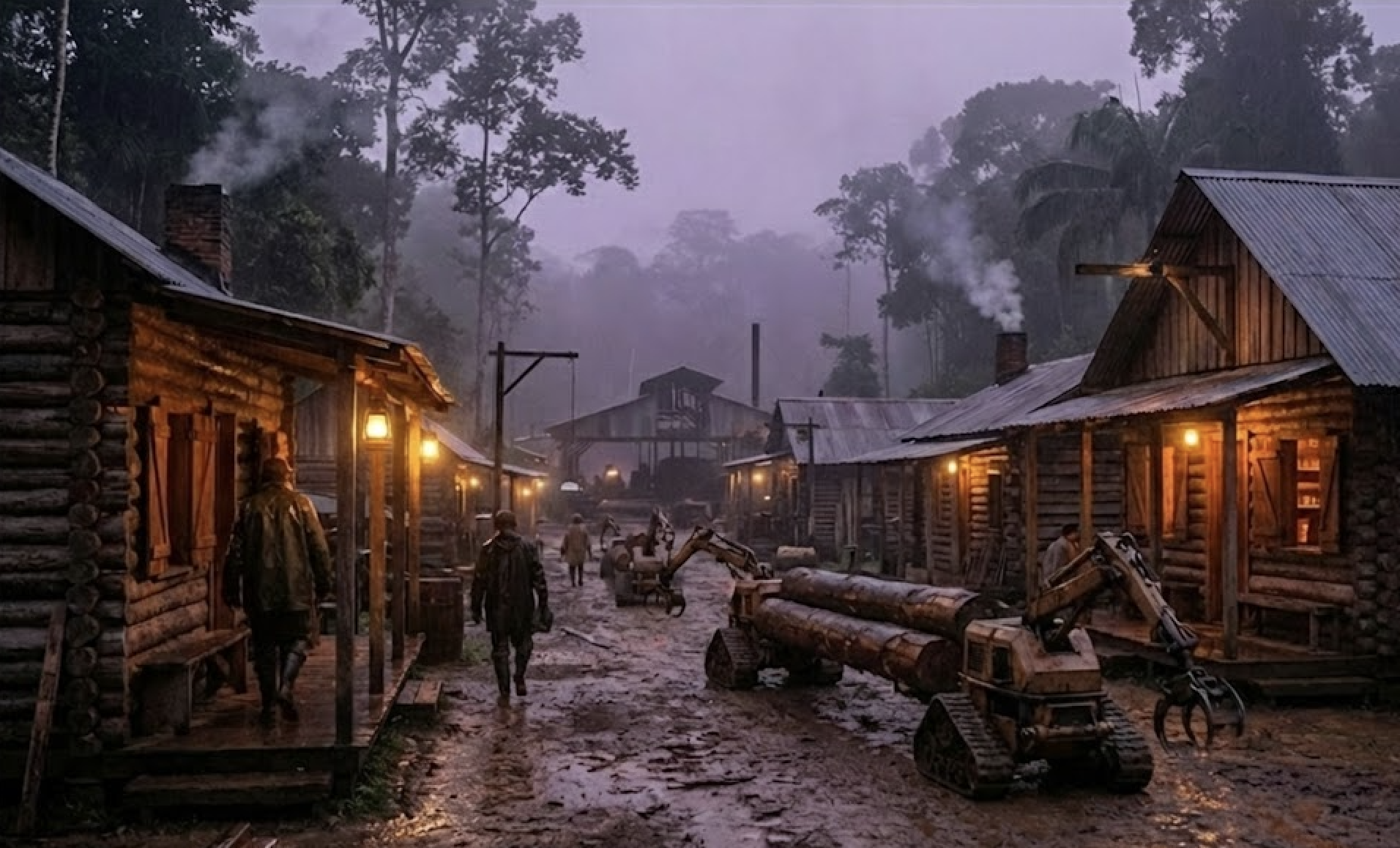
Morningstar felt every bit the humid, twilight frontier: dense tropical hardwoods pressed against log-cabin streets, their spice-sweet sap hanging in the misty air. A low, perpetual dusk filtered through the fog layer that hid the Atrana peaks, while warm rain spattered tin roofs almost hourly. The whine of chainsaws and the clatter of Manual Labor Bots echoed from the slopes, mixing with the rhythmic thump of the sawmill and the tang of fresh-cut lignum. After work, lumberjacks crowded Saws End, a rough-hewn tavern where resin smoke and fermented fruit ale masked the scent of damp bark still clinging to their gear. Lantern light flickered on open-shutter windows, throwing shifting silhouettes across muddy lanes as bots trundled past, hauling the day’s haul to the pit.
In the Gamma Age
By the Gamma Age the air still thrummed with industry, but axes now rang where chainsaws once screamed, and the acidic bite of mycelium curing vats joined the ever-present smell of wet timber. Constant drizzle beaded on the new composite façades, and sodium lamps fought the violet-grey half-light that never quite became night. The sawmills’ roar remained, yet Federal efficiency muted the chaos—logs gliding along raised tramways instead of skidding through mud. Off-shift workers gather at the Federal Hostel & Saloon, where polished fungus-wood counters and string-light verandas lend a veneer of order to the wild mountain gloom. Even so, every gust of wind still carries the deep, organic heartbeat of the rainforest and the distant crash of giant trunks surrendering to sharpened steel.
Town Structure
Morningstar adheres to a six-ring, concentric layout set by the Human Settlement Plan. Two main axes — Benevolence Street (formerly West–East Road) and Commonality Avenue (formerly North–South Road) — bisect the rings, creating four quadrants. Each outer ring (all except the Central Core) is encircled by a continuous Ring Road bearing that ring’s name, all interconnected via Benevolence Street and Commonality Avenue for seamless circulation.
Under the Federal Settlement Plan (Gamma Age), Morningstar’s six-ring pattern was formalized and modernized:
- Main Axes Renamed: Benevolence Street and Commonality Avenue were christened to reflect communal harmony.
- Building Materials Mandate: All newly constructed buildings must employ mycelium-composite panels; surviving Beta Age log structures receive mycelium retrofits only when undergoing substantial renovation.
Reservation Addressing System
Morningstar’s addresses follow a quadrant–street–number format:
- Quadrant Prefixes: SW, SE, NW, NE.
- Main Axes: Benevolence Street and Commonality Avenue begin at 1 in the Central Core (e.g., Benevolence St 1, Commonality Ave 1). As they radiate outward, numbering increases (e.g., West Benevolence St 2, North Commonality Ave 2).
- Ring Roads: Each outer ring’s road is named after its zone (e.g., Civic Ring Rd 3) and numbered sequentially along its circumference.
- Sequential Numbers: Buildings along any street or ring road are numbered ascending in the quadrant’s direction, ensuring clarity and navigability.
Example:
A trader’s storefront on the western arc of the Public Services Ring in the southwest quadrant would be addressed as SW Public Services Ring Rd 4.
Architecture and Materials
In the Beta Age
With the Last Frontier crash-site far away in the tropical lowlands, hauling metal or glass to the Atrana Mountains was a fool’s errand. Settlers therefore raised almost every structure from what surrounded them: straight wooden logs notched into square-corner cabins atop rough river-stone plinths. Windows were open bays closed by wooden shutters; only a handful of official buildings boasted panes cut from reclaimed shuttle-canopy glass, each one lugged up the Trade Route like treasure.
In the Gamma Age
After the Peace Treaty slashed Morningstar’s annual harvest quota, the Federal Council ruled that no new buildings could be framed in fresh-cut timber. Instead, crews now grow mycelium-composite panels on-site, skinning them with thin veneer milled from dismantled Beta Age cabins. Recycled hardwood off-cuts are laminated into structural beams, and surviving log houses are slowly being retrofitted with the same composite infill — trading rustic charm for sustainability without tapping the forest anew.
The Town Zones and Buildings
Central Core (15 000 sqm)
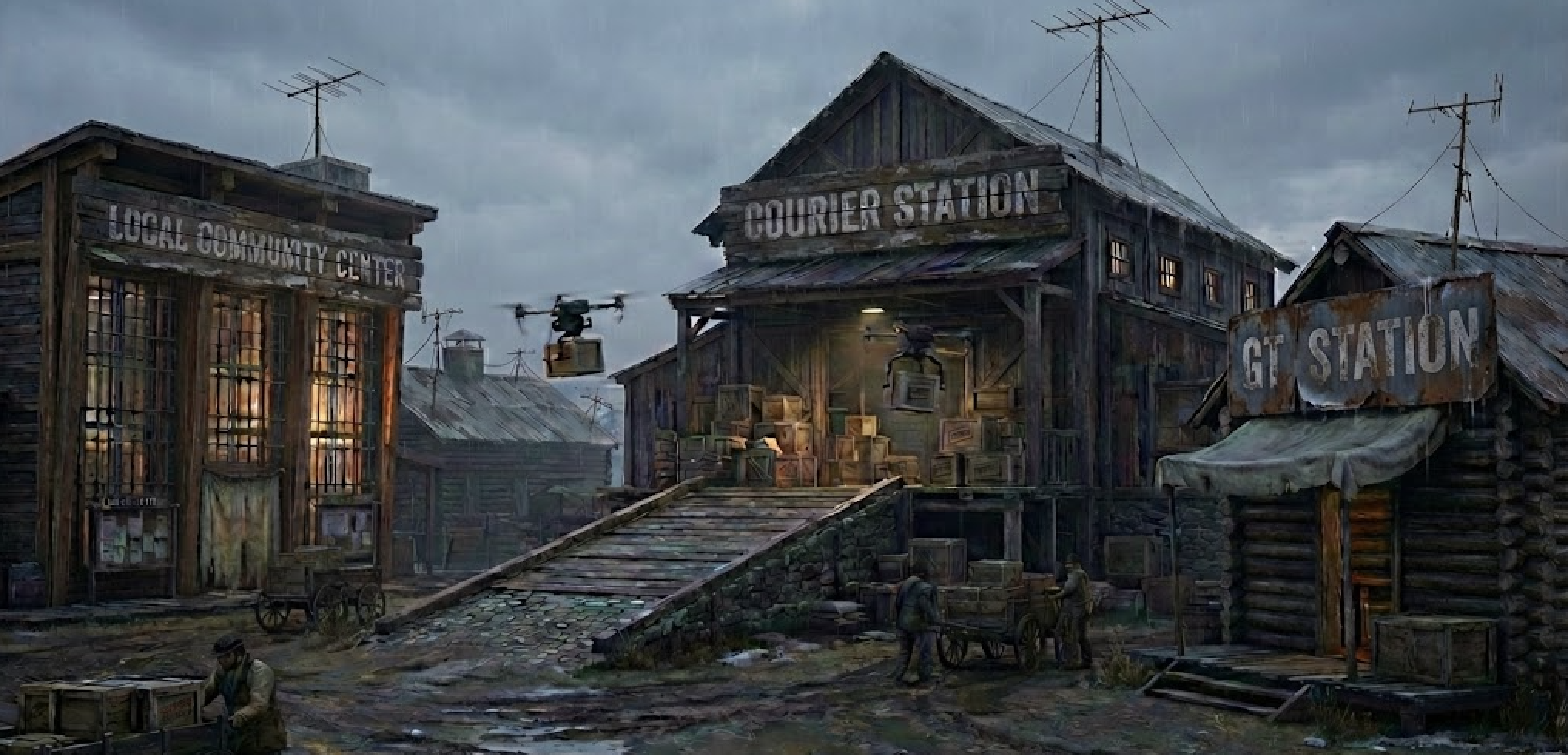
- Beta Age: Local Community Center of Morningstar
- Gamma Age: Mayor’s Forum
Civic Ring (50 000 sqm)
Public Services Ring (80 000 sqm)
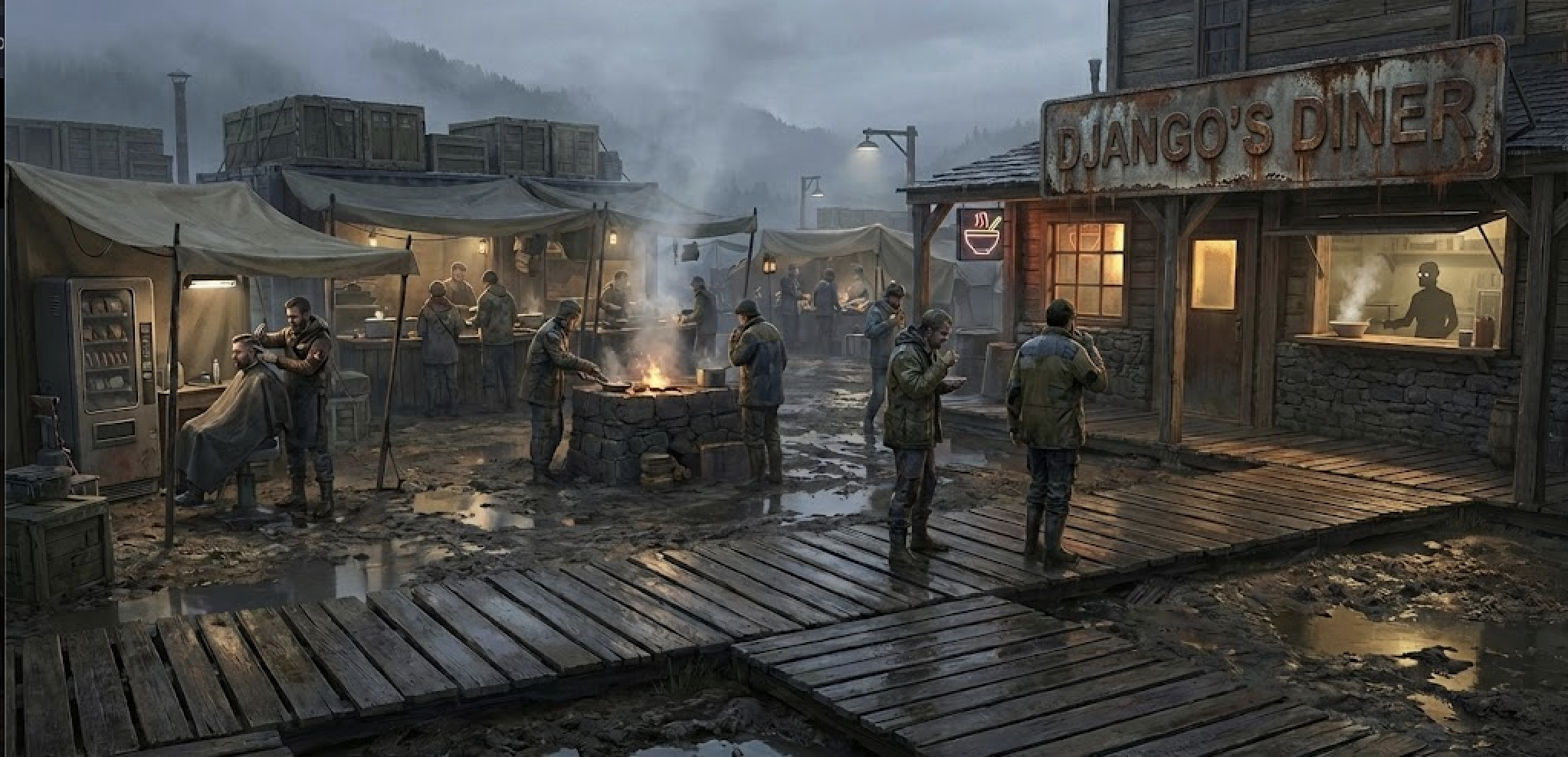
- Beta Age: Kuhl Funeral Home, Saws End, Django's Diner, Morningstar Food Market, Pharmacy of Morningstar, Medical Station of Morningstar, Hale and Hook Outfitters (Hunting Store),
Residential Ring (240 000 sqm)
- Beta Age: Log-cabin barracks and tent rows for lumber crews
- Gamma Age: 750 longhouse-style apartment blocks, pocket gardens, Federal News Lounge of Morningstar
Educational Ring (20 000 sqm)
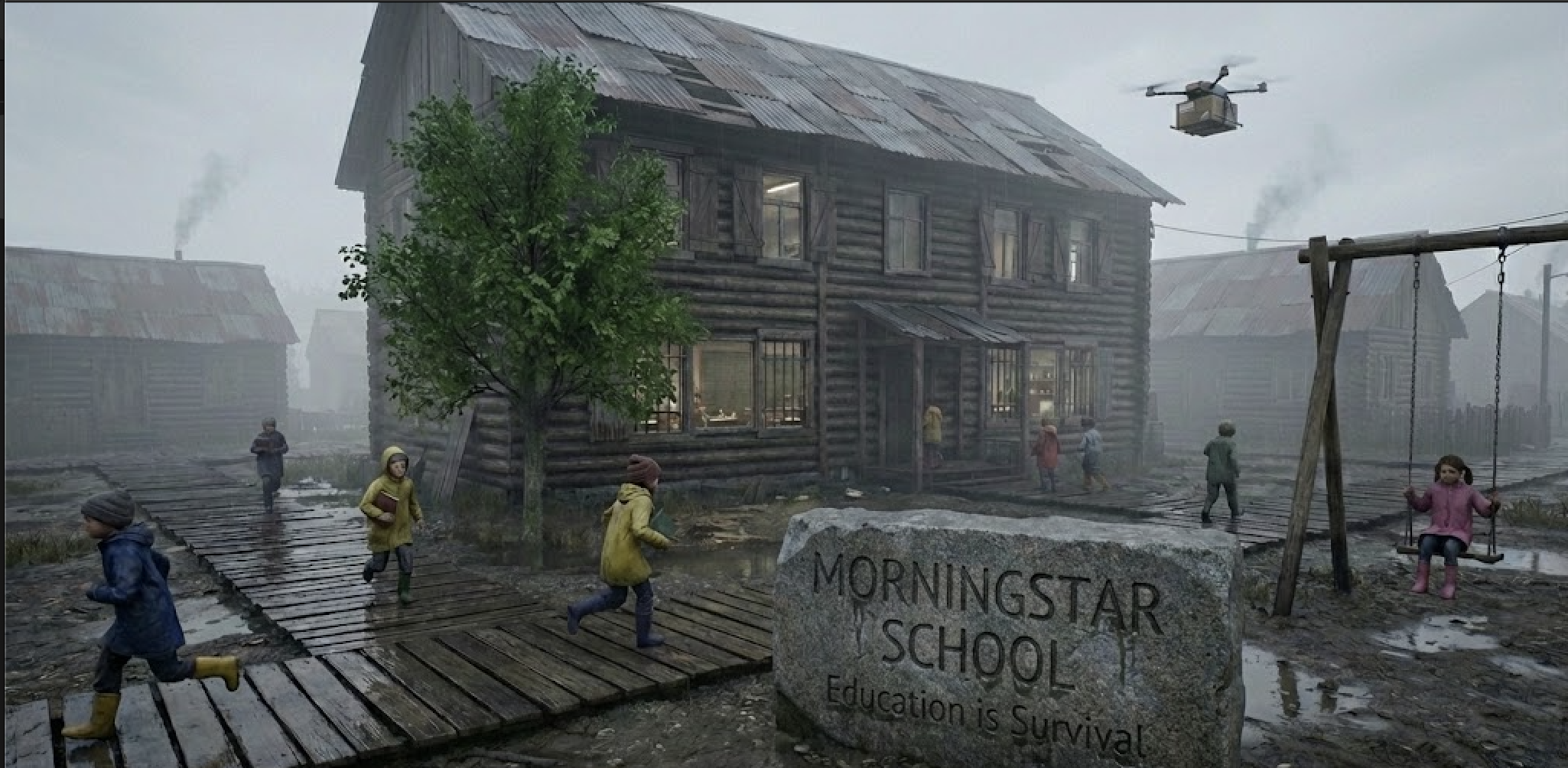
- Beta Age: Morningstar Primary and High School
- Gamma Age: Morningstar Elementary School
Industrial Ring (100 000 sqm)
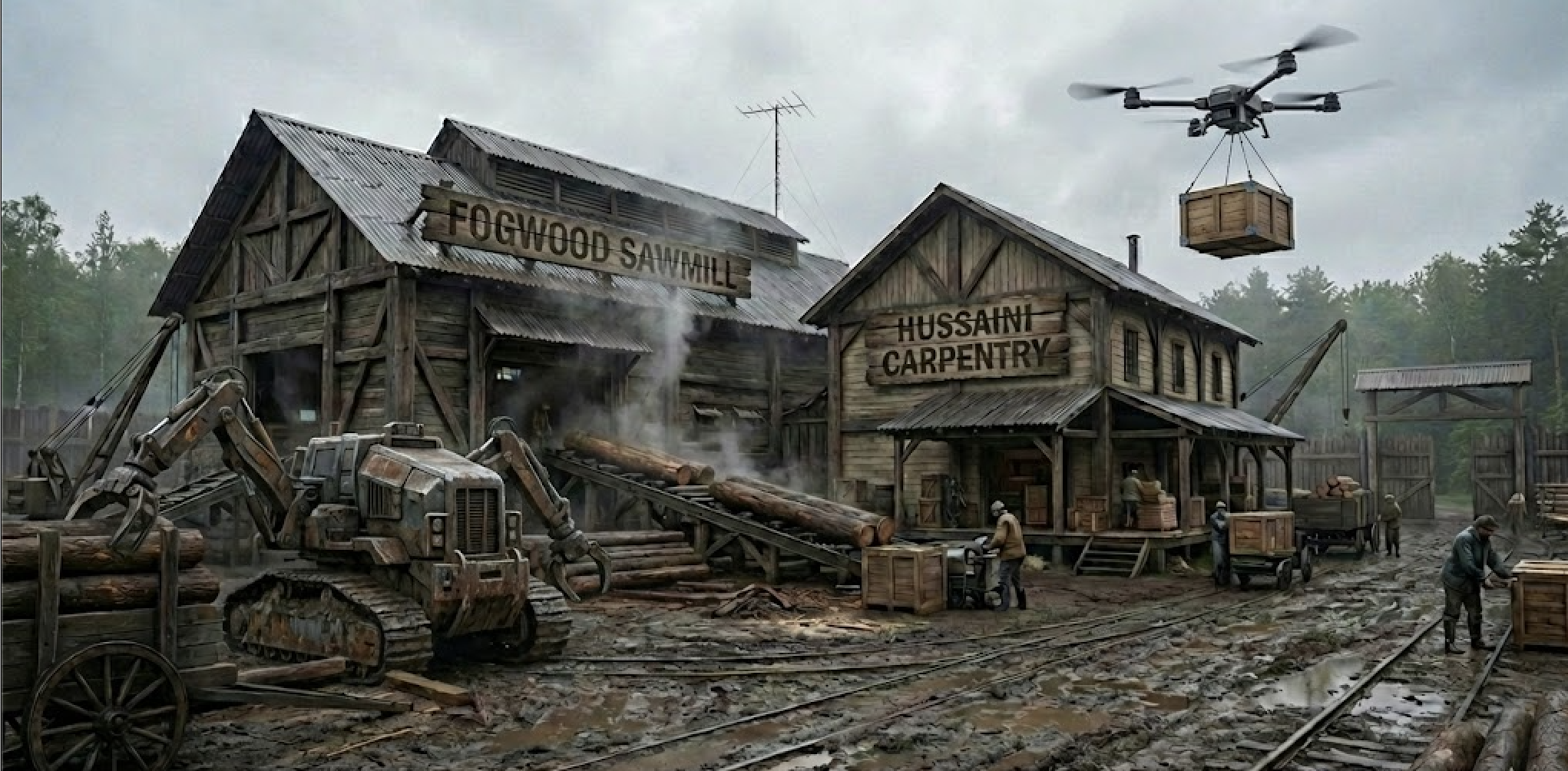
Outside the Town Wall (Beta Age only | Prohibited in the Gamma Age)

Outside the Town Wall (Beta and Gamma Age)
- Fogwood Sawmill Timber Yard (Beta Age)
- Federal Timber Yard (Gamme Age)
The Town Wall
Built in 2626, later refitted to meet Peace Treaty mobility limits.
- Construction: Hardwood logs banded with copper, stone footings
- Height: 4 m plus outward-facing spikes
- Main Gate: South, facing the Trade Route to Hope.
- Secondary Gates: East and West timber lanes, emergency North sally port
- Watchtowers: Four, one per corner, each with hand-crank spotlights
Tactical Advice for Dungeon Masters
Beta Age Hook
- The Expedition – The Free State of Settlers commissions the Last Frontier University to launch a ten-member research ascent to the fog-capped summit of the Atrana Mountains. On the expedition’s final night in Morningstar, the team beds down at the rough-hewn tavern-hostel Saw’s End, trading frontier bravado beneath the planet’s perpetual twilight. The next morning, however, finds three scholars brutally slain by blades — fueling panic and whispers that the summit’s “gods” or their giant Dark Side bird guardians have delivered a warning. Drafted by the settlement’s Contact Person, the PCs must solve the murders and salvage the climb before the narrow weather window closes — deciding whether they face human sabotage, mythic retribution, or something altogether stranger …
Gamma Age Hook
- Timber, Talons & Trade: The notorious Jane Mendoza Gang, masters of the Firetown black market in the neighbouring Ralar Region, has begun smuggling contraband into Morningstar.. After two anonymous threats and a sabotaged mycelium vat, the Local Sheriff requests backup; the Federal Sheriff deputises the PCs to slip in under cover as forestry auditors. Their mission: trace the supply chain, identify the gang’s front-operator, and shut the operation — while avoiding Mendoza’s armed fixers and the political fallout of exposing Communard officials who may be on the take. Succeed, and Morningstar’s fragile economy stays clean; fail, and the settlement becomes the gang’s newest black-market outpost, undermining federal control over the Atrana frontier.
Related Pages and Further Information
Gamma Age
Beta Age
Exohuman settlements:
- Arla Town (Asari Region| Beta Age only)
Other settlements in Asari: