
Table of Contents
Races | Economy | Buildings & Organizations
CENTRAL BANK OF THE FREE STATE OF SETTLERS
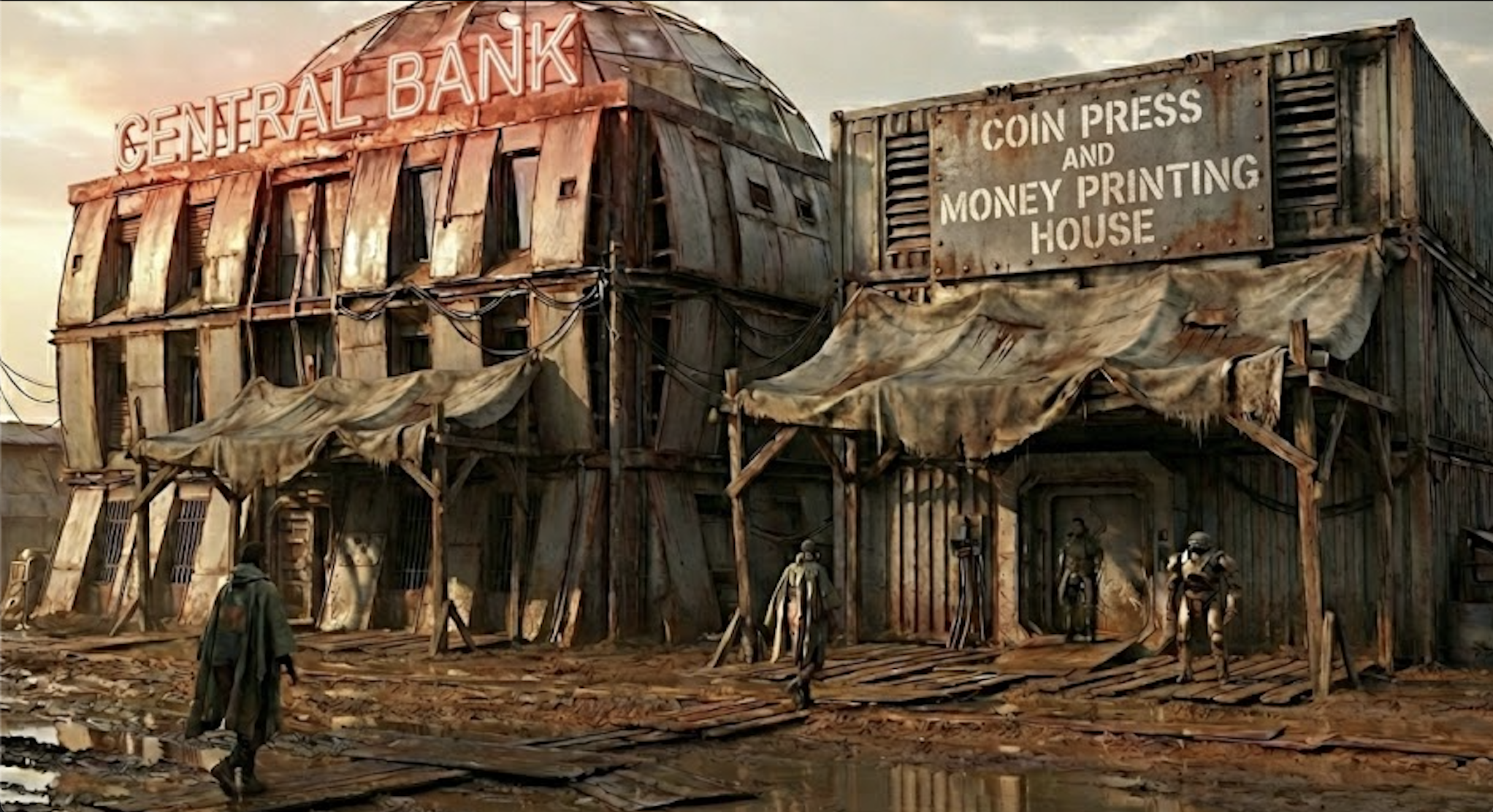
Overview
- Founding Year: 2625
- Chair: Silas Brenning (2625–2629)
- Primary Mandate: Monetary policy, financial regulation, and currency issuance for the Free State of Settlers
The Central Bank of the exohuman Free State of Settlers served as the core monetary authority during the Beta Age, managing the issuance of the national currency known as the Kourou and ensuring macroeconomic stability across the ExoHuman economy. Founded in the early months following Day Zero, the institution played a pivotal role in transitioning from a barter-based system to a regulated currency economy.
Tasked with overseeing financial institutions, enforcing banking regulations, and maintaining the liquidity and trust of the public banking system, the Central Bank also operated the official Coin Press and Money Printing House of the Free State.
Its regulatory reach extended to commercial banks, credit unions, and investment cooperatives operating under Free State charters. After the outbreak of the Great War in 2629, the institution's operations ceased. It was officially shut down during the first assembly of the Federal Confederation in 2631.
Though the Federal Confederation abolished traditional currency in favor of the Allotment Card System, the Kourou endures in the Black Markets of the Gamma Age, making the legacy of the Central Bank felt even after its dissolution.
History
The Monetary Transition (2625)
The foundation of the Central Bank and the introduction of the Kourou were part of the original economic strategy outlined in the Human Settlement Plan (HSP), which aimed to ensure economic cohesion and financial autonomy for the new colony.
Although settlers initially relied on a barter economy after Day Zero, this quickly proved inadequate for scaling an industrial society. In June 2625, the Settler’s Council passed the Monetary Stabilization Act to implement the monetary policy outlined in the HSP. The Act formally established the Central Bank of the Free State of Settlers and granted it authority to create a currency backed by land assets and projected agricultural output.
By November 2625, the CBFS launched its first print run of paper bills and copper coins, created using the tools and facilities of the newly built Coin Press and Money Printing House. These were distributed to settlers in New Kourou, Hope, and Morningstar.
Institutional Expansion and Oversight (2626–2628)
With its authority recognized across the Free State's territory, the Central Bank introduced strict licensing for commercial banks and supervised the creation of regional bank branches. It deployed inspection teams, investigated fraud, and enforced consumer protection policies to prevent exploitation of settlers by unscrupulous lenders. Its reserve policies ensured banks held sufficient assets to cover their deposits, thereby preventing liquidity crises and protecting the fledgling economy.
Collapse and Dissolution (2629–2631)
The outbreak of the Great War on June 17, 2629, disrupted the supply chains and destroyed many transport routes needed for currency distribution. Public confidence declined, and hoarding of Kourou notes began, while some settlements reverted to barter or local scrip. The bank ceased all public operations and secured its remaining currency stockpiles.
During the first session of the Federal Council of the newly established Federal Confederation in 2631, the Central Bank was formally disbanded. The Peace Treaty had outlawed private property, and with it, market-based monetary systems. The Central Bank's closure marked the end of formal currency-based economic policy for ExoHumans.
Role and Responsibilities
- Currency Issuance: Designed and distributed the official Kourou currency, both in bills and coins.
- Price Stability: Controlled money supply through scheduled releases and monitored inflation across major settlements.
- Commercial Oversight: Supervised private banking institutions and enforced anti-fraud regulations.
- Crisis Management: Acted as lender of last resort during financial instability, notably during the Hope Agricultural Panic of 2628.
- Cultural Stewardship: Promoted trust in the Kourou by honoring human scientific achievement and independence.
Organizational Structure
Central Bank Executive Offices
- Chair: Led monetary policy, strategic vision, and Council representation
- Vice Chair: Oversaw regulatory enforcement and banking inspections
- Director of Monetary Policy: Set interest rates, reserve ratios, and managed inflation
- Director of Financial Institutions: Issued licenses, conducted audits, and maintained financial stability
- Director of Currency Operations: Coordinated printing, distribution, and counterfeiting prevention
- Chief Legal Advisor: Ensured all policies aligned with Free State laws
- Head of Public Communications: Issued financial reports, crisis updates, and education campaigns
Coin Press and Money Printing House Staff
- Facility Director: Managed the entire production process
- Head Engraver: Designed both coin molds and note visuals
- Metallurgy Specialist: Oversaw copper melting, mold casting, and quality control
- Paper and Ink Technician: Mixed ink, maintained presses, and oversaw paper stock
- Security Officer: Managed the safeguarding of raw materials, finished currency, and transport
- Distribution Clerk: Logged, packed, and organized currency distribution to bank branches
The Kourou: Currency of the Beta Age
- Coins: Made of copper, issued in denominations of ¼, ½, 1 Kourou. Durable and used in everyday transactions.
- Paper Bills: Printed in denominations of 1, 5, 10, 20, 50, and 100 Kourou, intended for larger purchases and banking operations.
- Design Themes: Each banknote honored a scientific figure whose contributions were instrumental to humanity's journey into space. These figures were chosen as a tribute to human ingenuity and as a reminder of Earth's rich intellectual heritage. The practice of referring to the bills by the scientists' names became a part of everyday language, deepening the cultural resonance of the currency.
Legacy and Impact
- Economic Foundation: The Central Bank laid the groundwork for a functioning capitalist economy during the Beta Age.
- Symbol of Independence: For many settlers, the Kourou was a symbol of economic self-determination and sovereignty.
- Collapse of Currency: The shutdown of the Central Bank and abolition of money during the Gamma Age created a psychological and logistical shift in ExoHuman society.
- Survival on the Black Market: Despite its official obsolescence, the Kourou remains in circulation on the black markets of New Kourou, Hope, and Morningstar.
Tactical Advice for Dungeon Masters
- Bank Heist Scenario: Players may plan or foil a heist on the Central Bank during its final days.
- Counterfeit Operation: Players could uncover a counterfeit ring still producing old Kourou notes for black market circulation.
- Lost Vault Recovery: A hidden vault of untouched Kourou bills and coins could be a treasure trove for smuggling networks or rebel factions in the Gamma Age.
- Economic Espionage: During the Beta Age, players might be tasked with disrupting rival financial institutions or preventing a bank collapse.