
Table of Contents
Races | Culture | Institutions | Buildings & Organizations
HEADQUARTERS OF THE CENTRAL BANK OF THE FREE STATE OF SETTLERS
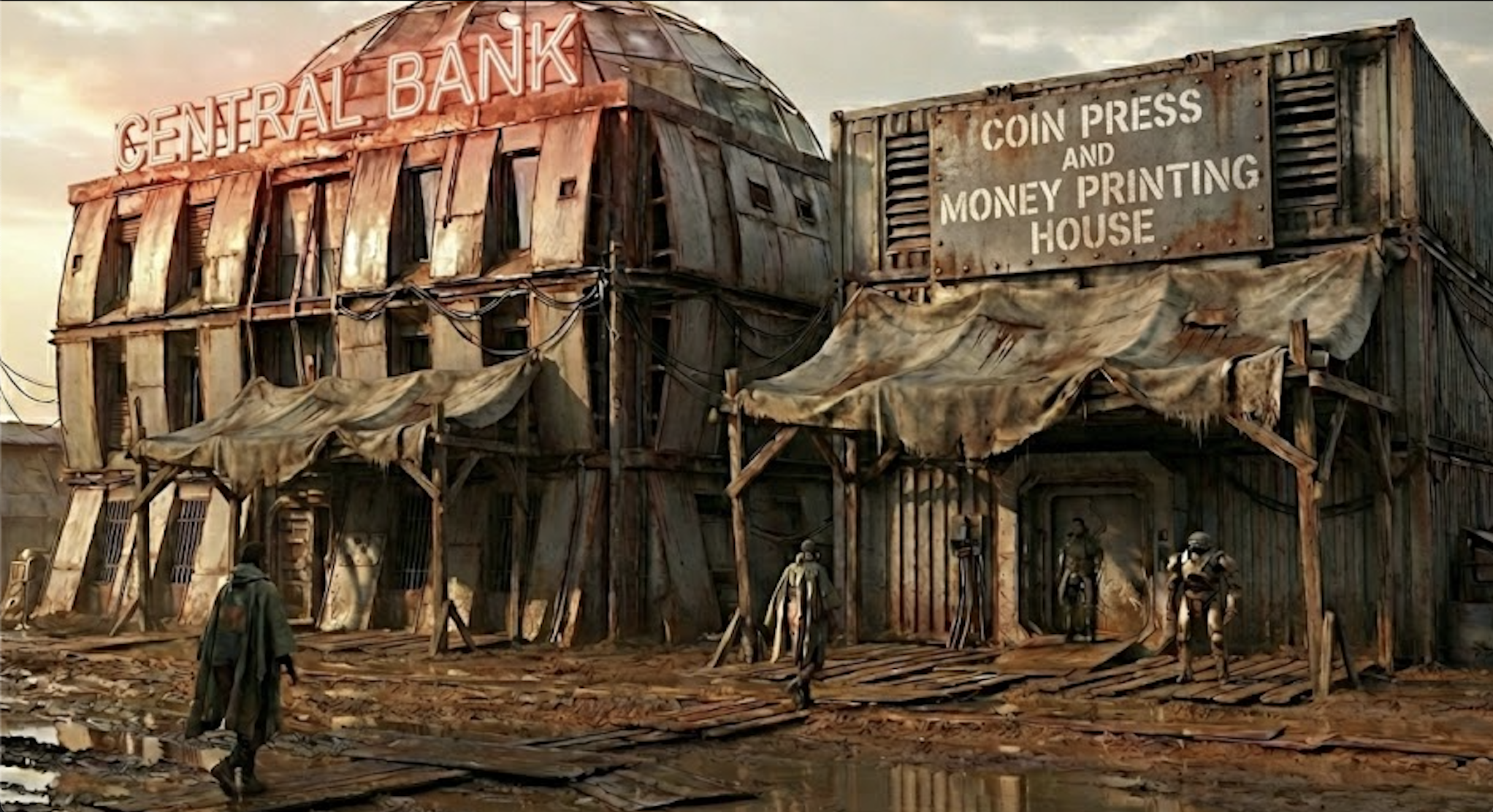
Overview
- Location: Northern Civic Ring, New Kourou
- Address: NE Talara Road 3
- Surroundings: Located adjacent to the Coin Press and Money Printing House, the Central Bank’s headquarters stood as a symbol of institutional trust and financial stability in the Beta Age.
The Central Bank of the Free State of Settlers was the official monetary authority of the exohuman Free State of Settlers, created in the months following Day Zero to establish and regulate a currency-based economy - based on the Human Settlement Plan (HSP). Transitioning settlers away from barter and salvage trade, the Central Bank introduced the Kourou as the official national currency and became the backbone of macroeconomic stability across the Asari Region.
Beyond currency issuance, the bank enforced financial regulations, licensed private banks, and provided crisis intervention during moments of economic distress. It also operated the Coin Press and Money Printing House as its central distribution and manufacturing facility.
With the introduction of the Communardism economic model by the Federal Confederation administration following the conclusion of the Peace Treaty with the Alliance of Native Tribes, the institution was permanently closed.
Architectural Significance
- Construction Material: Composite panels from command modules of the Last Frontier, reinforced with thermal shielding and steel underframes.
- Floors: 3
- Design Purpose: A blend of bureaucratic functionality and symbolic authority, the building was designed to project institutional reliability through minimalism and durability.
A central dome topped the building’s atrium, allowing natural light to fill the executive wing — symbolizing transparency, while the overall design emphasized strength and resilience.
Building Structure
Ground Floor:
- Public Lobby and Inquiry Hall: Served citizens with inquiries, issued reports, and distributed economic briefings.
- Security Screening Zone: All visitors were scanned before accessing internal offices.
- Press Briefing Room: Used for weekly economic updates, announcements, and public addresses.
Second Floor:
- Executive Boardroom: Central command space for major economic decisions and emergency response sessions.
- Chair and Vice Chair Offices: Private offices for top-level decision-makers, connected to secure data terminals.
- Director Wing: Offices for the Monetary Policy, Financial Institutions, Currency Operations, Legal, and Communications heads.
Third Floor:
- Regulatory Archives: Paper and digital records of issued licenses, audits, inflation reports, and monetary decisions.
- Currency Prototype Vault: Storage for experimental Kourou designs, anti-counterfeit measures, and decommissioned bills.
- Crisis Response Center: Used during emergencies to coordinate fiscal responses and policy adjustments.
Look and Feel
Inside, the bank felt quietly powerful. High ceilings and polished recycled metal floors gave the space an air of precision and control. The presence of armored doors, security terminals, and muted tones created a tension between openness and authority. Scented slightly by old paper, ozone from secure servers, and ink, the air carried the weight of responsibility.
In the lobby, citizens waited in orderly lines to submit requests or collect financial reports, while staff moved briskly through corridors, their eyes tired but focused.
Roles and Responsibilities
- Chair of the Central Bank (1): Set strategic direction and represented the Bank in governmental matters.
- Vice Chair (1): Oversaw regulatory enforcement and coordinated external financial inspections.
- Director of Monetary Policy (1): Managed money supply, interest rates, and inflation controls.
- Director of Financial Institutions (1): Licensed and audited private banks, oversaw financial stability.
- Director of Currency Operations (1): Managed printing logistics and anti-counterfeiting efforts.
- Chief Legal Advisor (1): Ensured all regulations aligned with Free State law.
- Head of Public Communications (1): Released updates, managed crisis messaging, and economic education campaigns.
- Security Liaison Officer (1): Coordinated protection and internal risk protocols.
Public Access, Operating Hours and Operational Rhythm
- Public Access: Limited to the Public Lobby and Press Briefing Room. Access to executive areas and archives was restricted to cleared personnel.
- Operating Hours: Monday to Friday, 8 am – 6 pm. Press briefings occurred every Tuesday at 10 am.
- Operational Rhythm: Divided into administrative and crisis-prep routines. Morning hours focused on planning and data analysis; afternoons on policy execution, coordination with financial institutions, and public messaging.
Security Measures
As a central institution of the Free State, the Headquarters of the Central Bank was one of the best-protected civilian buildings of the Beta Age:
- Guarding Bot Patrols: Two rotating Guarding Bots monitored the exterior and screened access checkpoints.The Guarding Bots were armed with Laser Guns.
- Armored Currency Vault: Access required dual biometric authentication through an armed Guarding Bot and a rotating passcode system.
- Crisis Lockdown Protocol: Enabled immediate interior lockdown in case of unrest or financial attack.
- Guarding Bot Support: One Guarding Bot was stationed permanently in the Crisis Response Center, authorized for active deterrence.
Player Interaction Possibilities (Legal and Illegal)
Legal Interactions:
- Act as public auditors or financial advisors assisting in economic investigations
- Attend a press briefing or deliver a message from the Settler’s Council
- Research past financial interventions in the Regulatory Archives
Illegal Interactions:
- Steal or tamper with currency prototypes or secret economic plans
- Hack or infiltrate the Regulatory Archives to erase incriminating evidence
- Bribe a Director for insider financial access
- Plant false inflation data to destabilize the economy
- Disguise as staff to smuggle classified reports to rival factions
Tactical Advice for Dungeon Masters
The Central Bank Headquarters is perfect for narrative arcs that blend political intrigue, white-collar crime, and economic sabotage. Ideas include:
- A sudden currency collapse leads players to uncover a manipulated inflation scheme.
- An NPC whistleblower seeks protection while leaking evidence of falsified crisis reports.