Table of Contents
Major Planetary Zones | (Twin) Sections of the Habitual Belt | Regions | Settlements
ARLA TOWN
Overview
Arla Town was a short-lived ExoHuman settlement on the eastern shore of Lake Arla in the Asari Region (Eastern Equatorial Section) of the Habitual Belt on VOI 700 D. Established September 3, 2626 under the Human Settlement Plan (HSP) by the Free State of Settlers. Envisioned as a regional fishing and processing hub, Arla Town was razed by the Trando Tribe during the Great War — since them, only overgrown ruins remain, a cautionary tale of frontier ambition.
- Population (est.): 300
- Founding Date: September 3, 2626
- Primary Industry: Aquatic resource exploitation (fish processing)
Industrial Foundations
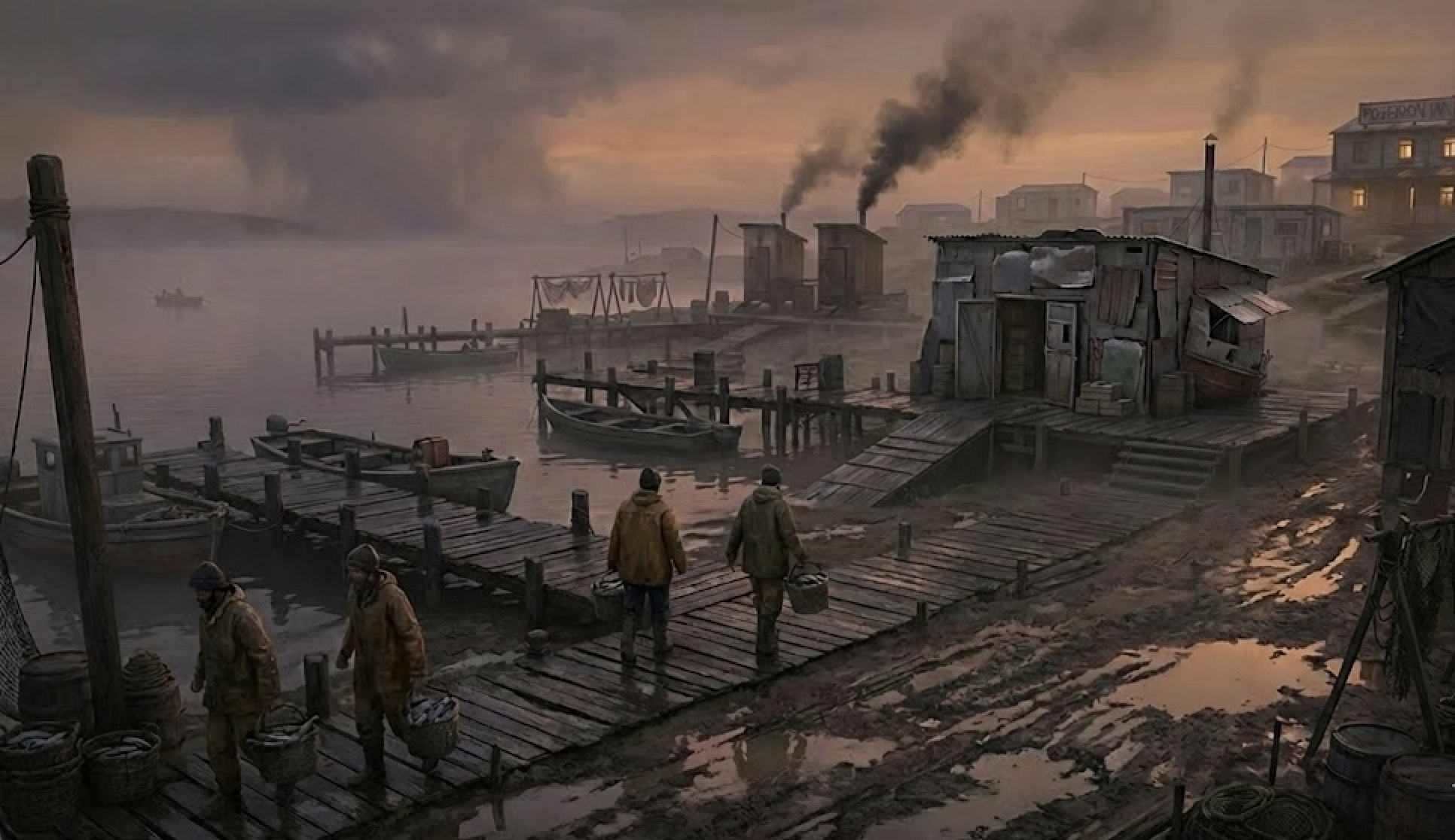
Arla Town’s economy revolved around intensive fishing operations in Lake Arla. The settlement housed a central fish processing facility and several smaller smokehouses and warehouses.
Fishing Infrastructure:
- Funkenberg Fish Factory: The Funkenberg Fish Factory was a prefab central processing unit for cleaning, storing, and packing fish for distribution to other Beta Age settlements, founded by Esrah Funkenberg.
- Fishing Docks: Located along the humid eastern shoreline, enabling daily boat launches and hauls.
- Smokehouses: Small units for preserving fish using traditional and improvised methods.
Short Operational Period:
The industrial efforts lasted less than three years before being violently disrupted. The factory and docks were destroyed during the Great War, marking the end of ExoHuman presence in this area.
Legacy Note: The success of Arla Town’s early fish industry inspired the Fisherpoint project on Lake Orlanda, envisioned as a second Exohuman fishing hub. Unlike Arla Town, Fisherpoint never matured into a real settlement, remaining only a construction site before its destruction by the Orlanda Tribe.
Geographical Position & Microclimate
Perched on Lake Arla’s humid eastern shoreline, Arla Town enjoyed constant moisture and rich aquatic biodiversity — but weather was volatile:
- Humidity: Near-constant lake haze (“Haze Doom”)
- Thunderstorms: Frequent convective storms at seasonal shifts
- Microclimates: Rapid fog drifts and sudden downpours made navigation and construction challenging
Social Composition of Arla Town
A working waterfront first, a community second. Population rose and fell with the catch and the lake’s moods; most adults were contract fishers or plant hands.
- Households & Children: Not purpose-built for families, but some settled anyway (skippers, foremen, quartermasters). Schooling was private only via the Funkenberg School on the factory grounds; no public school existed. Classes were small, fees offset by factory stipends and donations from church circles.
- Gender & Tenure: Male-skewed crews (roughly two-thirds men). Typical contracts ran one season (3–9 months), while factory supervisors and dockmasters tended to be year-round.
- Workforce Mix: Dominated by lake fishing and processing (boats, smokehouses, packing lines). A thin layer of logistics (courier station, warehousing), basic services (inn, market, supplies), minimal clerical/admin, and a small Guarding Troopers presence.
- Automation Footprint: Service Bots concentrated inside the Funkenberg Fish Factory (sorting tables, ice/cold-room handling, crate lifts).
Political Orientation in the Beta Age
No formal parties; decisions lived on wet planks and warehouse floors. Arla’s settlers carried two simultaneous memories—the sleek order of shipboard life and the chaos of the crash—and translated both into a dockside pragmatism. Policy was whatever kept boats upright, workers paid, and smokehouses lit.
The Contact Person worked by consensus more than ballots: mediating slip rights, settling gear disputes, balancing safety closures against the hunger for bigger catches, and minding relations with lake-shore Tribes and sacred-water boundaries. Frictions were practical rather than ideological—independent skippers vs. factory buyers over prices and grading; plant foremen pushing throughput vs. crews insisting on weather holds; warehouse schedulers vs. the courier station over dispatch windows. Votes, when taken, tended to be quick show-of-hands after the loudest arguments had spent themselves—frontier decision-making under the constant press of fog, thunder, and the next day’s haul.
Local Governance
Beta Age
- Local government: Annually elected Contact Person of Arla Town
- Local law enforcement: Local Guarding Troopers Station of Arla Town
Look and Feel
In the Beta Age
Arla Town’s wooden shacks clustered along the mist-cloaked shore; the air was thick with brine and the sharp tang of curing fish. Sunlight filtered dimly through perpetual haze, glinting on rust-streaked prefab walls. Daily life revolved around creaking docks and steam-fogged smokehouses, where workers in oilskins hauled brimming baskets of catch beneath the hiss of rack-dried smoke. In the evening hours, the Poseidon Inn’s raucous laughter echoed over gentle waves — a brief warmth against the ever-present humidity.
In the Gamma Age
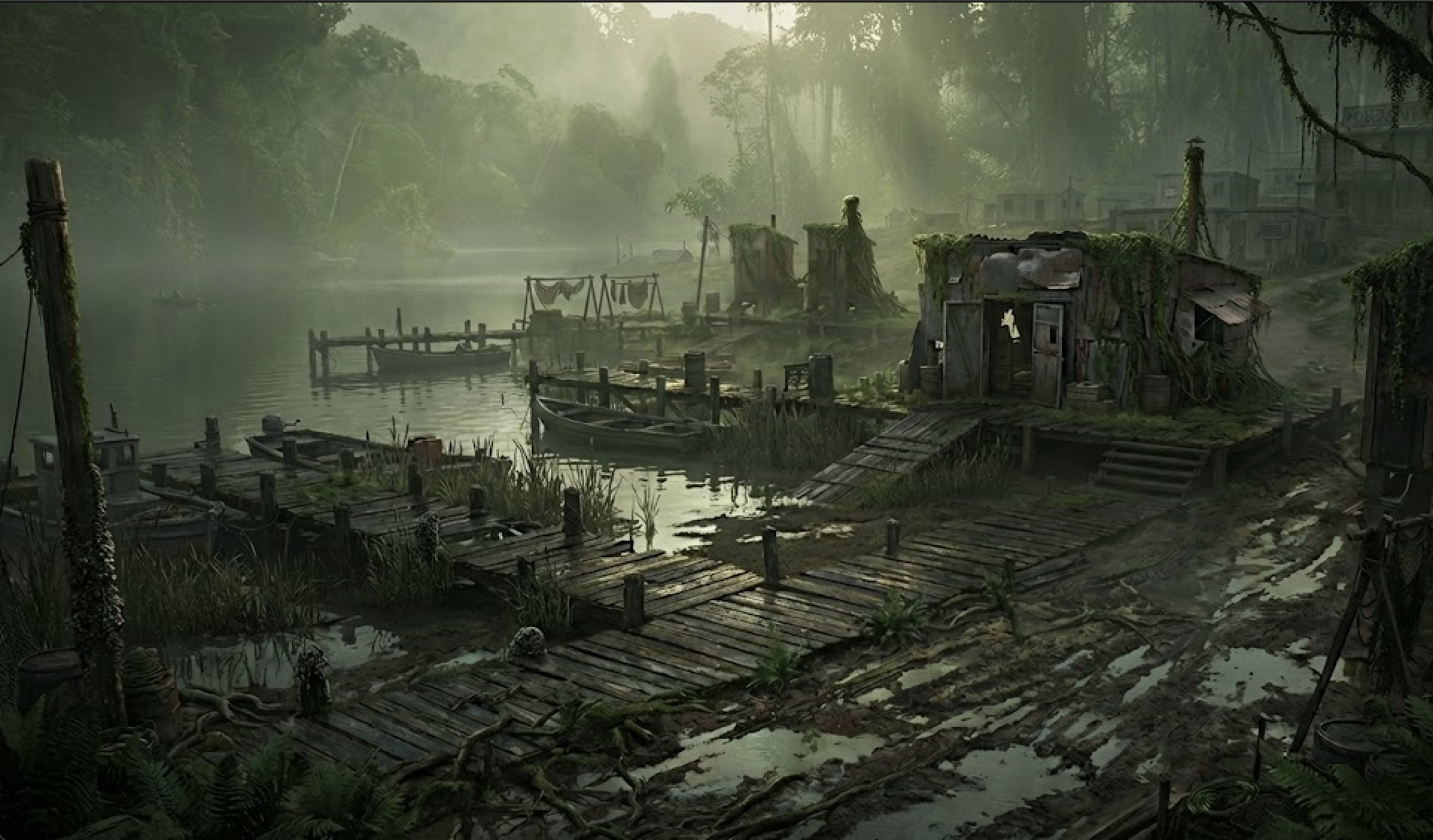 The settlement lies reclaimed by jungle vines and reeds; collapsed docks sag into silted shallows, and the Funkenberg ruins stand half-buried in moss. Fog drifts through shattered window frames, and the air smells of rot and green growth. Fallen beams creak under shifting earth, while ghostly bird calls answer the hush of abandoned smokehouses. Only treaty-authorized guides dare tread the cracked pathways, their boots stirring thick leaf litter that muffles every echo — Arla Town is now a silent monument to ambitions lost beneath the Haze Doom.
Architecture & Materials
As a utilitarian settlement, Arla Town’s architecture reflected temporary ambition rather than sustainable design.
- Materials: Mostly prefab structures and locally sourced wood.
- Design Aesthetic: Functional, modular, and industrial.
- Vulnerability: Poorly defended and culturally intrusive, making it an easy target during wartime.
Town Structure
Arla Town was laid out on the six‐ring grid prescribed by the Human Settlement Plan, with rings expanding concentrically from the Central Core. Due to its modest size and temporary industrial focus, the Educational Ring was merged into the Residential Ring for the first decade — schooling was conducted informally by Fish Factory foremen in shared quarters rather than in a dedicated school building.
- Main Axes: Poseidon Street (from West to East) and Persistence Avenue (from North to South) intersect at the Central Core, serving as the settlement’s principal thoroughfares.
- Ring Roads: Each outer ring (all except the Central Core) is encircled by a continuous Ring Road bearing that ring’s functional name; all are linked by Poseidon Street and Persistence Avenue to enable efficient movement.
Reservation Addressing System
Arla Town’s addresses followed a quadrant–street–number format:
- Quadrant Prefixes: SW, SE, NW, NE.
- Main Axes: Poseidon Street and Persistence Avenue begin at 1 in the Central Core (e.g., Poseidon St 1, Persistence Ave 1). Numbers increase outward from the core (e.g., West Poseidon St 2, North Persistence Ave 2).
- Ring Roads: Each outer ring’s road is named after its zone (e.g., Industrial Ring Rd 3) and numbered sequentially along its circumference.
- Sequential Numbers: Buildings are numbered in ascending order along any street or ring road in the direction of the quadrant, ensuring clear, navigable addresses.
Example:
A smokehouse on the eastern segment of the Industrial Ring in the southeast quadrant would carry the address SE Industrial Ring Rd 4.
The Town Zones and Buildings
Central Core (15 000 sqm)
- Beta Age: Local Community Center of Arla Town
Civic Ring (50 000 sqm)
Public Services Ring (80 000 sqm)
Residential Ring (240 000 sqm)
- Beta Age: Log-cabin barracks and tent rows for lumber crews
Industrial Ring (100 000 sqm)
- Beta Age: Funkenberg Fish Factory, Funkenberg School (Private School), Joran Veyl`s Dockhouse, Lira Kaelen’s Dockhouse, Daron Crest’s Dockhouse, Brenna Solvik’s Dockhouse, Torven Hald’s Dockhouse, Elira Dahn’s Dockhouse, Korrin Thalos’ Dockhouse, Selka Jorn’s Dockhouse, Varro Denik’s Dockhouse, Yorin Fesk’s Dockhouse, Mira Tann’s Dockhouse
Outside of Town
- Beta Age and Gamma Age: Lake View Cemetery
Tactical Advice for Dungeon Masters
Arla Town’s site offers compelling opportunities for adventures in both the Beta and Gamma Ages. In the Beta Age, it is an active but vulnerable frontier outpost, suitable for stories involving resource exploitation, tense relations with local tribes, and survival in a volatile microclimate. In the Gamma Age, the location transforms into a ruin steeped in political taboo and ecological reclamation—ripe for archaeological intrigue, forbidden expeditions, and cultural tension.
The fog, volatile weather, and the surrounding sacred grounds of Lake Arla add environmental hazards and moral complexity. The ruined dock area, shattered fish factory, and partially submerged barracks offer layered exploration zones. ExoHuman characters in the Gamma Age require explicit permission from the Native Supervisor to enter the area. Unauthorized entry constitutes a serious violation of the Peace Treaty.
Adventure Hooks – Beta Age:
- “The Last Shipment” – A heavily armed raiding party ambushed the New Kourou Courier Service caravan leaving Arla Town, slaughtering every courier and looting the preserved fish consignment. Arla Town's Guarding Trooper Commander-in-Chief is baffled: why risk lives and kill over salted fish? Rumors whisper that the barrels hide smuggled micro-fusion cells or black-market narcotics destined for Hope’s underworld. The PCs are dispatched to retrace the caravan’s last known route, interrogate survivors of the ambush (if any), and unmask the true motive behind the massacre—before whoever orchestrated it strikes again.
Adventure Hook – Gamma Age:
- “Ashes in the Haze” – The Federal Allotment Agency has secured the Trando Tribe’s blessing to send PCs into Arla Town’s vine-choked ruins to retrieve critical settlement records — original HSP ring-plans and resource surveys — and to recover any remaining Quantum Fusion Battery fragments for safe disposal. However, a rogue Individualist magnate and his hired Outlaw-Crew are racing them to the site, convinced that intact QFB remnants can be reverse-engineered for illicit profit on Firetown's Black Market. The PCs must navigate shifting sand drifts, coordinate with cooperative Trando guides, and outmaneuver the magnate’s ruthless operatives — ensuring the Agency secures both the archives and any salvageable QFB components before they fall into the wrong hands.
Related Pages and Further Information
Beta Age
- Fisherpoint (planned second fishing hub on Lake Orlanda; never completed)
Exohuman settlements:
- Arla Town (Asari Region| Beta Age only)
Other settlements in Asari: