
Table of Contents
Races | Culture | Institutions | Buildings & Organizations
HEADQUARTERS OF THE WEBER COMMUNICATION COMPANY AND BROADCASTING SERVICES
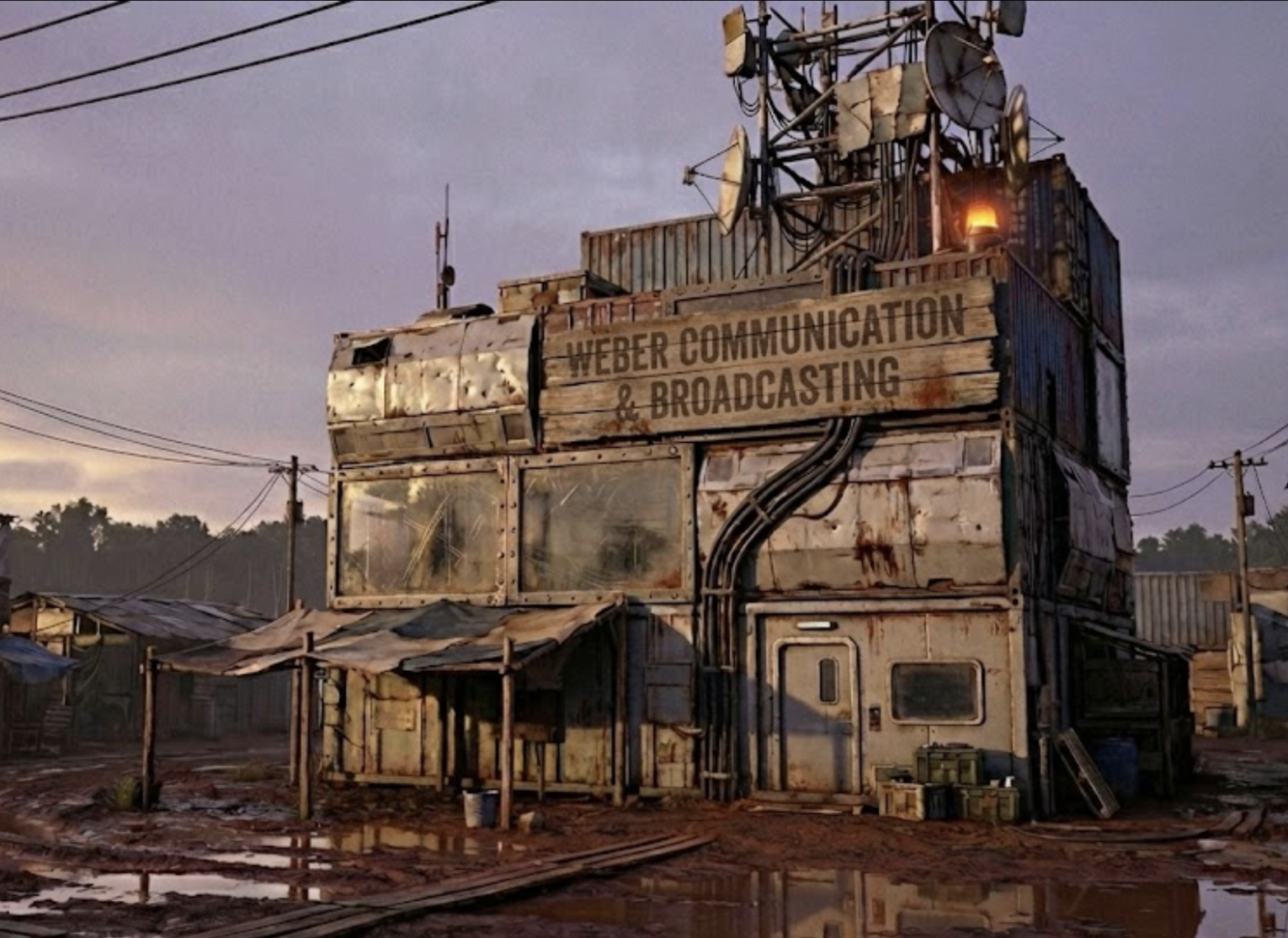
Overview
- Location: Public Services Ring, New Kourou
- Address: NW Public Services Ring Road 1
- Surroundings: Located near key commercial and cultural institutions, the building stood out for its prominent broadcast antenna array and constant low hum of transmission.
Founded in 2626 by communications engineer and visionary Klaus Weber, the Weber Communication Company (WCC) and its affiliated Weber Broadcasting Services were essential for connecting Exohuman settlements during the formative years of the Free State of Settlers.
From this headquarters, the first real-time Shortwave Radio Network on VOI 700 D was launched, enabling settlers in New Kourou, Hope, Morningstar, Firetown, and remote outposts across the Asari and Ralar Regions to communicate, share knowledge, and stay connected.
The headquarters not only coordinated the construction of relay stations and development of communication devices, but also broadcasted cultural programming, entertainment, and critical announcements — becoming a cornerstone of social cohesion and daily life in the Beta Age.
However, after the Great War, the signing of the Peace Treaty with the Alliance of Native Tribes and the introduction of Communardism brought sweeping institutional changes. The newly formed Federal Confederation nationalized all private companies, declaring their assets federal property for the collective benefit of the people.
On July 4, 2631, both WCC and Weber Broadcasting Services were absorbed into the Federal News Agency (FNA), effectively ending the independence of Exohuman media. The building was torn down less than two years later and replaced with Federal Allotment Center 3, constructed on February 28, 2633, using standardized mycelium blocks in accordance with federal design guidelines.
Architectural Significance
- Construction Material: Refurbished spaceship parts, container and transparent polymer glass from Last Frontier’s observatory modules.
- Floors: 4 + Basement
- Design Purpose: A blend of improvised frontier engineering and functional accessibility, combining salvaged hull panels with container-mod construction
The building appeared tall but uneven, with patched plating, exposed cable conduits, and a visibly improvised antenna structure welded from scrap metal. The exterior of the building was crowned by a distinct antenna dome and signal repeaters, making it a recognizable landmark in the Eastern Civic Ring. Internally, it was filled with transmission cables, soundproof studios, and high-efficiency server racks—balanced by a welcoming basement shop for public access.
Building Structure
Ground Floor (Public Area):
- Retail Shop: Offered fully assembled Shortwave Communication Devices (SWRWC) for 99 Kourou and DIY construction kits for 49 Kourou.
- Repair Station: Staffed by WCC technicians to handle diagnostics, part replacement, and firmware updates for communication devices.
- Demonstration Kiosk: Provided interactive guides and beginner support for first-time users.
First Floor to Second Floor (WCC Operations):
- Device Engineering Lab: Hosted ongoing R&D of SWRWC tech and network infrastructure.
- Signal Coordination Room: Maintained connection stability and managed relay tower coordination across the planet.
- Archives and Data Storage: Contained logs of communication tests, relay maps, and emergency frequencies.
- Staff Workspaces: Office pods for engineers, software developers, and hardware technicians.
Third Floor (Weber Broadcasting Services):
- Broadcast Studio: Main on-air studio equipped with sound booths, consoles, and multi-channel transmitters.
- Content Room: Where readers, musicians, and hosts prepared material for the nightly program.
- Call-In Terminal Bay: Allowed live audio feed-in from remote SWRWC users across VOI 700 D.
- Guest Waiting Room: Hosted visiting musicians, scientists, and settlement representatives before broadcast appearances.
Fourth Floor (Executive Level):
- Boardroom and Strategic Planning Room: Used for high-level decisions regarding network expansion and public communication strategy.
- Office of Klaus Weber: Private room of the founder, from which he coordinated both WCC and Broadcasting Services.
- Archives of Cultural Programs: Stored recordings of historic broadcasts, special guest segments, and musical archives.
Look and Feel
The headquarters buzzed with a quiet sense of purpose. Cables lined the corridors, and soft light panels kept the workspace calm and focused. The public basement, in contrast, felt bright and lively, where settlers tested devices and chatted with staff. Upstairs, the broadcast studio was warm and wood-paneled for acoustic clarity, filled with the energy of live voices, music, and poetry.
On the executive floor, Klaus Weber's office overlooked the Civic Ring through a curved polymer window. His desk faced a wall filled with framed frequency maps, each marked with the call signs of distant settlements he had helped connect.
Roles and Responsibilities
- Klaus Weber (Founder and Director): Visionary behind the communication infrastructure and cultural programming.
- Broadcast Hosts (3): Managed the daily broadcast schedule, hosted talk shows, and moderated call-ins.
- Musicians and Readers (rotating): Delivered live music and literature readings.
- Device Engineers (10): Maintained and upgraded SWRWC tech.
- Signal Technicians (6): Managed real-time connections and coordinated tower relays.
- Repair Staff (3): Worked in the Ground Floor service station.
- Shop Clerks (2): Assisted settlers with purchases and device instructions.
Public Access, Operating Hours and Operational Rhythm
Public Access: Basement retail and repair area was open to all settlers. The broadcast content was freely accessible via SWRWC devices.
Operating Hours:
- Shop & Repairs: Daily, 10 am – 6 pm
- Broadcast Services: 8 pm – midnight, daily
- Engineering Teams: Shift work around the clock for signal continuity
Operational Rhythm: Evenings were the busiest period, especially during the live broadcasts. During the day, engineers prepped signal updates while the content team curated programming for the night.
Security Measures
- Guarding Bot Presence: One Guarding Bot was stationed at the basement entrance and another patrolled the engineering floors during off-hours. They were both armed with a Guarding Troopers Stun Gun.
- Signal Lockdown Protocols: In emergencies, broadcast systems could be overridden to deliver public alerts.
- Backup Antenna Systems: A smaller emergency broadcast node was located on the roof, enabling reduced-function communication during crisis events.
- Staff Access Controls: Only verified personnel could enter the signal coordination room and executive floor. The entrance was screened by another Guarding Bot, which was also armed with a Guarding Troopers Stun Gun.
Player Interaction Possibilities (Legal and Illegal)
Legal Interactions:
- Participate in a talk show or perform as a musician
- Help restore broadcasting service after a relay tower failure
- Retrieve or research a historic audio broadcast for a mission
- Purchase or upgrade an SWRWC device in the public shop
- Deliver a message from the Settler’s Council during a live segment
Illegal Interactions:
- Hijack a broadcast to spread misinformation or rebel messaging
- Steal sensitive relay frequency maps from Klaus Weber’s office
- Sabotage a transmission to cause panic or confusion
- Impersonate a broadcaster to push propaganda
- Plant a virus in the broadcasting system to disrupt inter-settlement communication
Tactical Advice for Dungeon Masters
This building offers a rich combination of cultural significance, technical infrastructure, and high-stakes public influence. Possible mission hooks include:
- A saboteur plans to hijack a broadcast and players must stop the act live, mid-transmission.
- Klaus Weber seeks help to locate a rogue tower broadcasting misinformation.
- A player’s message must reach a loved one in a remote region—only possible through WCC's backup relay.
The HQ is ideal for both stealth and diplomacy-focused missions and provides strong narrative potential for themes like information control, media ethics, and the shaping of collective memory.