Table of Contents
Major Planetary Zones | (Twin) Sections of the Habitual Belt | Regions | Geographic Features
ATRANA MOUNTAINS
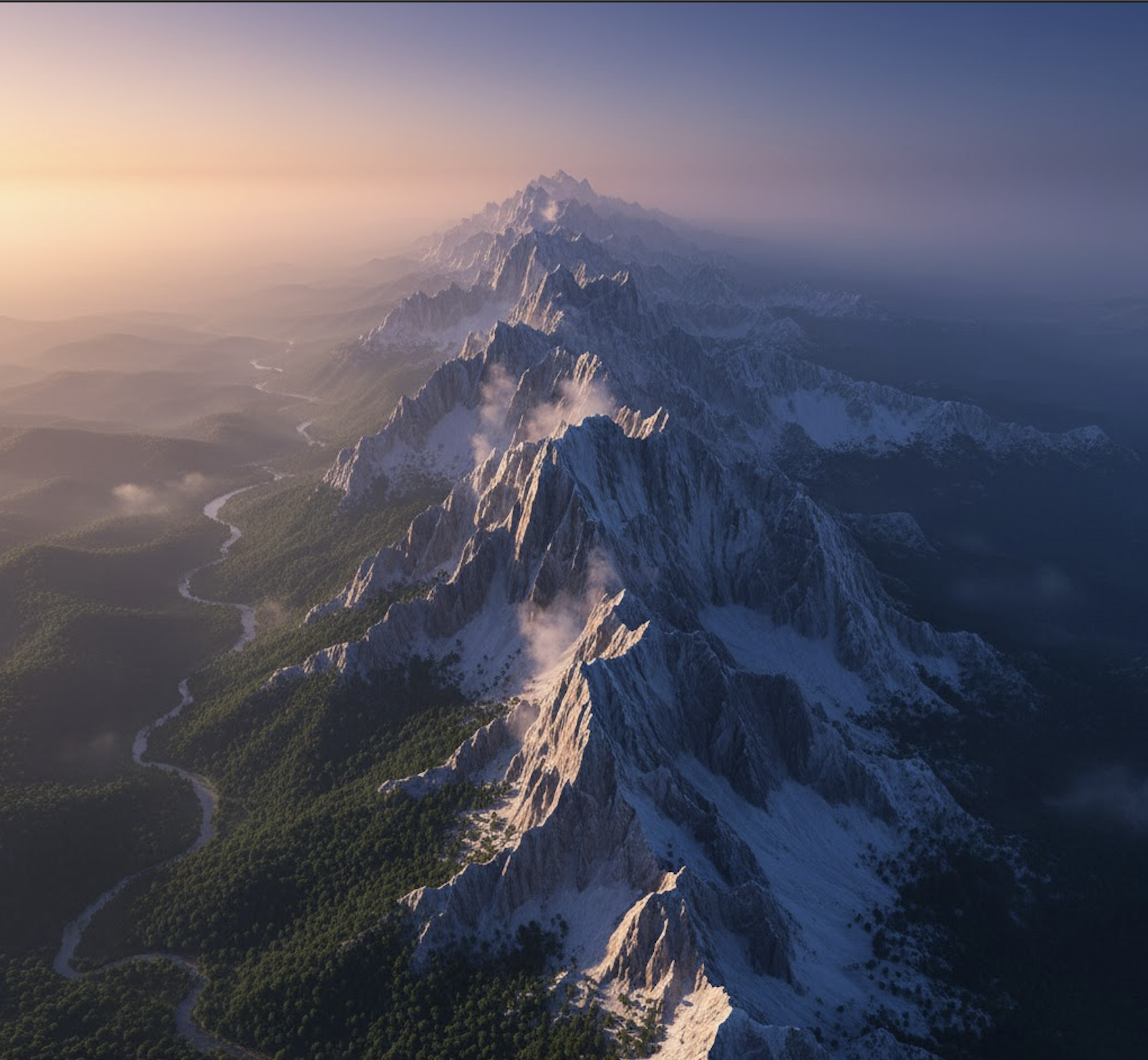
- Type: Mountain Range
- Location: On the border between Habitual Belt, Eastern Equatorial Section and Dark Side, Ralar Region
Overview
The Atrana Mountains — stretching roughly 250 kilometers from their northern to southern slopes — form a natural boundary between the Ralar Region on the Dark Side and the Asari Region in the Eastern Equatorial Section of the Habitual Belt. Towering up to 4,700 meters at Mount Atrana, the range divides the icy expanse of the Ralar Region from the tropical regions of Asari. Their contrasting exposures to light and heat create a diverse and biologically rich corridor between darkness and fertility.
The Atrana Mountains are also the source of the Arla River, which begins in a series of pure, spring-fed outflows in the northeastern range. These springs emerge from subterranean reservoirs fed by glacial melt and geothermal pressure, ensuring a stable flow of mineral-rich water year-round.
Local Climatic Conditions, Geography and Landscape

The Atrana Mountains are shaped by ancient tectonic activity and geothermal anomalies. Their steep ridges, deep gorges, and high-altitude snowfields give way to humid lower valleys and dense forests on the Habitual Belt side. On the Dark Side, the range descends into frostbitten cliffs and ice-choked valleys.
The geothermal vents that dot the range generate warm cave systems and unique microclimates, supporting biodiversity far beyond what would typically survive at such elevations.
Weather Patterns:
- Freezing, wind-blasted climate on the Dark Side
- Tropical humidity on lower Habitual Belt slopes
- Persistent mist and fog in geothermal vent regions
- Snowfall and glacial runoff at higher elevations
Local Flora
The Atrana Mountains’ flora reflects the dramatic elevation shifts and light disparities between regions. All known Exohuman data on the flora of the Atrana Mountains was collected during the brief exploration window between the landing on March 24, 2625 and the beginning of the Great War on June 17, 2629. Since further exploration has been prohibited due to the restrictions of the Peace Treaty between the Exohumans and the Alliance of Native Tribes, it is highly probable that not all plant species within the Atrana Mountains ecosystem are known to Exohumans.
- Cold-Tolerant Shrubs – Hardy alpine vegetation that thrives near the snowline
- Frostleaf Moss – Clings to shaded rocks on the Dark Side slopes
- Heat-Ferns – Thrive in the geothermal caves, absorbing humidity and mineral-rich steam
- Glowscale Vines – Bioluminescent vines used for tribal rituals and cave navigation
- Barkroot Trees – Short, wide-rooted trees that stabilize the lower tropical slopes
Local Fauna
Birds
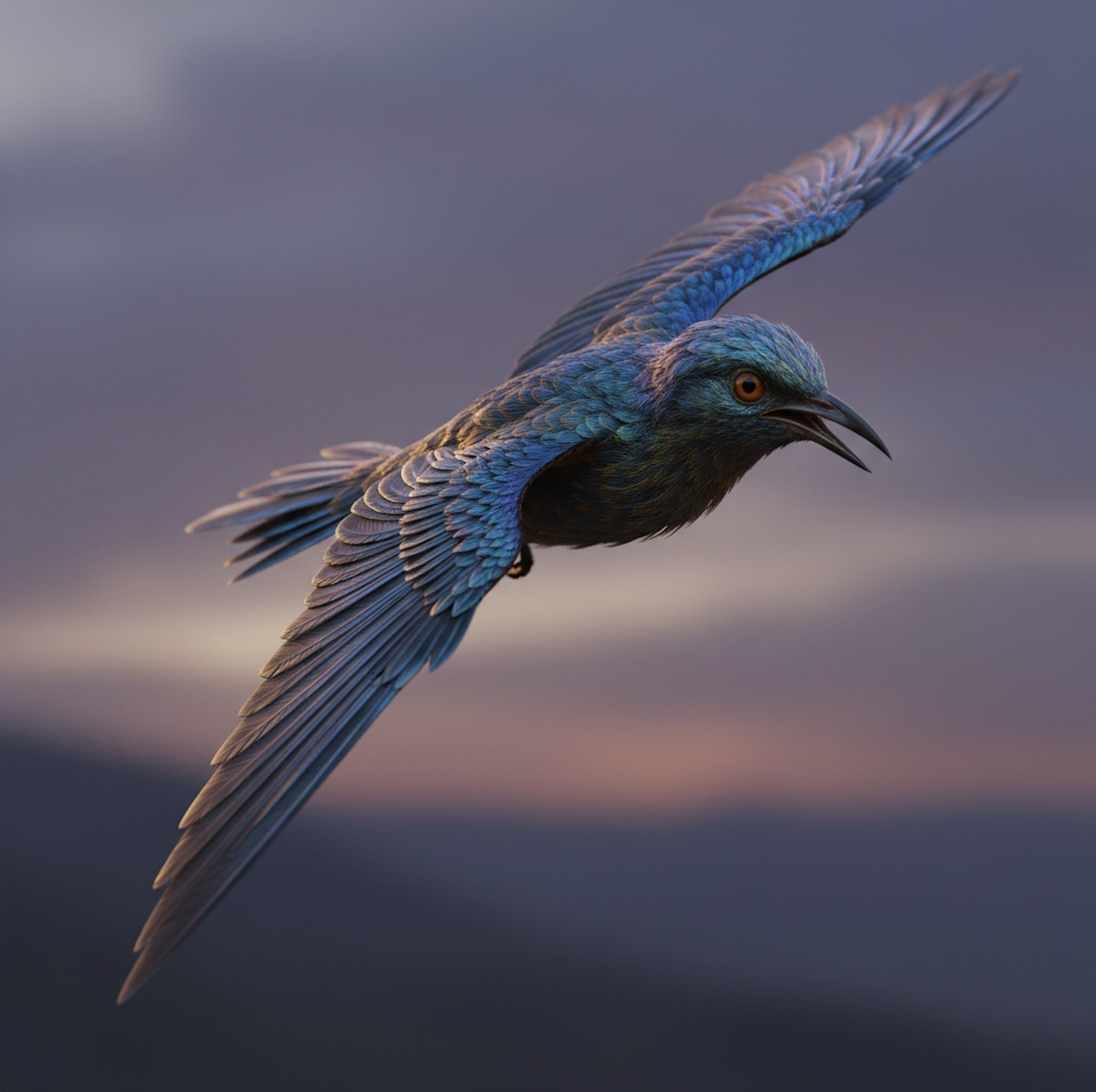
- Arr – Eagle-like bird of prey (Habitual Belt)
- Zapor Birds – Large avian predators nesting in geothermal vents (Dark Side)
- Flutterwings – Shimmering birds common in lower canopies (Habitual Belt)
Mammals
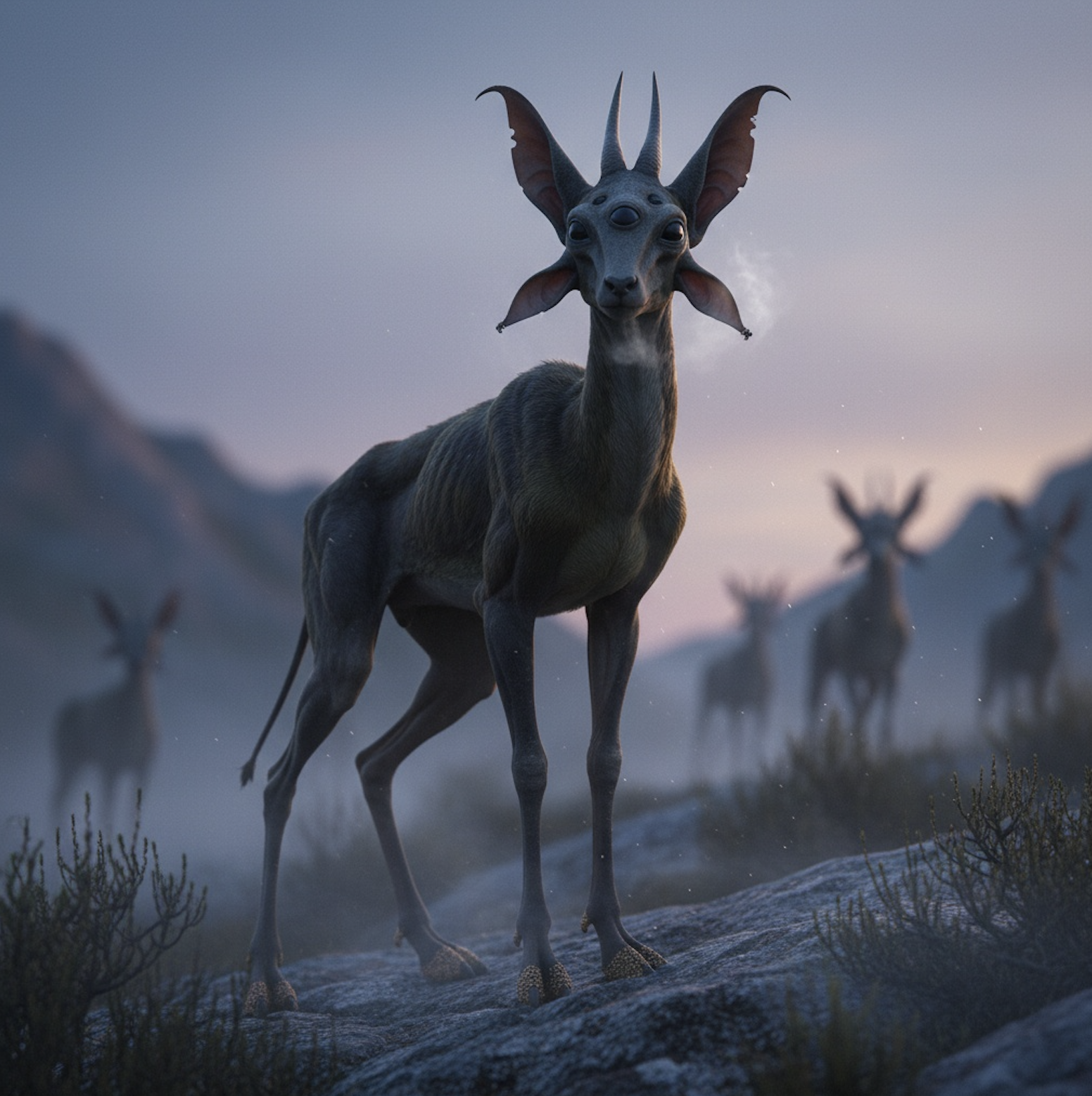
- Manla – Agile deer-like herbivores grazing in herds (Habitual Belt)
- Moar – Bear-like apex predator of the forested valleys (Habitual Belt)
- Nokari Mouse – Small, fur-insulated rodent.
- Korozo – Ultrasonic mammalian predators with razor fangs (Dark Side)
Amphibians and Reptiles
- Kintari Frog – Bright amphibians with strong legs and marsh camouflage (Habitual Belt)
- Kajanga – Eyeless amphibian-fish hybrids adapted to darkness (Dark Side)
- Naka Tula – Low, winged cave predator
Insects and Arachnids
- Bero Hiki – Cave-dwelling worms aiding nutrient cycling
- Cockroaches – Hardy settlers from the Last Frontier
- Talikra – Insect species capable of leaping large distances in pitch-black environments (Dark Side)
Local Population and Settlement History
Native Presence

For the Honga Tribe, the Atrana Mountains hold sacred meaning, as they are home to the source of the Arla River — their most revered waterway. The Honga’s migratory lifestyle, known as Shai Zaong (“Cycle of Life”), begins at these mountain springs. Their journey follows the river downstream to Lake Arla and then upstream again, forming a spiritual cycle
Exohuman Settlement
After crash-landing in the Asari Region, Exohumans began exploring the Atrana Mountains during the early Beta Age. They identified the region’s value for timber and hunting. On June 15, 2626, they founded Morningstar at an elevation of 300 meters — the first and only permanent Exohuman settlement in the range.
Morningstar remains the smallest of the Exohuman's settlements, housing 3,000 inhabitants (according to the 2635 census). The town also hosted the original Forge of Atrana, which produced hunting weapons and tools. However, during the Great War, the Forge of Atrana was repurposed for military armament production.
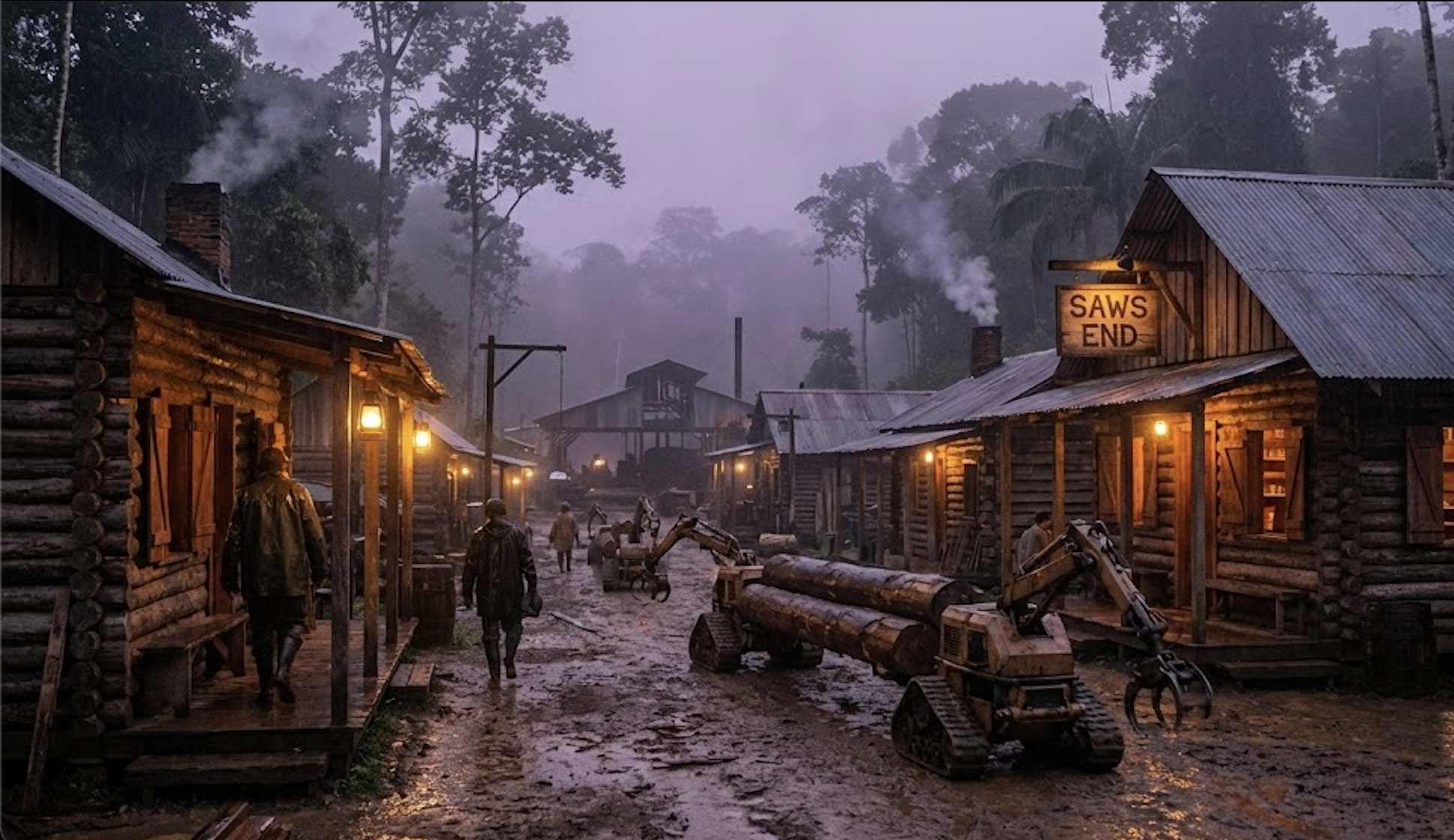
Following the Peace Treaty, the Forge of Atrana was dismantled in the Gamma Age by the Permanent Supervisor. Its successor, the Federal Weapon Manufactory, now operates under strict surveillance, producing non-firearms for Federal and Local Sheriff departments.
The Peace Treaty also imposed limits on timber extraction. Morningstar’s output was reduced from 3,000 hectares of forest annually to 1,500 hectares, with accessible forested land cut from 15,000 to 7,500 hectares.
Tactical Advice for Dungeon Masters
The Eastern Equatorial Section provides a vivid collision of harsh geography, spiritual heritage, and political tension. Adventures in the Atrana Mountains should draw on sacred boundaries, industrial overreach, and the looming presence of law enforcement.
The operational Federal Weapon Manufactory in Morningstar, timber conflicts, and ancient tribal rituals at the Arla River’s source can all be focal points for campaigns. In the Gamma Age, Exohuman activities are monitored closely, and violating treaty boundaries may result in pursuit by Native enforcers or diplomatic incidents.
Adventure Hooks – Beta Age:
- “The Heated Claim” – A geothermal cave newly discovered by Exohumans is claimed as sacred by the Honga. Players are sent to broker peace — or sabotage the opposition.
Adventure Hooks – Gamma Age:
- “The Silent Forge” – Communications with the Federal Weapon Manufactory break down. Players must investigate – only to discover that an Outlaw-Group has taken it over …
Related Pages and Further Information
The Mountain Ranges of Asari: