Table of Contents
Major Planetary Zones | (Twin) Sections of the Habitual Belt | Regions | Sites
NEW HORIZON’S REST CEMETERY
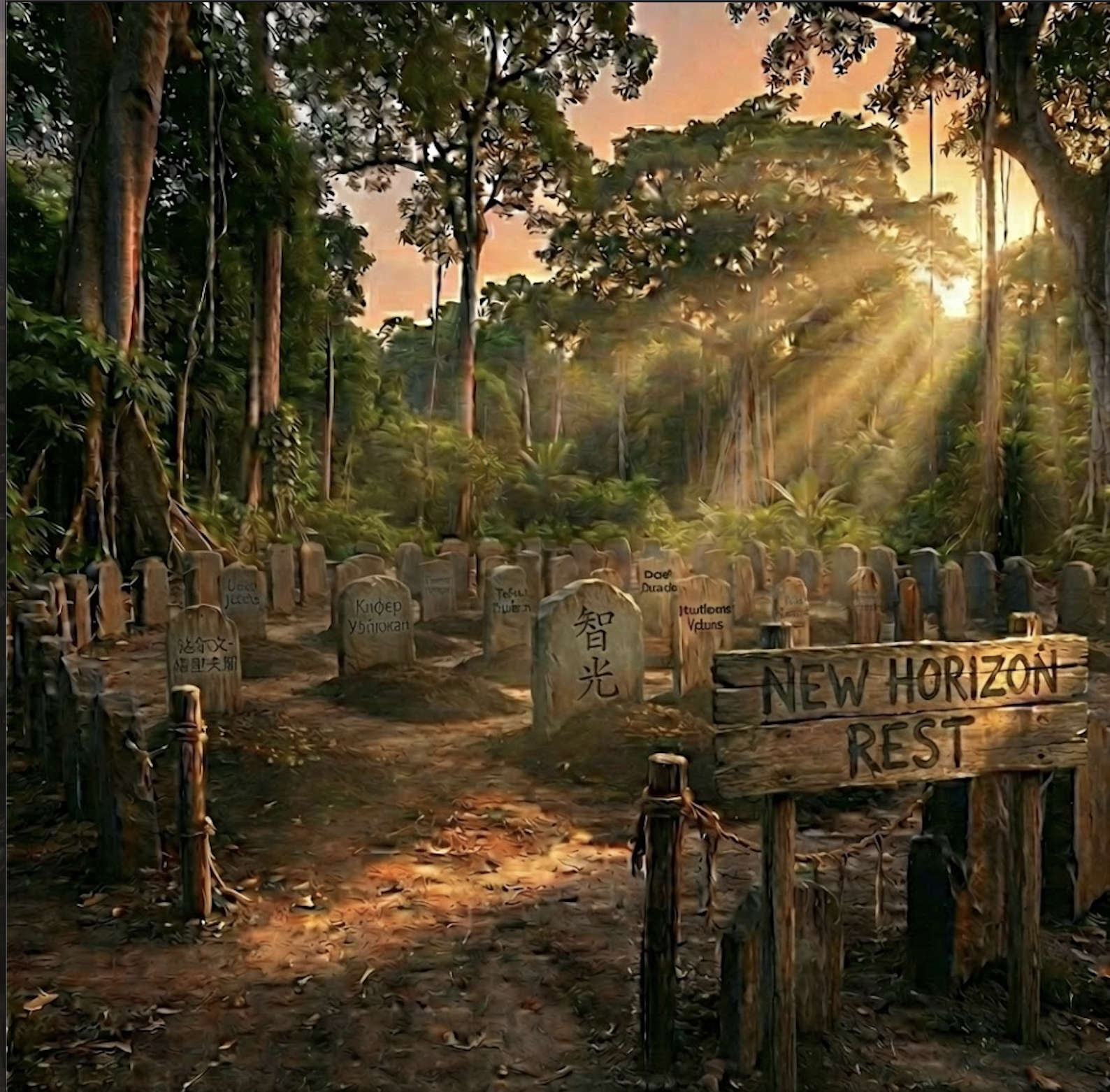
- Type: Site (cemetery)
- Location: 500 m west of the town wall of New Kourou, Asari Region
Overview
On 9 May 2625 the Settler’s Council voted to create a traditional, soil-based burial ground so that ExoHumans — after generations in space — could finally “return their dead to the earth of their new home.” Clearing began within days, and New Horizon’s Rest Cemetery opened on 18 July 2625.
In its early months the grounds were modest, but as the needs of the settlement grew, the cemetery was extended iteratively, adding new rows and small clearings whenever another cluster of burials became necessary. Each expansion reflected a community still learning how to anchor itself in the soil of VOI 700 D.
A unique cultural tradition emerged: descendants wrote the names of their deceased family members or friends using the writing systems of their Earth ancestors — Kanji for those with Japanese heritage, Cyrillic for those with Russian roots, and dozens more. Because so many settlers carried mixed or uncertain cultural backgrounds, these choices were not always rational or genealogically strict; sometimes they simply followed emotion, memory, or the wish to belong to a lineage imagined rather than proven. As a result, the cemetery’s markers became a mosaic of scripts and identities, standing together in quiet testament to humanity’s fragmented past.
Until its closure in 2631 the 1 500 m² plot served as the only sanctioned burial site for the settlement of New Kourou, ultimately receiving 147 graves. Dense Tropical Forest has since reclaimed the grounds; by the Gamma Age overgrown tombstones protrude like quiet relics among vines and broad-leaf trees.
A compact, wagon-wide trail linked the grounds to New Kourou’s eastern gate — officially named New Horizon Way but known to locals simply as “the Last Mile.” The path was closed and overgrown after the gate’s decommissioning in the Gamma Age.
Facts and Figures
- Established: July 2625
- Clearing Work: ≈ 45 mature trees and surrounding underbrush felled by Penal-Labour crews and two Manual Labor Bots
- Foot-print: 1 500 m² (roughly 30 m × 50 m)
- Operational Period: 18 July 2625 – 8 April 2631
- Interments: 147 individuals (64 soldiers of the Volunteer Army of Man, 83 civilians)
- Peak Burials: 30 in 2629 and 34 in 2630 during the Great War
- Status (Gamma Age): Abandoned; re-wilded during the Gamma Age
Cultural and Strategic Importance
- First “earth-return” rite: Marked a shift from starship composting to terrestrial burial, symbolising settlers’ claim to the planet.
- Martial memorial: The rows of 2629–2630 soldier graves became a rallying image in wartime propaganda.
- Political fault line: Its location outside New Kourou’s walls later violated the Gamma Age Peace Treaty, turning the grounds into forbidden land and a touch-stone for Individualist nostalgia.
Look and Feel
Beta Age (2625 – 2631)
Fresh-cut boundary posts framed the cemetery in a loose, uneven line — some still bleeding sap, others already darkened by the humid twilight. The soil was raked as neatly as the settler crews could manage, yet the rows of graves expanded in small, irregular bursts, each new cluster marking another hard week for the colony.
The headstones themselves were frontier-hewn: edgy, matte-cut basalt slabs whose faces carried not only names and dates but an eclectic tapestry of Earthborn scripts. Kanji beside Cyrillic, Arabic beside Old English runes — choices guided as much by longing, memory, or family myth as by true ancestry. In the orange-violet light these characters caught faint reflections, giving the rows a quiet, shifting rhythm.
A ring of towering Asari-forest trees enclosed the grounds like a natural amphitheater, their trunks rising 25 meters before flaring into rustling canopies. The air held the smell of damp loam, freshly planed Morningstar-wood coffins, and thin trails of incense drifting from slow-moving funeral lines.
Sound carried softly here: murmured prayers, the rhythmic strike of shovels, the harness creak of a Hoo-drawn hearse cart. Under the alien sky — unfamiliar stars wheeling overhead — mourners felt a solemn sense of arrival. For the first time since leaving Earth, the dead were returning to real soil, and the living gathered in a space that mixed loss with the fragile hope of belonging.
Gamma Age (post-2631)
Nature has reclaimed the plot. Vines coil around shattered fence posts; wide-leaf creepers blur grave rows into mounds tangled with moss. Many basalt markers lie half-submerged, their inscriptions pitted by acid rainfall. Light filters through a thick canopy, casting green-gold shafts onto rusted lantern husks. Insects buzz loudly where mourners once whispered, and the scent is rich with decaying foliage rather than incense. Footfalls crunch on leaf litter over gravel, and an uneasy hush settles—part reverence, part foreboding—reminding visitors they stand in forbidden ground where memory and wilderness intertwine.
History / Legacy
- Clearing and fence-setting were accomplished by mixed Penal-Labour crews under Guarding Trooper watch, with Manual Labor Bots hauling timber.
- When the Free State dissolved on 8 April 2631 the cemetery ceased operation; families were barred from visiting by treaty clause, and new deaths reverted to ship-era composting protocols. Without caretakers, tropical creepers engulfed the markers within a decade. Today only broken basalt slabs and rusted gate hinges hint at the once-solemn field.
Tactical Advice for Dungeon Masters
Beta-Age Hook:
- “Grave of the Unknown Pilot” — With the Peace Treaty’s burial ban kicking in at noon, the PCs — as elite Guarding Troopers — must escort an “unknown pilot” coffin from Schmitz Funeral Home to New Horizon’s Rest along the mist-choked Last Mile. Under the settlement’s perpetual twilight and steady drizzle, they clear fallen logs and jury-rig a disabled Manual Labor Bot to haul the remains across flooded creek beds. Mid-trail, a patrol of Honga Warriors emerges from the undergrowth, performing a dawn-light ceremony by their ancestral totems; the PCs must parley for safe passage or face a lethal skirmish that would doom the burial. At the cemetery gate, they uncover a hidden dispatch satchel taped inside the pilot’s flight suit—encrypted orders revealing high-level corruption in the Settler’s Council …
Gamma-Age Hook:
- “Roots of Remembrance:” — The Native Supervisor has brokered New Kourou’s first Annual Memorial Day, opening New Horizon’s Rest to settlers once more. Deputized by the Federal Sheriff, the PCs lead a crew of volunteers to ready the overgrown graves when they discover two headstones — dated October 2625 and bearing the same family name — dug open and empty. Worse, the surname isn’t on any passenger manifest or settler roll. Charged with securing the grounds, the PCs must trace the origin of these phantom markers: Were the remains illicitly moved for a hidden rite, or did the stones conceal a deeper conspiracy at the colony’s birth?
Related Pages and Further Information
Known Sites in the Asari Region: