
This is an old revision of the document!
Table of Contents
102 Pen and Paper Adventure | Beta Age | Hunting an Unknown Hunter
SCENE 3 — TRAVELING TO MORNINGSTAR
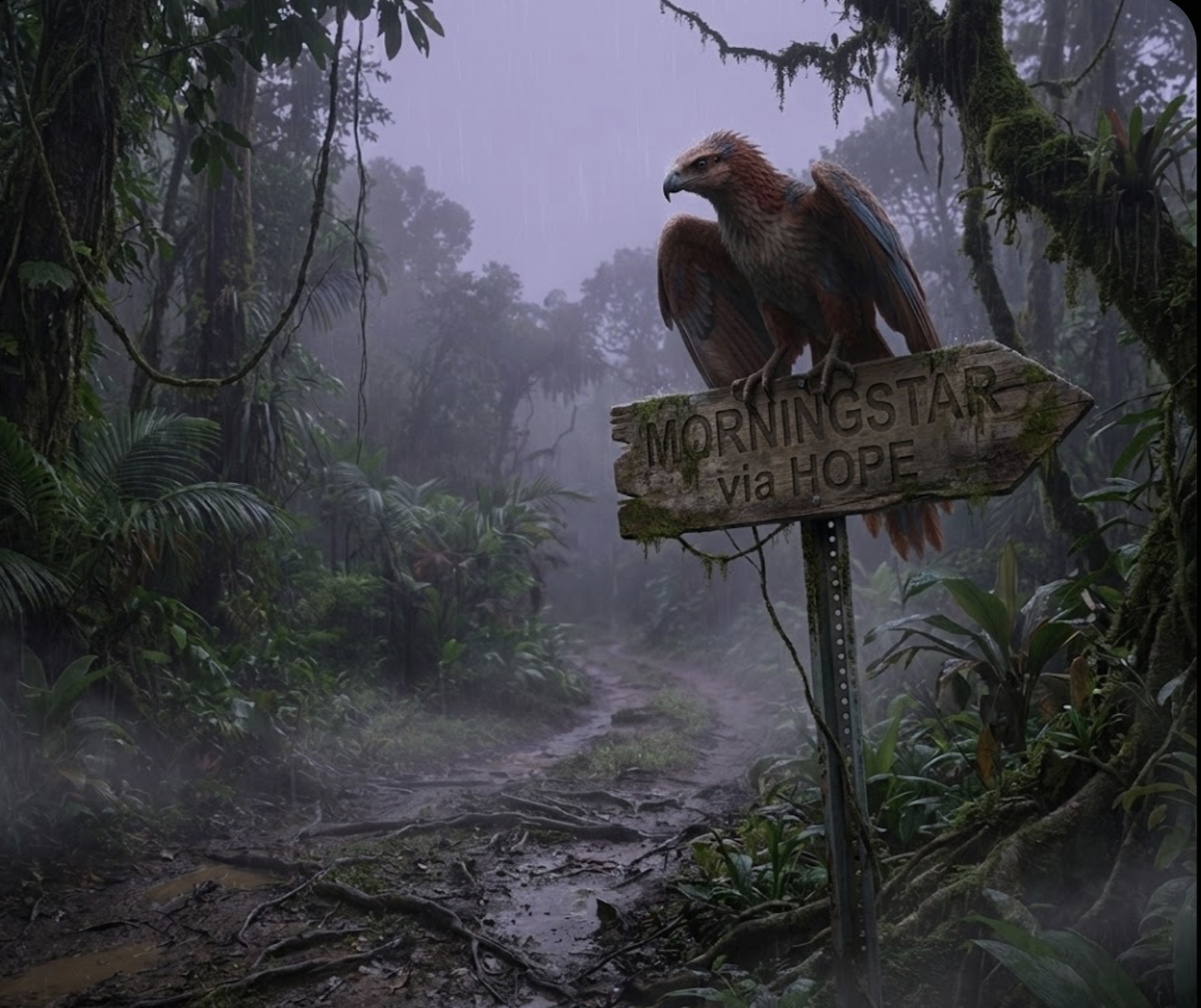
1 | Scene Overview
- Location: The Trade Route between New Kourou, Hope, and Morningstar at the lower slopes of the Atrana Mountains
- Type: Travel · Journey · Risk Assessment · Conditional Encounters
- Era: Beta Age
- Tone: Frontier travel · watchful tension · controlled uncertainty
Atmosphere & Sensory Cues: Warm, moisture-heavy air · perpetual violet-grey twilight filtering through dense canopy · rain pattering on leaves and canvas · buzzing insects and distant animal calls · slick roots and dark soil underfoot ·
Scene Phases (Structure at a Glance): This scene is intentionally structured in three consecutive phases. Not all phases are guaranteed to resolve peacefully, but all of them frame player choice and consequence.
- Phase I — The Southern Trade Route (New Kourou → Hope):Travel through dense tropical forest. Visibility is limited, nature is dominant, and human control is contested. This phase carries the highest risk of ambush and establishes the tone of vigilance and pressure.
- Phase II — Hope (Optional / Conditional Rest Stop): A temporary return to order. For PCs traveling with a caravan of the New Kourou Courier Service, this stop is mandatory. For all others, it is a strategic choice. Time passes here, rumors circulate, and resources can be gained or lost.
- Phase III — The Northern Trade Route (Hope → Morningstar): Beyond Hope, the Trade Route begins to climb into the lower slopes of the Atrana Mountains. The ground turns steeper, wetter, and more demanding. Veyra tire faster, Hoos strain against the gradient, and travel on foot becomes a test of endurance rather than speed. PCs who skipped rest in Hope feel this phase more sharply — fatigue accumulates faster, patience wears thin, and mistakes carry heavier consequences. This phase shifts the threat from overt exohuman control to territorial awareness: the land is watched, weighed, and remembered, with possible Honga intervention.
Encounter Structure (Declared, Not Mandatory): Along this route, the PCs may face up to three distinct forms of pressure, depending on their behavior, travel method, and decisions:
- Predatory presence from the wilderness (Arr).
- Exohuman control and intimidation along the Trade Route (Highwayman ambush).
2 | Read-Aloud Description
Initial Read-Aloud (Phase 1)
The road north narrows quickly after the last buildings fall away. Broad-leafed plants crowd the edges. The air turns warmer and thicker, full of damp soil and crushed greenery. Behind you, settlement sounds dissolve into insects and distant, unseen movement.
The forest thickens until it feels like a ceiling. Moisture beads on everything and a light rain comes and goes without warning. Dark soil clings to boots, and the undergrowth never fully stops whispering. Now and then, the light shifts oddly, as if something large passed overhead — but when you look up, there’s only canopy and mist …
Staged Read-Alouds (Progressive Descriptions)
| Trigger | Phase | Read-Aloud or Narrative Insert |
| Highwayman ambush is triggered (On Foot / Mounted) | Phase I — (Ambush) | The forest goes unnaturally tight before a deafening CRA-AAACK shatters the canopy. A massive Barkroot tree crashes across the Trade Route with an earth-shaking thud, throwing a vertical wall of brown muck and splintered wood high into the air. Before your mounts can clear the mire, a sharp whistling sound slices through the twilight, the aerodynamic hiss of a bone-tipped projectile. An arrow slams into the mud right between your positions. From the ridge above, a gaunt, stubbled man steps out of the foliage. He carries a rusty, pressurized tank on his back connected to an improvised nozzle with a flickering blue chemical pilot flame. 'Hands where I can see them,' he rasps. 'Slowly. I want to see you sink into that muck.' |
| Highwayman ambush is triggered (Hearse Carriage travel) | Phase I — (Ambush) | A deafening CRA-AAACK echoes through the walls of the carriage as a massive Barkroot tree strikes the Trade Route. Jop bellows in panic, his broad hooves sliding as the heavy hearse skids to a violent halt inches from the trunk. Simultaneously, an aerodynamic whistle cuts the air. A bone-tipped arrow punches clean through the copper hull with a sickening CRUNCH. From inside the cabin, a scream of pain erupts, one of your companions has been struck in the shoulder. Outside, a gaunt man in a battered leather hat steps from the wreckage. He carries a pressurized container on his back, a hissing blue pilot light dancing at the tip of his nozzle. 'You know,' he sneers, 'I ain't never robbed a monk on a hearse before. Especially not one where the cargo has a voice. Get out. One by one. If the doors stay shut, I turn this box into ash.' |
—
| Trigger | Phase | Read-Aloud or Narrative Insert |
| PCs approach Hope | Phase II | The forest begins to loosen its grip. Trees thin, light opens slightly, and the air shifts — less rot and rain, more grain and river-water. Ahead, the road widens into churned mud scored by cart wheels. Smoke curls up through the canopy, carrying the scent of roasted Zelor Grain, Tandora Fruits, and animal hide. Fields open on either side of the road, cut through by irrigation ditches where Manual Labor Bots work in patient, uneven rhythms. This isn’t a wilderness outpost — it’s a place that feeds others. You’ve reached Hope. |
| PCs approach Hope with New Kourou Courier Service | Phase II | The guide raises a hand and the convoy slows without discussion. “Route Stop,” he calls. “Four hours.”The wagons peel off the Trade Route toward a wide, hard-packed clearing just outside Hope — hitch rails, feed troughs, and exchange pens already waiting. Hoos are unhitched and led away, fresh teams brought in with practiced efficiency. Axles are checked, harnesses retightened, manifests stamped. Across the road, a low, busy building on Hope’s Seedway 9 gives off heat and food-smell — the route canteen where couriers eat, drink, and wait. Next door, the shutters of Laurin’s Armory & Outdoors stand open, racks of tools and gear visible through the haze. |
—
| Trigger | Phase | Read-Aloud or Narrative Insert |
| PCs reach the Atrana Foothills | Phase III (General) | Fog rolls in as the land steepens, swallowing distance and softening sound. Damp stone replaces soil underfoot, and the air tastes like moss and cold water. Shapes appear late and vanish early. Ahead, somewhere beyond the curtain of grey, you hear it — the steady crack of split timber and the faint clang of tools. |
| Honga intervention is triggered | Phase III (Trigger → Transition) | The forest goes unnaturally still. No insects. No birds. Then a sharp whistle cuts through the air — brief, controlled, unmistakably deliberate. Silence follows. Something shifts in the undergrowth to your right — not wind, not an animal. Just weight, placed carefully. Cut immediately to Scene 3b — Prisoners of the Honga. |
| PCs approach Morningstar (no Honga trigger / after Foothills progress) | Phase III (Arrival Threshold) | The climb keeps going until you start to understand the difference between distance and altitude. Rain slicks the stones underfoot and turns the road into a slow grind. The forest presses close — dense hardwoods sweating sap that smells spice-sweet in the mist — and the fog above you sits like a ceiling, hiding whatever peaks it’s wrapped around. Then the sounds change. A far-off whine like insects at first — chainsaws — and beneath it a steady, heavy rhythm that repeats until you can feel it in your chest: Thump. Thump. Thump. It’s the heartbeat of a sawmill. Out of the fog, lantern light bleeds through the trees — glow on tin roofs, smoke-thread shadows, and the whine of heavy chainsaws. Morningstar isn’t a holiday destination. It’s a frontier workplace perched on the edge of the world. |
3 | Scene Intent
| Scene Type | Player Intents | DM Function / Story Link |
| Travel (branched) | Reach Destination · deal with challenges of chosen method · manage resources | Establish journey tone; introduce modular encounters; control pacing; lead into Scene 4 (Arrival in Morningstar) |
4 | Key (N)PCs + Dynamic Cues
| Name | Role / Affiliation | Motivation / Goal | Dynamic Cues — How They React in Play | Wiki Link |
| Arr | Aerial Predator | Find prey, attack | Patient, alert. Knows the terrain, keeps an eye on everything. Senses when the right moment has come to strike. | Arr |
| Harlan Tameron | Highwayman Leader | Enforce the toll; secure valuables; survive his worsening infection | Desperate, feverish, but trying to maintain an imposing posture. Relies heavily on his improvised flamethrower nozzle to keep front-liners at bay in the mud. | — |
| Daryl | Hidden Bowman Archer | Provide long-range sniper suppression | Hidden elevated in a Barkroot tree on the left ridge. Armed with a stolen Senti Hunting Bow. Fires lethal shots on a delay to protect Harlan. | — |
| Honga Scout | Honga Tribe | Identify dangers, remain invisible | Informs his tribe about dangers, passes on messages, gets help when necessary | The Honga |
5 | Consequences, Timing & Encounter Triggers
Use at most one of the following unless you want to escalate tension deliberately.
Arr Presence — Predatory Escalation Logic
The Arr is not a random encounter. It is an apex predator reacting to weakness, exposure, and neglect. The Arr disengages if injured, driven off, or denied clear advantage. It does not pursue recklessly.
| PC Action / Cue | Response | Consequences / Mechanics |
| PCs notice a large shadow passing overhead or distant wingbeats | An Arr circles high above, assessing movement and vulnerability without committing | The Arr is now “aware” of the party. Further risky actions may trigger an attack check |
| 🩸 PCs are injured or bleeding in the open | The Arr returns sooner than expected, circling lower and tighter. | Increase ambush likelihood. If an attack occurs, the Arr prioritizes wounded PCs or mounts. |
| 😴 PCs rest in the open without a guard | The forest goes quiet. Wind shifts. Then impact from above. | Arr attack begins with surprise and advantage on its opening action. |
| 👁️ PCs maintain vigilance (guards, cover, awareness) | The Arr tests distance but does not commit. | If an attack occurs, no surprise; Arr does not gain advantage on its opening action. |
—
Highwayman Encounter (Optional, Before Hope / Non-Caravan Only)
| PC Action / Cue | Response | Consequences / Mechanics |
| PCs take a moment to assess the situation | Through foliage and shadow, you catch fragments of movement: silhouettes above the road, disciplined and steady. | WIS (Perception) DC 13: Identify at least two attackers, elevated positions, scoped crossbows. DC 15: Also recognize coordinated kill angles and professional ambush discipline. |
| PCs in the Mortician's Cart do not get out | The Highwayman gives the PC one last warning: “Last chance. If there's breath in that box, get it out. I'm not checking for pulses after I light the fuse.” He begins a slow, calm count. “One… Two… Three…” If still shut: “Okay. Have it your way.” | Mechanic: The Highwayman Holds Action for 1 round (or a count of 5). If the doors remain shut after the count, a Highwayman fires a burning bolt into the roof. The cart takes 1d6 Fire damage per round. Smoke fills the cabin (Blindness) and forces occupants out. |
| PCs comply (weapons lowered, calm posture) | One of the attackers drops down into view, face partially hidden beneath leaf-camo. He carries a rough fabric loot bag, already open. He moves fast and practiced, rifling through packs, belts, saddlebags — ignoring bulky gear or items with no resale value. | Robbery in earnest. All currency found is taken. The DM determines what is found with WIS (Perception) checks against each PC (DC based on how well items are hidden). Any small, valuable, portable items that fit into the bag are taken at DM discretion; oversized or low-value items are ignored. PCs may attempt CHA (Persuasion or Deception) DC 15 to protect one specific item or a portion of their money (e.g. “leave my last cash,” or “not that tool”). On success, the attacker leaves that item behind; on failure, it goes into the bag. The ambushers disengage cleanly once the bag is full. |
| Use Shiver-Thorn Capsule (from the Tinkerer – if still available) | Affected ambushers recoil briefly, coughing and shielding their eyes. | No roll. Combat begins immediately. PCs gain advantage on their first attack or escape attempt while the ambushers are distracted. |
| Use Spineback Flicker Pod (from the Tinkerer – if still available) | Ambushers flinch as the burning resin hits them. | Combat begins immediately. DEX DC 12: Success imposes disadvantage on 1 Ambusher's next action. |
| Use Rootcoil Strangler Vine (from the Tinkerer – if still available) | The vine snaps out, tangling the target's legs. | Combat begins immediately. STR DC 13: Success restrains one Ambusher briefly. Failure restrains the user. |
| PCs escalate to open combat (lethal attacks, charge, spells) | The warning phase ends. Bolts are no longer pulled. The attackers commit fully. | Roll initiative normally. Ambushers fight tactically and may disengage if outmatched. |
| PCs attempt to flee | A single bolt cracks past, smashing into gear or mount — disabling, not killing. The attackers melt back into the forest. | DEX (Athletics or Acrobatics) DC 13: Success = escape with minor loss. Failure = loss of time, supplies, or minor injury (DM choice). |
| PCs defeat or rout the ambushers | Rain and insects return. The road feels empty again, but not safe. | No roll. Encounter ends. PCs may search the area. |
| PCs loot the ambushers | What’s left behind is practical, mobile, and well-used — tools of control, not show. | Loot gained: 2× DIY Scoped Crossbows (each with 8 mixed bolts, some resin-stained); 1× rope (10 m); climbing hooks; leaf-camo poncho; 1× small vial of solvent liquid (highly flammable, fast-evaporating); 200 Kourou; 1× pair of DIY Shuko & Ashiko (hand/foot climbing spikes, usable for climbing or close-quarters grappling); 1× DIY Nunchaku (reinforced wood with weighted cores, suited for control, disarm, or non-lethal strikes). |
—
Hope Route Stop & Rest Decision
| PC Action / Cue | Response | Consequences / Mechanics |
| 🛑 PCs arrive in Hope and choose to rest | The road funnels naturally toward Seedway traffic, food stalls, hitch rails, and the Route Stop. The journey pauses. | Immediately transition to Scene 3a — Rest Stop in Hope. Time advances, supplies may change, and new social threads open. |
—
Honga Encounter (Optional - after Hope)
| PC Action / Cue | Response | Consequences / Mechanics |
| The party enters Honga-sensitive foothill territory (Phase III) | A sharp whistle cuts the air. The forest stills. Something moves in the undergrowth — close, deliberate, unseen. | This is a narrative transition trigger. Do not resolve the encounter here. Immediately proceed to Scene 3b — Prisoners of the Honga for the opening capture and all mechanics. |
—
Arrival in Morningstar (End of Scene)
| PC Action / Cue | Response | Consequences / Mechanics |
| PCs reach the Morningstar outskirts (Phase III) and no Honga trigger has occurred | The fog thins just enough to reveal the first log-built structures and tin roofs, work-lights in the mist, and the constant industrial pulse of saws and bots on the slopes. | This is the natural end of Scene 3. Cut here and proceed to Scene 4 — Arrival in Morningstar. |
6 | DM Notes
- Tone: Frontier realism with quiet, constant pressure.
- Scene Function: Scene 3 is a journey container, not a single encounter. Its purpose is to frame risk, fatigue, and consequence through modular pressure points.
- The Wanted Status on the Road: If the PCs have a High Exposure status, the “Ticking Clock” from the settlements does not apply in the deep woods. However, Highwaymen like Harlan might recognize them from the bounty wire, using it as leverage to rob them completely blind under the threat of turning them in.
- Player Agency First: Every danger has readable signals: silence, shadows, whistles. Reward PCs who slow down, post guards, and choose restraint. Poor decisions escalate logically — never arbitrarily.
- Highwaymen Philosophy: Harlan Tameron wants control, not blood. The ambush is structured to feel winnable but risky.
- Clear Hand-Off Logic: * Scene 3a — Rest Stop in Hope is a temporary side scene. After it resolves, return to this scene and continue Phase III.
- When the Honga whistle sounds in Phase III, cut immediately. All mechanics and moral framing belong in Scene 3b — Prisoners of the Honga.
—-
DM Tutorial: How to approach the scene
Related Pages and Further Information
- ↑↑ Start: Hunting An Unknown Hunter
- ★ Overview: All Scenes of Hunting An Unknown Hunter
- ☞ Resolution: Case Resolution and discoverable Backstory
- → Next Scene: Scene 3a — Rest Stop in Hope (Optional), Scene 3b — Prisoners of the Honga (Optional after Rest Stop in Hope), Scene 4 — Arrival in Morningstar