Table of Contents
Races | Historical Events
THE GREAT WAR
Overview
- Duration: June 17, 2629 – April 8, 2631
- Outcome: Unconditional surrender of the VAM, resulting in the Peace Treaty of 2631.
The Great War was a pivotal conflict on VOI 700 D, fought between the Volunteer Army of Man and the Alliance of Native Tribes. Sparked by escalating tensions over land, resources, and cultural clashes, it left deep scars on both sides, shaping the trajectory of post-war society.
Historical Context
The Exohumans' arrival on VOI 700 D in 2625 was a crash landing. Their generational starship, Last Frontier, was irreparably damaged upon descent, leaving settlers with limited infrastructure and resources. Most of their advanced technology was either destroyed or rendered unusable, forcing the settlers to rely on the Human Settlement Plan (HSP) to rebuild. Central to this plan was the acquisition of energy resources and materials for survival.
Initially welcomed by the Native Tribes as stranded guests, the Exohumans established the settlements New Kourou, Firetown Hope, and Morningstar, but their rapid expansion into farming, mining, and energy production brought them into conflict with Native traditions and territories. The Honga Trail, a sacred nomadic path, became a flashpoint when the settlers laid district heating pipelines across it. These encroachments led to the formation of the Alliance of Native Tribes and the eventual outbreak of the Great War.
The War’s Phases
1. The Opening Offensive (June 2629):
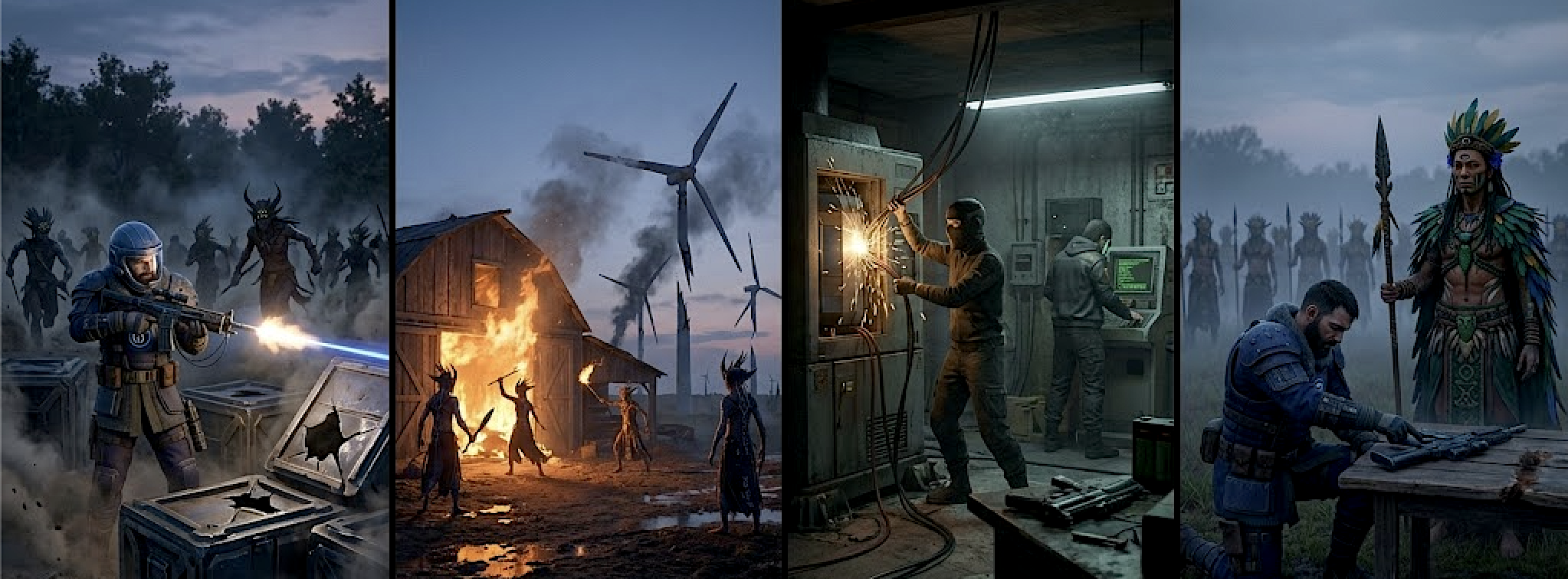
The Native Alliance launched a coordinated attack on the three exohuman settlements in the Habitual Belt, deploying 30,000 warriors. Despite being outnumbered, exohuman settlements were defended by GAIA’s automated defense systems, Laser Guns, and Laser Cannons, salvaged from the Last Frontier. Additional support came from hunting weapons produced by the Forge of Atrana, such as the Windstrike Rifle and Ironstrike Slingshot, and improvised weapons crafted from spaceship components.
The Exohumans repelled the attack, killing 5,000 Native warriors at the cost of 500 defenders. This disproportionate loss deeply impacted the morale of the Alliance but set the stage for a protracted conflict.
2. Guerilla Warfare and Resource Raids (2629–2630):
As direct assaults proved too costly, the Native Alliance transitioned to hit-and-run tactics, striking at settler vulnerabilities rather than engaging in open combat. Exohuman supply lines and food production became primary targets, as Native forces raided farms in the Asari Region, worsening food shortages and disrupting agricultural expansion. Simultaneously, wind farms in the Atrana Mountain Region were sabotaged, further limiting Exohuman energy production and increasing reliance on finite Quantum Fusion Batteries (QFBs).
To exacerbate settler hardships, Native warriors targeted water infrastructure, sabotaging wells and reservoirs, making daily life in Exohuman settlements increasingly unsustainable. Mining operations, particularly the Copper Mine of Firetown, were also attacked, crippling Exohuman industry by disrupting the supply of critical materials like copper — essential for power systems and technological development. By January 2630, the cumulative effect of these strikes led to widespread famine across Exohuman settlements, significantly weakening their war effort.
3. Stalemate and Anti-War Movement (2630–2631):
By 2630, the war had devolved into a brutal stalemate. Exohumans had fortified their settlements, relying on automated defenses and laser weapons, while the Native Alliance continued to apply pressure through raids, sabotage, and attrition tactics. However, it was not just the Native Alliance that threatened Exohuman war efforts—internal divisions within Exohuman society played a decisive role in the final collapse.
As casualties mounted and settlement conditions deteriorated, a faction of settlers known as the Anti-War Movement gained traction. This group, opposed to the continued escalation of war, believed that surrender was the only viable path to survival. On March 31, 2631, members of the Anti-War Movement executed a coordinated sabotage operation targeting the Quantum Fusion Battery (QFB) charging infrastructure, effectively rendering Exohuman energy-based weapons useless.
Instead of destroying the QFBs themselves, the saboteurs disabled the charging infrastructure, ensuring that no more batteries could be replenished. Their actions included:
- Tampering with QFB recalibration stations, corrupting energy flow regulators and preventing quantum stabilization.
- Disrupting power inputs to charging hubs, cutting off access to solar, wind, and geothermal energy sources.
- Disabling mobile QFB chargers, ambushing fuel-based power units used for frontline military operations.
- Hacking into GAIA’s monitoring system, falsifying energy readings to make QFBs appear charged until they unexpectedly failed in battle.
With no means to recharge their energy-based weaponry, the Volunteer Army of Man (VAM) rapidly collapsed. Guarding Troopers, who had relied on laser cannons and automated defenses, were left defenseless against Native ambushes. Panic spread across the Exohuman settlements as food shortages, exhaustion, and the failure of their technological superiority made continued resistance impossible.
On April 8, 2631, just seven days after the sabotage, the Volunteer Army of Man unconditionally surrendered to the Alliance of Native Tribes, marking the official end of the Great War and the beginning of the Gamma Age.
Key Participants
1. Volunteer Army of Man (VAM):
Composition:
- Guarding Troopers: 250 highly trained personnel who formed the elite unit of the VAM. Originally the security force aboard the Last Frontier, they were equipped with advanced weaponry and operated as the backbone of exohuman defenses during the Great War.
- People’s Army: 24,000 improvised soldiers, comprising settlers of fighting age who volunteered en masse following the war's outbreak.
Armament:
- High-Tech Weapons: Laser Guns and Laser Cannons, salvaged from the Last Frontier, these weapons provided overwhelming firepower and psychological advantage during the early stages of the war. Primarily wielded by the Guarding Troopers.
- Hunting Weapons: Windstrike Rifles and Ironstrike Slingshots, crafted by the Forge of Atrana, were effective and reliable tools for long-range combat and guerrilla engagements.
- Improvised Weapons: Created from spaceship scrap, such as slingshots with iron balls and makeshift firearms, these weapons embodied the ingenuity of the People’s Army but lacked the precision and durability of high-tech alternatives.
Role:
- Guarding Troopers: Served as the vanguard of exohuman military operations, defending settlements and leading high-risk counter-offensives. They were directed by the AI GAIA, ensuring strategic deployment and resource optimization.
- People’s Army: Focused on supporting operations with their sheer numbers, leveraging the adaptability of their weaponry and employing guerrilla tactics.
2. Alliance of Native Tribes:
Composition and Purpose:
The Alliance of Native Tribes was a coalition formed during the Great War, uniting the six tribes of the Eastern Equatorial Section of VOI 700 D's Habitual Belt. Spearheaded by the Honga, the largest and most nomadic tribe, this unprecedented alliance sought to defend Native land and traditions against exohuman encroachment. The coalition's creation marked the first large-scale collaboration of Native Tribes outside of their annual Lakira Shime ceremony.
Formation of the Alliance:
The alliance was a direct response to exohuman activities, such as deforestation and resource extraction, which violated sacred Native traditions and lands. The Honga initiated the alliance, calling leaders from neighboring tribes for a council. When their ultimatum to halt these activities was ignored, they mobilized a combined force of 100,000 warriors, drawing strength from the Honga (50,000), Trando (30,000), Senti (15,000), and Orlanda (5,000).
Armament and Strategy:
The Native Alliance relied on their natural abilities and traditional weaponry:
- Weapons: Bows, venom-coated spears, and advanced traps utilizing their environmental mastery.
- Tactics: Guerilla warfare and strategic ambushes, exploiting their superior knowledge of the terrain to outmaneuver the technologically advanced but numerically inferior exohumans.
Casualties
- Exohuman Losses: 9,000 (23% of the population)
- Native Losses: 36,000 (36% of their mobilized warriors)
While Native losses were numerically higher, the Exohumans suffered far more significantly in proportion to their total population. The war claimed nearly one-third of all exohumans on VOI 700 D, a devastating blow from which they continue to struggle to recover in the Gamma Age.
Legacy
The Great War remains the most divisive event in exohuman history.
1. Societal Divisions:
- Individualists: Reject the surrender, claiming the VAM was never militarily defeated and blaming the Anti-War Movement for sabotaging exohuman survival. They argue that the exohumans' true defeat was self-inflicted, not imposed by the Native Tribes.
- Communards: Defend the surrender, citing the unsustainable casualties and the threat of total extinction. They advocate for a collaborative future where exohumans integrate as “one tribe among many” on VOI 700 D, respecting Native traditions and ecological balance.
2. Political Impact:
The war led to the dissolution of the Free State of Settlers and the establishment of the Federal Confederation, a governance system prioritizing cooperation and sustainability. The Peace Treaty imposed strict restrictions on exohuman expansion and technology, further polarizing society.
3. Cultural Memory:
Weapons like the Windstrike Rifle and Ironstrike Slingshot, originally crafted for survival, now symbolize both ingenuity and the tragedy of war. The Forge of Atrana, once a beacon of adaptability, is viewed by some as a pillar of resilience and by others as a harbinger of destruction.
Tactical Advice for Dungeon Masters
The Great War provides a gritty, high-stakes setting for Beta Age campaigns, as well as opportunities for flashbacks, ancestral missions, or mystery arcs set in the Gamma Age. It allows Dungeon Masters to explore large-scale conflict, sabotage, shifting alliances, and the moral cost of survival on a hostile planet.
1. Missions During the Great War:
- Espionage: Task players with infiltrating Native camps or sabotaging exohuman supply lines.
- Moral Dilemmas: Explore the ethics of warfare by involving players in controversial missions, such as the Burning of Trando Cabins or anti-war sabotage.
2. Missions After the Great War:
- War Crime Investigations: Investigate the actions of exohuman leaders or Native factions during the conflict.
- Rebuilding Trust: Task players with brokering peace between exohuman survivors and Native Tribes.