
This is an old revision of the document!
Table of Contents
Races | Economy | Buildings & Organizations
FIRETOWN GARBAGE COLLECTION COOP (FGCC)
Overview
- Location: Industrial Ring, Firetown
- Address: SW Industrial Ring Road 1
- Surroundings: Adjacent to Firetown Tool & Machine Works
Founded in December 2628, almost two years after Firetown’s official establishment, the Firetown Garbage Collection Coop (FGCC) emerged from an official call by the Contact Person of Firetown to organize waste management for the fast-growing settlement.
Rumors swirled that the Trade Guild of New Kourou intended to seize the contract, which would have expanded its influence into Firetown. In response, a coalition of local interests — Entertainment District hosts and mongers from the Firetown Market — under the leadership of Tina Bonanno (founder of the Dark Side Hotel and infamous mastermind of the Cartel Network) — established the Coop. The FGCC won the call, though persistent whispers claimed bribery and blackmail of the decision board secured the victory.
The FGCC’s official purpose was straightforward: collect Firetown’s refuse and burn it weekly in the molten lava flows of the Ralar Volcano. Unofficially, however, the Coop doubled as the Cartel Network’s clean-up crew — erasing evidence, disposing of bodies, and vanishing incriminating documents in the same fiery abyss as common trash.
The FGCC was disbanded in 2631 after the rise of Communardism and the establishment of the Federal Confederation. Nationalization brought the waste sector under the Federal Allotment Agency, replacing the FGCC with the Federal Garbage Collection Center and the Federal Organic Waste Recycling Plant in Firetown.
Architectural Significance
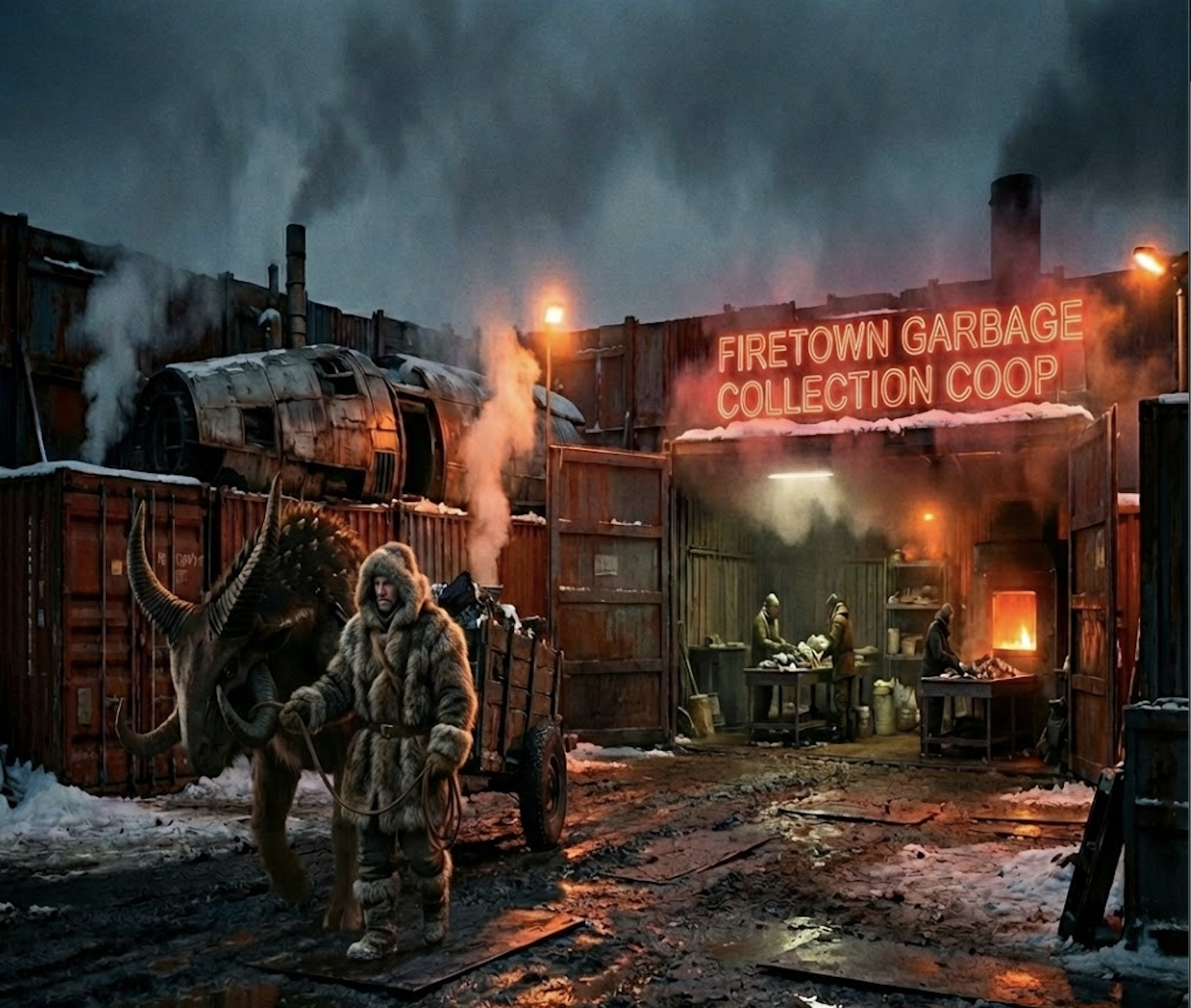
- Construction Material: Volcanic stones, corrugated hull-plating sheds salvaged from Last Frontier cargo containers.
- Floors: Single storey depot with an attached carriage shed.
- Design Aesthetic: Utilitarian frontier style — soot-blackened walls, roof vents spewing acrid smoke, open yard stacked with refuse piles.
- Geothermal Feed Vents: Insulated steel stacks and vent assemblies integrated into the rear façade, channeling heat and hot water from the Geothermal Power Plant to maintain interior temperature
- Air Vents / Heat Recovery Ventilator: The building's air exchange was managed by a centralized, mechanical ventilation system with a central intake on the exterior of the building.
- Power Supply: Quantum Fusion Battery
Building Structure
Perimeter
- Fence: 2 m stony palisade reinforced with scrap iron; one wagon gate.
Depot Hall
- Sorting Yard: Covered area where employees unloaded carts, refuse separated into combustibles, recyclables, and “special consignments.”
- Incinerator Pit: Lava-stone funnel where interim burning took place before weekly volcano runs.
- Carriage Shed: Housing for five to seven Hoos and their refuse carts, with feeding troughs and hay storage.
- Office Shack: desk, coop registry, and bribe-fund lockbox.
- Break Corner: Rough benches, water barrel, dice board for staff
- Restrooms (2): Simple genderneutral cubicles equipped with AuroraSan units for basic hygiene.
Look and Feel
The FGCC site reeked of rot and ash. Black smoke clung to the depot rafters. Hoos stamped nervously in their stalls, the air thick with dung and scorched metal. Trash-Tonis, faces smudged with soot, dragged sacks from doorsteps to carriages, their laughter often masking darker duties. Visitors sensed an unsettling mix of honest labor and criminal undercurrent — a place where waste and secrets alike vanished without a trace.
Roles and Responsibilities
- Coop Director (1): Alfonso Bonanno, only son of Tina Bonanno — managed contracts, bribes, and Cartel operations.
- Clerk (1): Received customer requests, arranged collection schedules, logged complaints, and acted as contact point for “special” arrangements.
- Trash-Tonis (≈10): Paired teams of collectors; each drove a Hoo-drawn cart, responsible for both refuse and clandestine “specials.”
- Sorters (≈6): Stationed in the Sorting Yard; sifted through refuse for reusable materials, resellable goods, or valuables discarded during Firetown’s long nights (e.g. jewelry, wallets). Reusable scrap was sold on to factories across the Free State of Settlers.
- Stablemaster (1): Maintained Hoos and wagons.
- Bookkeeper (1): Kept false ledgers to cover cartel dealings.
Public Access, Operating Hours and Operational Rhythm
- Access: Locals could contract FGCC for household or commercial refuse; “special requests” were arranged through Cartel channels.
Schedule:
- Collections: Twice weekly in Firetown’s inner rings.
- Special Pick-ups: By call
- Volcano Disposal: Every 7th day
Services and “Products”
| Service | Official Purpose | Hidden Function | Avg. Fee | Note for DMs |
| Regular Refuse Collection | Household & market waste removal | Cartel surveillance of client households | 10 K | Tonis overhear secrets while collecting waste. |
| Commercial Disposal | Bulk refuse from saloons & hotels | Transport of smuggled goods in refuse sacks | 20 K | Double use: cover-up of contraband shipments. |
| Special Removal | Hazardous/biological waste | Disposal of bodies, evidence, or sensitive papers | 200–X K | Perfect hook for mystery or crime campaigns. |
Security Measures
- Cartel Guards: Plain-clothed thugs from the Entertainment District occasionally watched the yard.
- Bribed Watchmen: Certain Local Guarding Troopers were paid to “look the other way.”
- Low-Tech Secrecy: No formal alarm systems — discretion relied on fear and cartel reputation.
Player Interaction Possibilities (Legal and Illegal)
Legal interactions:
- Arrange a routine household or shop refuse collection.
- Pay extra for a same-day pick-up after a tavern brawl or large market day.
- Negotiate a disposal contract for a business in the Entertainment District.
Illegal interactions:
- Blackmail a Trash-Toni who knows too much about “special disposals.”
- Intercept a volcano run carrying sensitive evidence.
- Infiltrate the yard to discover cartel ties to Firetown’s power brokers.
Garbage Carriages of the FGCC
The garbage carriages of the Firetown Garbage Collection Coop were a distinctive feature of Firetown’s inner rings. Each carriage was a two-wheeled wooden wagon, reinforced with scrap metal plates and fitted with iron hoops to bear the weight of rotting waste.
Design Features:
- Drawn by Hoos: Each carriage was pulled by one or two Hoos, harnessed in pairs for heavier loads and longer routes through Firetown’s tight streets.
- Appearance: Carriages were painted in ash-black, their outlines broken by the flicker of side-mounted torches, which illuminated alleys and doorways as the Trash-Tonis entered houses to collect waste.
- Iron-rimmed Wheels: Designed to endure cobbled and uneven terrain, the heavy rims produced a deep, grinding echo that residents quickly associated with the Coop’s approach.
- Side Hooks and Racks: Allowed sacks, crates, and barrels of refuse to be hung from the sides when the main bin was overloaded.
- Trophy Roofline: The Trash-Tonis often tied curious or valuable-looking finds from the trash to the carriage roofs — dangling bottles, dented helmets, torn banners, or even broken instruments. These grisly trophies swayed and clattered as the carts rolled on, a morbid decoration that turned each collection run into a moving spectacle.
- Copper Cart Bell: Each carriage carried a mounted copper bell that the Trash-Tonis struck at every street corner, its sharp clang mingling with the grinding wheels to create their infamous signature sound.
The Signature Sound:
Locals dubbed the FGCC’s employees “Trash-Tonis” not only for their grim work, but also for the haunting jingle-grind of carriage wheels and bells that echoed through Firetown. The sound of iron rims scraping cobblestones, mixed with the sharp clang of the copper cart bell, became an unsettling herald: it signaled not just the collection of waste, but also the vanishing of secrets, debts, and sometimes people. In Firetown, this sound evoked a mix of resignation and unease:
- Innkeepers and tavern hosts would gather refuse sacks at their doors, waiting to escort the Trash-Tonis inside for collection.
- Market mongers paused their work to hand over crates of spoiled produce or broken wares.
- Ordinary residents treated the bell with indifference tinged with dread — it was both a public service and a reminder that secrets, debts, or even people could vanish into the carts, never to return.