
This is an old revision of the document!
Table of Contents
Races | Culture | Buildings & Institutions
LAST FRONTIER UNIVERSITY (LFU)
Overview
- Last Address: SW Educational Ring Road 1, New Kourou (Educational Ring)
- Operational Period in the Beta Age: 2625–2629
- Remark: Provisional campus built from Last Frontier wreckage; destroyed by fire during the Great War (2629). Successor: Danah Wanah University.
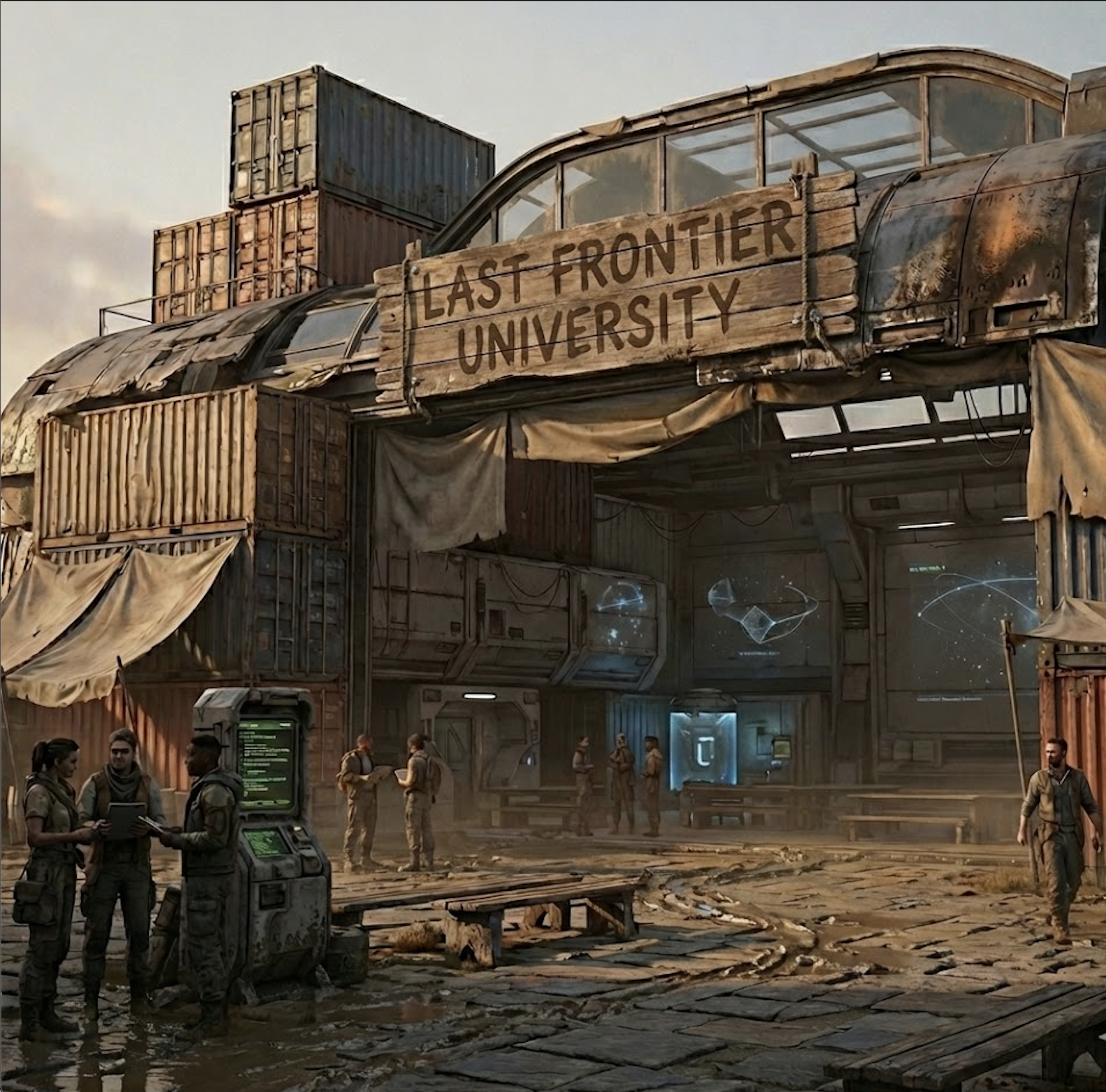
The Last Frontier University (LFU) was the first academic institution for ExoHumans — originating aboard the multigenerational ship Last Frontier(2421–2625) and rapidly reconstructed on the surface after the crash. Set in the Educational Ring of New Kourou, LFU became the intellectual heart of the early Free State of Settlers, teaching frontier sciences, engineering, agriculture, and political theory.
In 2629, during the opening months of the Great War, the campus was consumed by fire.
History
- Shipboard Operations (Alpha Age, 2421–2625): ~1,200 students/year trained in Earth sciences, ship systems, medicine, engineering, and colonial governance using GAIA tutoring, AR/VR sims, and modular labs across Last Frontier.
- Planetfall Transition (2625): After crash-landing, LFU established a provisional campus in New Kourou’s Educational Ring built from salvaged alloys and mycelium-brick; instruction pivoted from GAIA-heavy to faculty-led due to energy scarcity.
- Survey Years (2625–2627): From a Field Depot, LFU mounted university expeditions focused on the Asari Region (Habitual Belt habitat and surrounds), with extended surveys into the bordering Ralar Region (Dark Side margin) and the Tijonara Region (Desert Side dunes/arroyos). A few sorties probed more distant zones before rising conflict curtailed exploration.
- Restriction & Decline (2627–2629): Escalating tensions and rationing limited fieldwork to maintenance corridors; effort shifted to archiving and teaching.
- Destruction (2629): Campus burned during the Great War, ending LFU’s Beta Age chapter.
Architectural Significance
- Materials: Weathered cargo containers from the Last Frontier, welded into multi-purpose “learning pods”; patched canopies; improvised timber scaffolding; recycled shuttle-glass for skylight strips.
- Design Purpose: A fast-assembled, open-air academic complex centered around a large roofed courtyard where containers formed the walls of classrooms, labs, and archives.
LFU did not resemble a traditional university. Instead, it looked like a frontier knowledge outpost: an open-front hangar roof stretched above stacked containers, fabric canopies shielding lecture areas, and glass strips cut from shuttle canopies admitting diffuse twilight. Everything was built out of necessity, ingenuity, and the desire to salvage learning from chaos.
Building Structure (2625–2629)
Ground Level – Teaching & Research Courtyard
- Open Lecture Bays (A & B): Large open-air teaching zones under the main hangar roof. Containers served as rear storage and equipment walls, while the front remained open to accommodate large student groups. Flickering holo-projector mounts were fixed to overhead beams.
- Hydroponics Lab Pod: A converted container fitted with troughs of Zelor Grain and Mirel Leaf.
- Culture Bioreactor Pod: Two stacked containers housing bio-print scaffolds, stem-cell vats, and soft-glow indicator rings. Access restricted via hatch-locks.
- Reference Library Pod: A two-container unit with shelves of GAIA data-slates, printed books, and scrolls. Shuttle-glass clerestory panels filtered in soft twilight for reading.
- Public Loo: Six unisex restrooms featuring the AuroraSan System.
Upper Containers – Administration & Archives (Stacked containers formed a functional second tier, accessed via exterior staircases and reinforced catwalks).
- Dean’s Office: A compact workspace with a shuttle-alloy desk and a large wall map of VOI 700 D’s known terrain.
- Faculty Pods (3): Small offices for professors.
- Archive Loft: Contained parchment scrolls, transcribed lecture notes, early law-drafts, and a secure holo-crystal safe storing GAIA’s educational modules.
Exterior Grounds
- Assembly Courtyard: Flagstone circle at the campus front, where public lectures, academy announcements, and open debates were held.
- Student Gathering Area: Benches and crate-tables arranged beneath cloth canopies, used for group work and lively cross-disciplinary arguments.
Look and Feel
Before its destruction, LFU radiated the raw optimism of early New Kourou. The entire campus was open to the twilight sky. Students gathered beneath the patched hangar roof as holo-projectors cast drifting constellations and planetary diagrams across container walls scarred from the crash. The scent of warm metal, nutrient-infused hydroponics, and ozone from bioreactors mingled in the air. Scholars crossed the courtyard clutching data-slates, while the distant hum of Courier Drones echoed above.
It felt improvised but alive — a place where the last remnants of starship culture were reforged into a learning community on alien soil.
Fields of Study & Programs (Beta Age)
Core Faculties (Shipboard → Planetfall):
- Biology; Environmental Science; Geography; Physics & Geology
- Mechanical Engineering; Civil Engineering & Architecture; Medicine
- Law & Governance; Social Sciences & Psychology; Navigation & Systems (shipboard focus; later retired at planetfall)
Awards:
- Bachelor (3 yrs): Faculty-led after planetfall.
- Master / Specialist Tracks: Limited after planetfall; prioritized applied needs (engineering, medicine, agriculture).
- Research Units: Expeditionary surveys (2625–2627); then desk synthesis, archiving, and teaching.
Expeditions & Research Operations (2625–2627)
| Program / Unit | What Enters | Primary Handling | Outputs | Mandated Destination / Use |
| University Expeditions | Teams, kits, corridor permits | Habitat mapping in Asari; Dark Side edge transects in Ralar; dune/arroyo traverses in Tijonara; limited long-range reconnaissance | Route charts, biota catalogs, site reports, risk advisories | Settlement siting, maintenance-corridor guidance |
| Ship-Era Knowledge Transfer | Digital plates, curricula | Print & teach; low-energy lab analogs | Course readers, lab manuals | Campus instruction |
| Planetfall Practicums | Apprentices & juniors | Workshops, Medical Stations, plant rotations | Applied skills, placement logs | Industrial Ring & civic works |
*(Exploration beyond maintenance corridors ceased as conflict escalated.)*
Roles & Responsibilities (Planetfall)
- University Dean (1): Governance, salvage allocation, civic liaison.
- Faculty Leads (8–10): Block stewardship, curriculum, field supervision.
- Professors & Lecturers (≈24): Teaching, lab oversight, archive curation.
- Archivists (3–4): Catalog micro-plates, journals, expedition records.
- Field Wardens (4): Corridor permits, kit checks, risk ledgers (active chiefly 2625–2627).
- Operations & Maintenance (8–10): Workshops, lamps, water, repairs.
- Registry & Bursary (3): Admissions, timetables, supply ledgers.
Public Access & Operating Rhythm
- Public Lectures: Weekly talks in the Main Lecture Hall (space permitting).
- Teaching Blocks: 08:00–12:00 lectures; 13:00–17:00 labs/practica; evenings for colloquia.
- Archives Reading Room: Permit access; supervised hand-crank copying.
Security Measures (Planetfall)
- Perimeter: 3 m alloy fence around quad and Field Depot.
- Restricted Access: Archives/labs by analog key
- Regular Patrols: Regular patrols by the Guarding Troopers along New Kourou's Educational Ring
Tactical Advice for Dungeon Masters
- Hook — Ashes of Asari: In LFU’s ruins, a half-charred expedition map surfaces—marking an unreported spur in Asari with marginalia on Ralar anomalies and a Tijonara dune crossing. Who hid it, and why was it never filed? Audit ledgers, question aging faculty, and trace surviving corridor markers; the truth may recast early planetfall history — and someone is ready to kill to keep it buried …
Related Pages and Further Information
- Danah Wanah University (successor, Gamma Age)
Schools within the Free State of Settlers
- Funkenberg School (Private School)