Table of Contents
Major Planetary Zones
THE DESERT SIDE
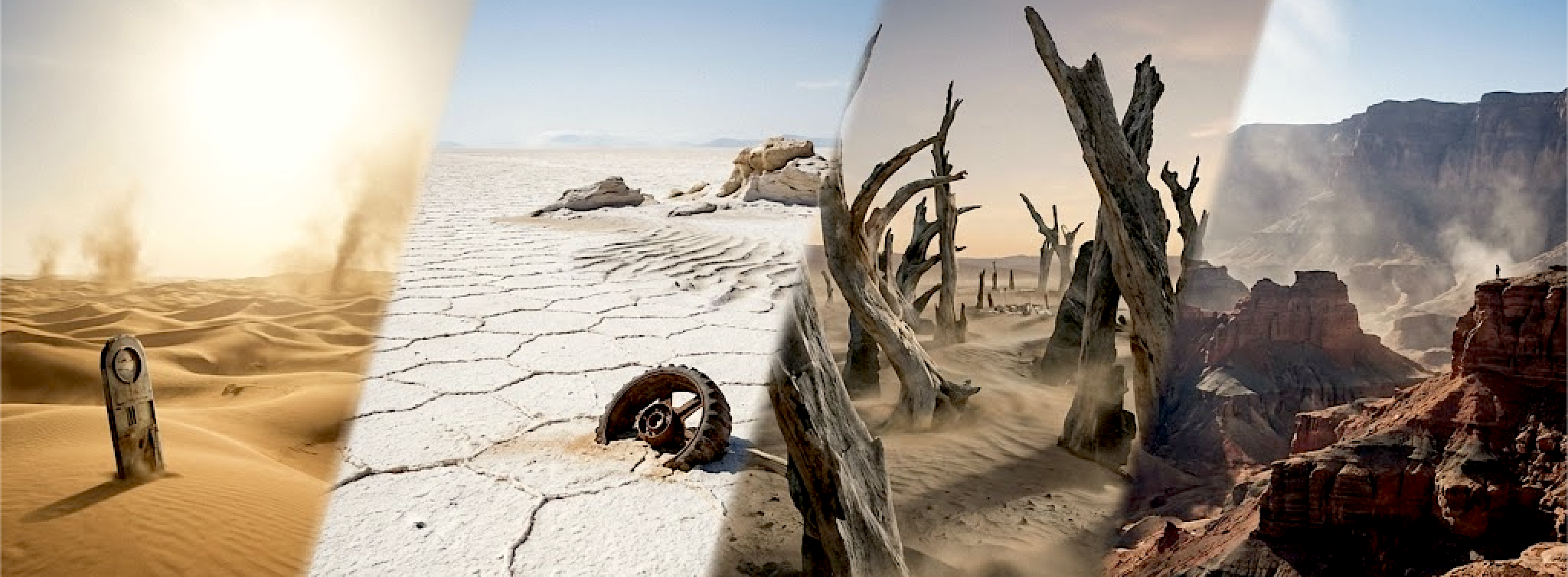
Overview
The Desert Side is one of the three Major Planetary Zones of the Planet VOI 700 D. It is located west of the Habitual Belt. Due to the planet's tidal lock, only the Desert Side faces the sun, while the Dark Side remains in eternal darkness.
The Desert Side has an area of approximately 72 million square kilometers, making it about 1.7 times the combined size of North and South America on Earth. It is the most extreme and inhospitable region of the planet.
Like the Dark Side, vast portions of the Desert Side remain unexplored. During the Beta Age, Exohuman expeditions primarily focused on the Habitual Belt in search of habitable zones and settlement opportunities. The Desert Side’s harsh climate and extreme conditions made large-scale exploration nearly impossible. In the Gamma Age, movement became even more restricted due to the Peace Treaty with the Alliance of Native Tribes, further limiting Exohuman access to the region.
Geological studies suggest that the Desert Side was once home to two separate continents divided by an ocean, which has since evaporated. This ancient sea left behind immense salt basins and fossilized terrain features—clues to a time when the Desert Side may have supported a more hospitable, hydrated environment.
To date, only the outer edges of the Desert Side — those closest to the Habitual Belt — have been examined. The most notable of these is the Tijonara Region, which borders the Asari Region of the Eastern Equatorial Section of the Habitual Belt. As Asari is the most thoroughly explored and densely inhabited area by Exohuman settlers, the neighboring Tijonara Region became the most accessible part of the Desert Side. It is also the only region within the Desert Side that was officially named by Exohuman explorers.
What lies beyond the salt flats and endless dunes remains a mystery. Unknown landscapes, undiscovered lifeforms, and forgotten ruins may yet lie buried beneath the scorching sands.
Climatic Conditions & Geography

The general temperature ranges from 40°C to 70°C, with the transitional zones near the Habitual Belt being slightly less extreme. Since the Desert Side is exposed to continuous solar radiation without atmospheric protection, conditions are extremely dry and hostile. Survival for most mammals is impossible without specialized adaptations or artificial protection. Vegetation is scarce, and water sources are nearly nonexistent due to high evaporation rates.
The Desert Side has a total length and width of approximately 21,200 kilometers. From south to north, it is composed of unknown regions and theoretical subzones, but unlike the Habitual Belt, it lacks formally recognized (Twin-)Sections. Its landscape consists primarily of:
- Shifting Sand Dunes – Vast expanses of wind-sculpted dunes that are constantly reshaped by scorching solar winds.
- Salt Flats and Evaporated Lakes – Dazzling white plains formed by the evaporation of ancient ocean basins and lake beds, rich in mineral deposits.
- Rocky Plateaus and Canyon Networks – Particularly in Tijonara, rocky steppes and winding canyons offer rare shade and microclimates.
The only exceptions to this barren environment are found in the transitional zones near the Habitual Belt. Here, temperatures are lower, and remnants of ancient forests — now completely petrified — still stand. These “fossilized forests” formed when plant material was rapidly mineralized under extreme conditions, preserving them as stone replicas of their original form.
The most well-known of these is the “Lea Gha Elashe” (Forest of the Dead), located in the Region Tijonara, south of the boundary line, on the eastern shore of Lake Arla. The Native Tribes of the bordering region Asari consider this forest sacred, believing it to be the resting place of their ancestors' spirits, where they can seek wisdom and guidance. This forest transitions into the “Gha Sol Shaol” (Gate of the Gods) mountain range, a towering formation that extends over 100 kilometers, serving as a natural barrier between the Habitual Belt and the Desert Side.
Known Regions of the Desert Side
- Tijonara Region – Located along the border with the Asari Region of the Habitual Belt, Tijonara is the only thoroughly explored region of the Desert Side. It is defined by its rocky plateaus, canyon systems, and the presence of Lake Arla — a rare desert oasis
Flora
The extreme environmental conditions of the Desert Side make plant life almost non-existent. However, in some isolated locations, extremophilic organisms have managed to survive:
- Endolithic Microorganisms – These life forms live within the mineral structure of petrified trees, using photosynthesis and extracting nutrients from minerals.
- Salt-Resilient Microbial Mats – Found in the dried salt lakes, these microbial colonies have adapted to extreme UV radiation and temperature fluctuations.
All known flora are extremophilic, surviving only by clinging to mineral substrates or salt-heavy environments.
Fauna
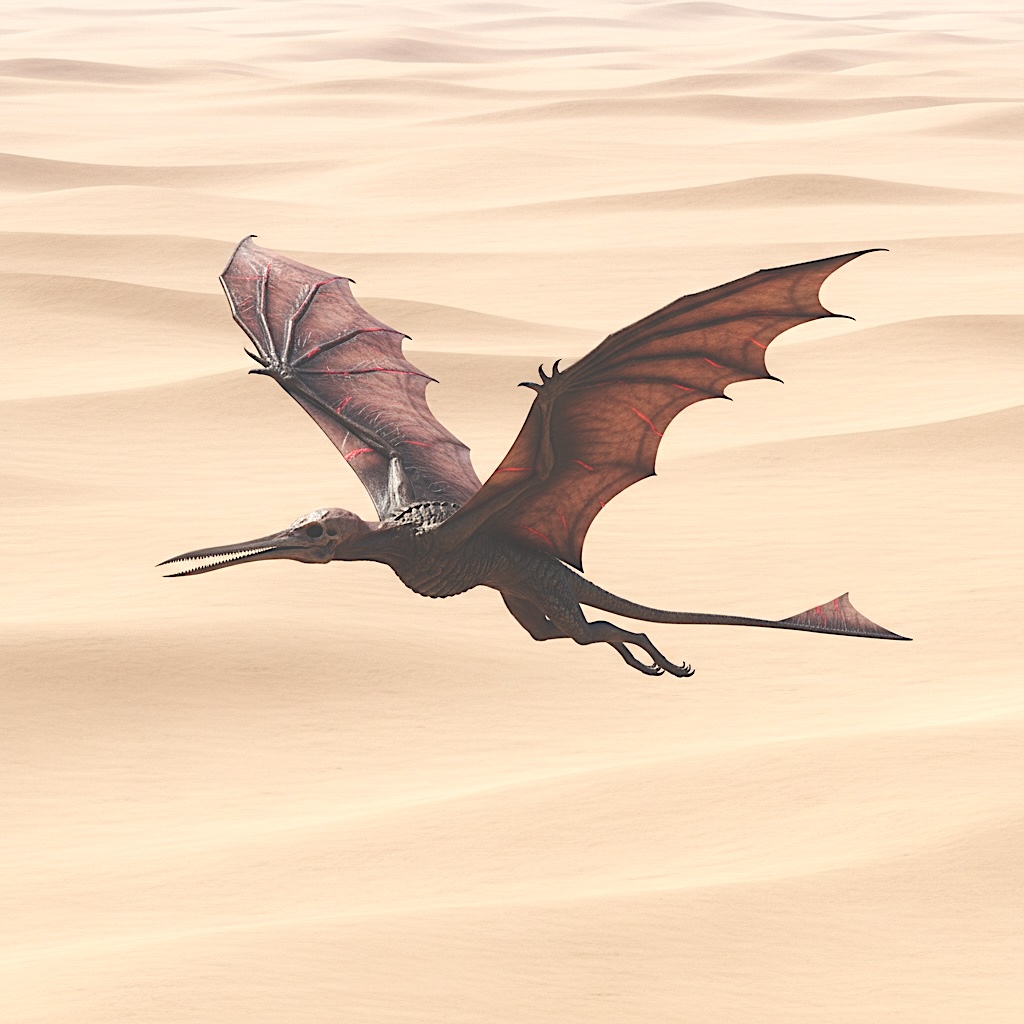
While most of the Desert Side is inhospitable to life, some regions support highly adapted creatures:
- Heat-Resistant Predators – Carnivorous creatures that have adapted to the extreme temperatures, capable of hunting prey that strays too far into the open desert.
- Burrowing Creatures – Species that spend most of their time beneath the sand, avoiding direct sunlight and using underground tunnels for shelter.
- Aerial Scavengers – Flying creatures that migrate between the Desert Side and the Habitual Belt, feeding on anything that succumbs to the harsh environment.
Native and Exohuman Population
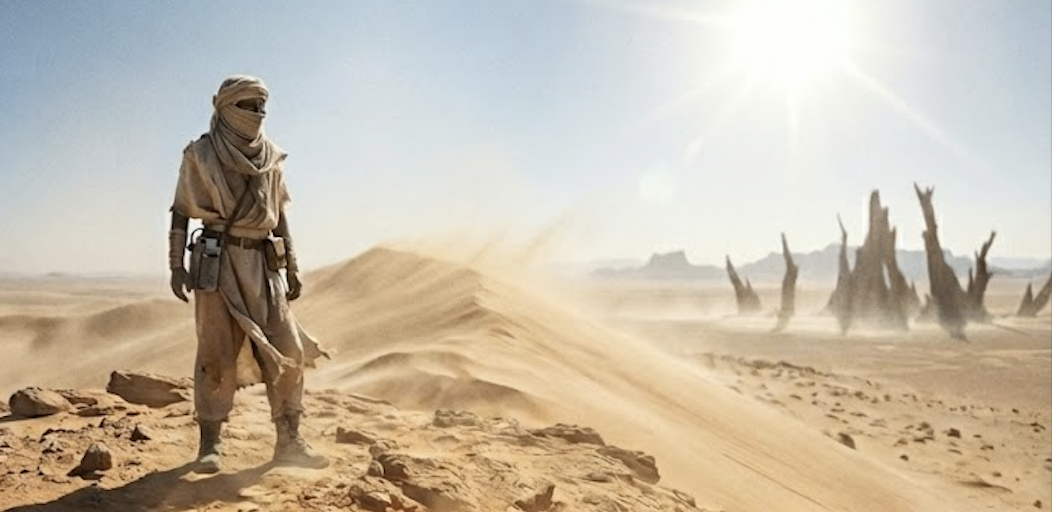
The Desert Side is largely uninhabited due to its extreme conditions. However, a small exohuman subculture has emerged within the Gamma Age:
- The Desert People – A renegade group of Exohumans who have abandoned civilization, choosing to survive in the harshest regions of VOI 700 D. They live in small, hidden enclaves and have developed techniques to endure the relentless heat.
No Native Tribes are known to inhabit the Desert Side, as even their hardened survival skills are not sufficient to thrive in such an extreme environment.
Tactical Advice for Dungeon Masters
The Desert Side is a brutal, unforgiving environment that challenges players to think creatively, act resourcefully, and survive against the odds. Its relentless heat, scarcity of water, and ever-shifting terrain make it ideal for high-risk, exploration-heavy campaigns centered around endurance, ingenuity, and the raw will to press forward.
Dungeon Masters can use the Tijonara Region as a narrative staging ground — a relatively accessible and partially mapped area that offers a foothold before players venture into the vast, undocumented interior. Its proximity to the well-settled Asari Region allows for supply routes, political intrigue, and early story arcs before the group sets out into the great unknown. Thematically, the Desert Side is a land defined by absence — of water, of shelter, of safety, of certainty. It provides fertile ground for stories about:
- Isolation and mental strain under the blazing sun
- Forbidden knowledge and relics of civilizations long buried beneath the dunes
- Moral ambiguity, where laws no longer apply and survival dictates choices
- Solar cults, mutated wildlife, or technologies altered by centuries of exposure
This region offers nearly unlimited narrative freedom due to its unexplored nature and extreme environmental conditions. The lack of verified maps or records allows Dungeon Masters to invent entire biomes, societies, and ancient sites without contradicting canon — as long as these inventions stay grounded in the technological and ecological limitations of VOI 700 D.
Beta Age (2625–2631) – The Era of Exploration and Survival
During the Beta Age, Exohuman settlers sent scouting expeditions to the Desert Side, hoping to find habitable zones. Their missions often ended in failure due to the extreme environment, but the discoveries they made shaped early Exohuman knowledge of the planet.
- “The Lost Caravan” – A merchant convoy attempted to cross a dried-out lake bed, but never arrived at its destination. Players must investigate whether they succumbed to the elements, fell victim to desert predators, or were attacked by the Desert People.
- “The Spirits of the Dead” – A Native priest has ventured into the Lea Gha Elashe (Forest of the Dead) to commune with the spirits of his ancestors. He has not returned. Players must decide whether to rescue him or let him fulfill his spiritual journey.
Gamma Age (starting 2631) – The Era of Forbidden Lands
By the Gamma Age, the Desert Side remains largely untouched. The Peace Treaty restricts Exohuman movement, and most settlement efforts have been abandoned. However, rumors of hidden treasures, lost Exohuman relics, and forbidden knowledge continue to draw adventurers.
- “The Sun-Chained Temple” – Explorers discover the ruins of an ancient structure buried beneath the shifting sands. Who built it, and what secrets does it hold?
- “The Hunger of the Borr” – Swarms of the aerial predator Borr are growing larger and more aggressive, threatening the outskirts of the Habitual Belt. The players must track their nesting sites and decide whether to exterminate them or find another solution.
Related Pages and Further Information:
Known Regions of the Dark Side: