
This is an old revision of the document!
Table of Contents
Races | Culture | Institutions | Buildings & Organizations
HEADQUARTERS OF THE NEW KOUROU ROBOTICS SYNDICATE (NKRS)
Overview
- Location: Industrial Ring, New Kourou
- Address: SE Industrial Ring Road 4
- Surroundings: Adjacent to the New Kourou Relay Station, the building was embedded within the logistics and manufacturing zone of the Industrial Ring.
The New Kourou Robotics Syndicate (NKRS) was founded in 2625, just months after Day Zero, by Dr. Elora Venn, a former robotics systems supervisor aboard the Last Frontier and a leading authority in adaptive machine learning. As one of the earliest post-crash institutions, NKRS played a vital role in the Exohuman recovery by salvaging, maintaining, and redistributing robotic labor capacity essential for survival in the harsh new world of VOI 700 D.
Unlike the independently governed Guarding Bots and Medical Bots, NKRS focused solely on civilian Service Bots — from agricultural field hands and cargo lifters to domestic and maintenance assistants. To ensure fair and reliable access to these limited resources, NKRS implemented a subscription-based rental and repair system, controlling distribution and securing dominance over the critical Quantum Fusion Batteries (QFBs) required to power the bots.
The facility combined repair services, warehousing, bot testing, and rental operations under one roof, making it the single most important robotics hub in the Free State of Settlers during the Beta Age until it was officially shut down in 2631, when the Federal Confederation nationalized the Syndicate following the Peace Treaty and banned the use of Service Bots across VOI 700 D.
The main facility was decommissioned. Only the Spare Parts Warehouse remains in limited use, maintained by the Federal Health Care System (FHCS) for the servicing of regulated Medical Bots.
Architectural Significance
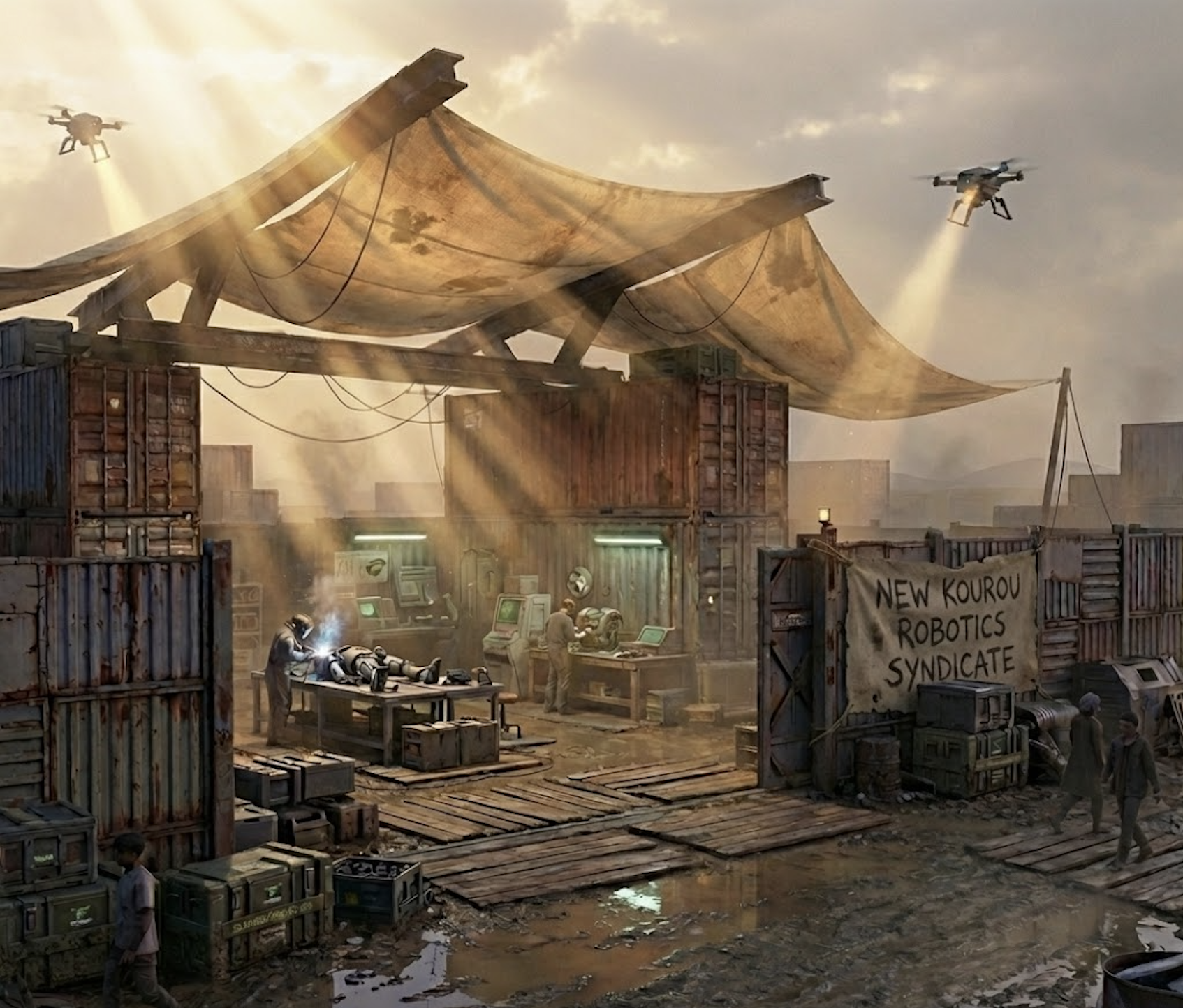
- Construction Material: Weathered cargo containers, reinforced techframe alloy, canopy rigging salvaged from the Last Frontier’s emergency tarp systems.
- Floors: Ground-level camp layout with container stacks (1–2 levels), plus open working areas.
- Design Purpose: Rapid, modular assembly to restart automated labor as quickly as possible; prioritised open access, tool mobility, and ventilation.
The headquarters resembled a frontier workshop more than a conventional building: open, noisy, improvised, and constantly in motion under a massive cloth canopy.
Building Structure
Perimeter
- Container-Skin Fence: A 3-meter defensive perimeter made from welded vertical cargo-container panels, patched with scrap alloy.
- Main Gate: Reinforced sliding plate with a Guarding Bot checkpoint.
- Central Robotics Yard (Open-Air) The heart of the facility: a broad, open construction yard sheltered by a huge beige canopy stretched over steel posts and stacked containers. Features include:welding tables and diagnostic rigs, disassembled Service Bots, limbs, sensor arrays, QFB loading racks and cable clusters, tool benches and parts crates, repair pits and crawler tracks
This is where the majority of mechanical work occurred.
Container Offices & Workshops
Weathered containers repurposed into:
- Rental Counter: Public-facing window where settlers applied for bot rentals or maintenance packages.
- Parts Depot: Shelves, bins, and drawers filled with salvaged bot components.
- Dr. Elora Venn’s Workshop: Adaptive machine-learning lab built inside two joined containers with cut windows and improvised insulation.
- Operations Office: Paper logs, scheduling boards, and bot tracking ledgers.
- Charging Control Cabin: Oversees load balancing for charging rails.
- Charging Corridor: A partial-roofed lane of charging cradles—green indicators blinking—where Service Bots cycled through restoration and diagnostics.
Warehouse Extension
A fenced-off container block used for:
- Inactive Bot Storage: Units awaiting repair or reassignment.
- QFB Vault: Reinforced chamber with passive cooling and electromagnetic shielding for battery reserves.
Outdoor Test Field
- obstacle tracks
- dirt terrain patches
- lifting and navigation rigs
- calibration posts
Used to verify limb articulation, traction, and power draw before bots were returned to settlers.
Look and Feel
The NKRS headquarters felt like a strange mix between a machine graveyard and a factory of hope. Grease stains, ozone discharge, and the scent of solder hung in the air. Everywhere, bots stood in varying states of repair — some twitching with new firmware, others missing limbs or eye sensors. Blue sparks occasionally flashed behind safety glass as engineers worked through endless repair lists.
Despite its utilitarian layout, the headquarters held a sense of calm precision. Settlers waited patiently in line, hopeful for the support of a working Service Bot that might ease their burdens, till their fields, or help raise their children.
Roles and Responsibilities
- Dr. Elora Venn (Founder and Technical Director): Oversaw strategic direction, research into machine learning, and access to high-priority Service Bots.
- QFB Technicians (4): Specialized in handling, charging, and distributing Quantum Fusion Batteries with strict safety protocols.
- Repair Engineers (8): Responsible for bot diagnostics, physical repair, firmware updates, and parts fabrication.
- Rental Clerks (3): Managed public interface, subscription processing, and usage logs.
- Logistics Coordinators (2): Oversaw stock rotation, test schedules, and transport to remote settlements.
- Bot Test Supervisors (2): Operated the Outdoor Test Field and ensured each bot met safety and performance standards before redeployment.
Public Access, Operating Hours and Operational Rhythm
Public Access: Only the Rental Counter and Demonstration Kiosk on the ground floor were open to settlers. All other areas required staff clearance.
Operating Hours:
- Repair Services: 7 am – 7 pm, Monday through Saturday
- Rental Services: 9 am – 5 pm, daily
- Test Field Operations: 10 am – 4 pm, weather permitting
Operational Rhythm: Mornings were dominated by diagnostics and QFB recharging, afternoons by testing and deployment. Repair shifts rotated to cover emergencies, particularly during harvest and construction seasons.
Security Measures
- Guarding Bot Patrols: Two Guarding Bots patrolled the QFB Vault and warehouse extension.They were armed with Guarding Troopers Stun Guns.
- QFB Vault Protection: Vault access required triple authentication (biometric, access card, and daily rotating code).
- Inventory and Tracking System: All Service Bots were tagged with chips and programmed to shut down if removed from authorized zones.
- Dr. Venn’s Lab Lockdown Protocol: Automatically sealed the second-floor lab during unauthorized access attempts.
Player Interaction Possibilities (Legal and Illegal)
Legal Interactions:
- Rent or return a Service Bot for agricultural or domestic use
- Escort a bot transport convoy to a distant settlement
- Assist engineers with high-priority repairs for a critical mission
- Request a bot customization for a specific task (e.g. mine surveying)
- Take part in a public testing demonstration or competition
Illegal Interactions:
- Attempt to steal or black-market a QFB
- Hack into bot firmware to bypass rental restrictions
- Infiltrate Dr. Venn’s lab to extract forbidden machine learning data
- Smuggle a Service Bot into unauthorized territory for off-grid usage
- Disrupt the test field to sabotage a competitor’s deployment
Tactical Advice for Dungeon Masters
The NKRS HQ is a goldmine for bot-related storylines — from cyber sabotage to technology smuggling, ethical dilemmas over automation, or full-on battery heists. Possible hooks include:
- A rogue Service Bot goes missing, and the players must trace its QFB signature across the Industrial Ring.
- Dr. Venn asks the players to deliver an experimental AI chip to a frontier settlement, discreetly.
- A rebel group infiltrates the NKRS to repurpose bots for non-civic missions — the players must decide to help or stop them.
Related Pages and Further Information
Further information about the respective Service Bot-models: