
This is an old revision of the document!
Table of Contents
102 Pen and Paper Adventure | Beta Age | Hunting an Unknown Hunter
SCENE 5 — FOLLOW THE ERRAND RUNNER
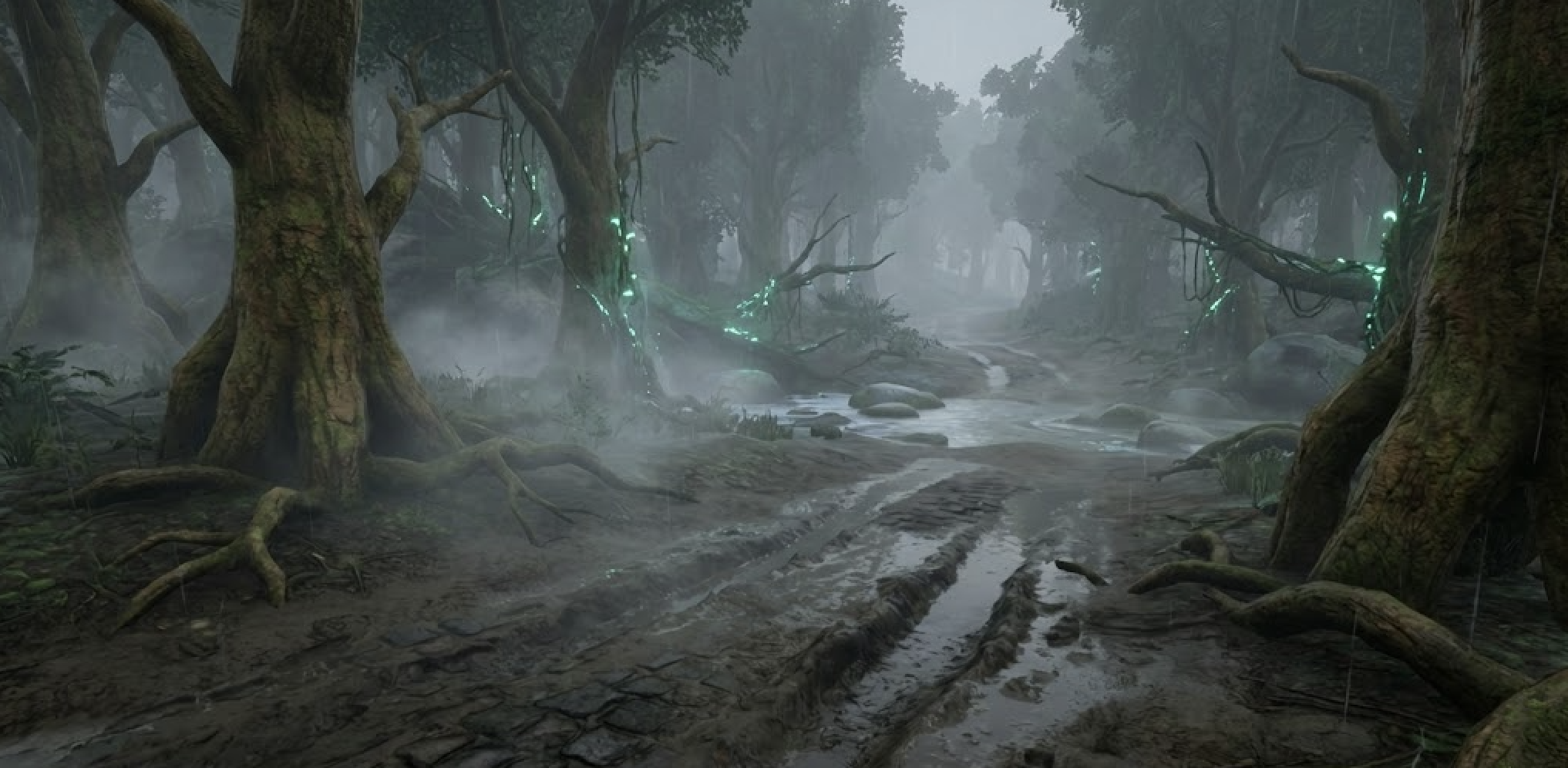
1 | Scene Overview
- Location: From Morningstar to the lower slopes of the Atrana Mountains, Habitual Belt side, near the upper reaches of the Arla River
- Distance: Approximately 10 km by the shifting forest route
- Type: Pursuit · Environmental Hazard · Escalating Tension · Transition
- Era: Beta Age
- Tone: Fading civilization · tightening wilderness · unseen danger · hunter’s ground
Atmosphere & Sensory Cues: Persistent mist · humid tropical air · soft rainfall · mud sucking at boots and wheels · chainsaw noise fading into forest silence · bioluminescent vines faintly glowing under canopy · distant animal calls · the sense of being watched
2 | Read-Aloud Descriptions
Initial Read-Aloud (Scene Opening)
Beyond Morningstar’s Maingate, the world does not end all at once — it thins.
At first, the road is still paved beneath you, dark stone slick with moisture, cutting straight north between walls of forest. Barkroot trees crowd close on either side, their thick roots pushing up through the soil like knotted fingers, but the settlement hasn’t quite let go yet.
Behind you, the Fogwood Sawmill is still audible. Chainsaws whine and bite, metal teeth screaming against timber. The sound is distant, muted by mist, but steady.
Then, step by step, it fades.
The paving breaks apart into packed earth and mud. The forest closes ranks. Humid air clings to skin and fabric, warm and heavy, carrying the smell of wet leaves, resin, and slow-moving water. Mist drifts between trunks and low branches, softening distance and swallowing detail.
This is not a new frontier. This is what lies beyond it.
Staged Read-Aloud (Scene Threshold)
| Trigger / Timing | Read-Aloud / Narrative Insert |
| The PCs notice the hidden route markers | At first, the signs appear unrelated. A vine tied around a low branch. Three stones stacked beside an exposed root. A shallow cut in the bark of a Barkroot tree. Farther ahead, the Errand Runner slows only briefly before changing direction. The markers do not form a visible path. Each one merely points toward the next. |
| PCs reach the edge of J.W.’s property | The forest changes without warning. Ahead, half-swallowed by mist and foliage, a wooden wall rises between the trees — rough timbers sunk deep into the ground, reinforced with scavenged metal plates and wire. It stands nearly three meters high, cutting cleanly across the forest floor. Set into the wall is a heavy timber gate, closed. Off to one side, a weathered wooden post leans at an angle. A faded sign is nailed to it: NO TRESPASSING – PRIVATE PROPERTY. Above the sign, hanging from iron hooks, is the skull of a Moar — massive, yellowed, its teeth still intact. Whatever rules applied behind you no longer reach this place. You are no longer following someone. You have arrived. |
This Read Aloud marks the ending of this scene. If the PCs arrive freely and unrestrained, proceed to Scene 6a — In the Realm of the Hunter. If the PCs arrive captured, bound, or escorted under force, proceed to Scene 6b — As a Prisoner in the Realm of the Hunter.
3 | Scene Intent
| Scene Type | Player Intents | DM Function / Story Link |
| Pursuit & Escalation | Track the errand runner · choose pace and method · avoid traps · decide how far to commit | Establishes this as the hunter’s territory. Tests player caution, mobility choices, and awareness. Leads directly into Scene 6a or Scene 6b, depending on how the PCs enter the Hunter’s domain |
4 | Key (N)PCs + Environmental Actors
| Name / Role | Motivation / Function | Dynamic Cues — How They React in Play | Wiki Link |
| Mustafa “Mu” Metzger | Errand Runner · Hunter’s Hand | Maintains steady pace. Yellow rain coat remains visible at distance. If he notices pursuit, he does not flee — he prepares the ground. | Mustafa Metzger |
| Hunter’s Trappers (×4) | Territory control · capture · enforcement | Their appearance is unsettling. Pale, bluish skin reflecting faintly from luminescent safety wiring woven into their gear. Large, light-sensitive pupils remain permanently dilated, rarely blinking. Their bodies are shortened and hunched, movements economical and quiet — more crawl than stride. They speak little, relying on hand signals and short clicks. To PCs familiar with earlier events, they may resemble the Man Without a Name. These trappers are Blues — hidden passengers from the Last Frontier. They prefer stun weapons, restraints, and silent takedowns. | The Blues |
| Hunter’s Hands (×5) | Armed interception · intimidation · enforcement | Also Blues — but equipped differently. Heavier clothing, reinforced harnesses, visible firearms and melee weapons. Their movements are disciplined, synchronized, and confident. They issue clear surrender commands and act without hesitation. | The Blues |
| Manla | Grazing · flight response | Herds scatter noisily when startled, crashing through undergrowth and mud. Their panic can mask other movement — or announce the PCs’ presence far ahead. | Manla |
| Moar | Apex predator · dominance | Investigates prolonged noise, injury, blood, or immobilized prey. Does not rush. If a Moar is near, the forest grows unnaturally quiet first. | Moar |
5 | Triggers, Clues & Consequences
Phase 1 — The Hunt Path
| Trigger / Cue | Immediate Reaction | Clue / Consequence |
| Follow on foot | Distance slowly increases. The Errand Runner's yellow coat flickers in and out of the fog. | Mechanic: Requires repeated WIS (Survival) or WIS (Perception) probes (DC 13, increasing over time). Failure risks losing the trail entirely. |
| Follow using the Mortician’s Cart | Terrain betrays them. The heavy cart struggles in mud and roots, making noise. | Consequence: The errand runner notices pursuit. He silently reports it via Shortwave Device to nearby Hands. Escalates immediately into a coordinated interception (Phase 2b). |
| Follow on mounts (Veyras) | Pace is easily matched, keeping the target in sight. | Mechanic: Requires repeated DEX (Animal Handling) or WIS (Survival) probes (DC 12). Failure alerts the errand runner despite the distance, causing him to prepare traps ahead. |
| Errand Runner becomes aware of pursuit | Behavior does not change. He does not flee or accelerate. | Consequence: He radios ahead, selects terrain, and allows the PCs to continue — knowingly. Escalates to Interception (Phase 2b). |
| PCs watch how the Errand Runner chooses his route | Mu does not follow a permanent path. At irregular intervals, he briefly checks branches, roots, tree trunks, or patches of disturbed ground before changing direction. | Mechanic: A WIS (Perception), WIS (Survival), INT (Investigation), or relevant tracking probe (DC 13). Success: Read the staged description “The PCs notice the hidden route markers.” The PCs realize that Mu is following a sequence of temporary signs. |
| PCs examine one of the discovered markers | The sign is simple and easily overlooked: a knotted vine, stacked stones, cut bark, bent branch, strip of fabric, or concealed metal tag. | Clue: The marker does not reveal the destination. Its position or orientation indicates only the direction of the next sign. The route can therefore be changed without constructing a new trail. |
| PCs identify several markers in succession | The hidden sequence becomes easier to recognize. | Future probes to follow Mu gain Advantage or reduce their DC by 2. If the PCs later lose sight of him, they may continue by following the marker system. |
| PCs lose sight of Mu after discovering the marker system | The yellow raincoat disappears, but the last confirmed marker still indicates a direction. | The PCs may continue without seeing Mu. A WIS (Survival), INT (Investigation), or group tracking probe (DC 13) locates the next marker. Success keeps them on the hidden route; failure sends them toward Phase 2a or another dangerous detour. |
| PCs lose sight of Mu without discovering the marker system | The forest offers no obvious road and no continuous trail. | Recovering the pursuit requires WIS (Survival) DC 14. Success reveals disturbed mud, snapped vegetation, or another secondary trace. Failure leaves the PCs navigating blind and increases the likelihood of Phase 2a. |
| PCs remove, damage, or rearrange a marker | The hidden route becomes harder to retrace. Mu or J.W.’s Hands may later notice the interference. | Future route-finding probes suffer Disadvantage unless the PCs record or restore the marker. Discovering the tampering may alert J.W.’s Hands that someone is following the route. |
| PCs linger, stop, or tend injuries | The forest falls unnaturally silent. Ambient animal sounds fade. | Consequence: A Moar presence becomes imminent. Something large is moving closer. Leads to a Moar Encounter (Phase 2a). |
—
Phase 2 — Potential Escalation
Escalation 2a: PCs are caught in a Capture Trap
| Trigger / Cue | Immediate Reaction | Clue / Consequence | |
| PCs step into a trap (Lost Trail) | A concealed pit-and-net trap collapses beneath the lead PCs. A weighted net snaps shut. | Mechanic: PCs suffer 1d6 piercing damage from barbed hooks and are Immobilized. | |
| PCs try to free themselves | The trap resists violently. | Mechanic: Coordinated STR or DEX probes (DC 15). Each failed attempt causes 1d4 damage as barbs tear deeper. Noise increases the chance of being found. | |
| PCs fail to free themselves | After roughly two hours, two armed Trappers arrive to check the trap, expecting game. | Consequence: Finding the PCs, they use stun weapons, restrain them, confiscate equipment, and march them to their boss. Unlocks Scene 6b. | |
| PCs free themselves (Making noise) | The violent struggle echoes. The undergrowth shifts. | Consequence: A Moar is drawn to the disturbance. It attacks whoever appears weakest or most injured (Full Combat). | |
| PCs fight the Moar | Whether the PCs kill the Moar or merely survive, the noise attracts witnesses. | Consequence: Four armed Trappers emerge. They attempt to take the PCs hostage. If PCs submit, unlocks Scene 6b. | |
| PCs defeat the Trappers or Hands (unlikely) | The surviving opponents refuse to provide J.W.’s exact location willingly. Their equipment and recent tracks nevertheless reveal the same temporary marker system used by Mu. | Consequence: A successful interrogation, tracking, or investigation probe allows the PCs to identify the next marker and continue toward the compound. Unlocks the final Read-Aloud and proceeds to Scene 6a. |
Escalation 2b: PCs are noticed and intercepted
| Trigger / Cue | Immediate Reaction | Clue / Consequence |
| PCs are intercepted by Hunter's Hands | Five armed Hands emerge at a favorable choke point in the fog. The errand runner is present. | Consequence: Weapons are drawn. The PCs are ordered to surrender and disarm immediately. |
| PCs choose to surrender | Control is taken cleanly. The PCs are bound, searched, and stripped of weapons. | Consequence: They are marched through the forest toward J.W.’s property. Unlocks Scene 6b. |
| PCs choose to fight | The Hands and the errand runner have initiative, prepared positions, and superior numbers. | Mechanic: Firearms and melee weapons are used without hesitation. Once defeated, PCs are stunned, restrained, and dragged to the boss under visibly worse conditions. Unlocks Scene 6b. If the PCs somehow defeat the Hands against all odds, they can follow the remaining tracks or force a surviving Hand to show them the way, proceeding directly to Scene 6a. |
6 | DM Notes
- This scene is about pressure, not speed: From the moment the PCs leave Morningstar, the world closes around them. Civilization dissolves. Let the forest do the work: mud, mist, humidity, and silence are your primary tools.
- The Errand Runner is Bait: He never rushes or looks back in panic. If aware of pursuit, he radios ahead and maintains his pace, leading the PCs into a prepared situation. His yellow raincoat is meant to be seen, not caught.
- A Controlled Forest: Make it clear through description that the land is curated and watched. Traps appear where trails fail. Silence replaces birdsong. Even the route itself is controlled: temporary signs guide authorized travellers from one marker to the next while remaining almost invisible to outsiders.
- The “Roman Way” is discovered here, but not named: Attentive PCs may realize that Mu follows temporary markers rather than a permanent path. Let them understand and use the system, but do not call it the “Roman Way” in this scene. That name and its old-Earth explanation belong to Sagan in Scene 4a+2 — The Roman Way.
- The Blues: The Trappers and Hands move differently—avoiding light, moving with an economical crawl. Their appearance should remind the PCs of the *Man Without a Name*, raising unease and unanswered questions.
- Traps are Infrastructure: If players fall into a trap, frame it as inevitability, not punishment. Noise draws predators. Predators draw witnesses. Someone is always listening.
- The Moar: It is not there to balance an encounter; it is there to remind the players that they are small, loud, and bleeding in a place that eats such things.
- Clean Transitions: When Trappers or Hands take control (via surrender or defeat), keep it clean. Weapons are removed. Words are few. This is not cruelty; it is procedure.
- The Wall: Scene 5 converges at the wooden barrier. The gate, the sign, the Moar skull—these are statements. The players should understand they are no longer acting freely.
DM Tutorial: How to approach the scene
Related Pages and Further Information
- ↑↑ Start: Hunting An Unknown Hunter
- ★ Overview: All Scenes of Hunting An Unknown Hunter
- ☞ Resolution: Case Resolution and discoverable Backstory
- ← Previous Scene: Scene 4c Morningstar Food Market