
Table of Contents
Races | History | Lost Populations
THE BLUES – HIDDEN PASSENGERS OF THE LAST FRONTIER
Overview
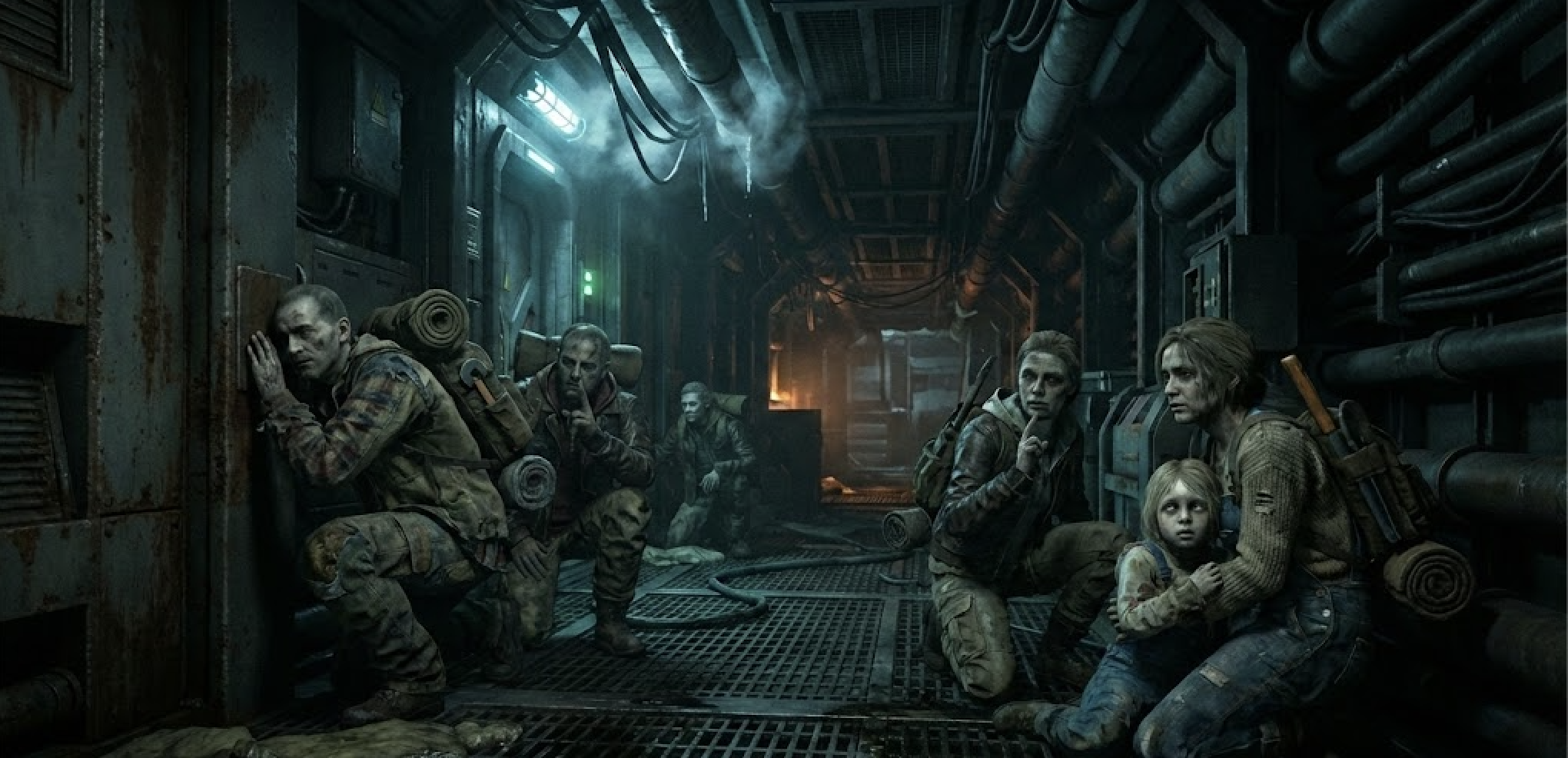
The Blues were an unregistered group of stowaways who secretly lived within the service decks of the Last Frontier during its 204-year voyage through space. Descended from roughly 25 original fugitives who bribed their way aboard prior to launch in 2421, the Blues survived four generations in the vessel’s maintenance strata — unseen, undocumented, and unacknowledged by both the GAIA AI system and the Starship Council.
By the time of the Crash Landing on VOI 700 D, their population had grown only slightly, numbering about 75 individuals, many of them weakened by malnutrition, poor air, and genetic degradation from generations of inbreeding and deprivation.
Location and Environment
The Blues moved constantly through the maintenance and disposal strata (Deck 29–34), an industrial labyrinth of ventilation tunnels, water conduits, and incinerator halls. They had no permanent settlement, choosing instead to live like migratory shadows — one step ahead of patrol drones and Guarding Troopers.
Typical hideouts included:
- Vent Shafts – narrow maintenance corridors whose heat signatures blended with surrounding systems.
- Recycling Gantries – scaffolds above waste-reclamation tanks used for temporary camps.
- Power Conduits – warm service ducts offering protection from cold-space radiation.
- Agricultural Deck Accessways – near hydroponic sections, ideal for stealing food at night.
To avoid detection, the Blues exploited GAIA’s sensor blind spots, staying close to heat and vibration sources that confused infrared and motion readings.
Description and Life Conditions
Life in the ship’s bowels was a constant struggle for survival. Each Blue carried a personal bed-roll, filter mask, and cloth satchel — all scavenged from discarded maintenance kits. When occupying a space, they followed strict rotations:
- Four sentinels on guard at all times to warn of approaching patrols.
- Pipe-tapping code: three knocks meant “move,” two meant “freeze.”
- Food raids: nighttime incursions to steal nutrient paste or algae blocks from returning service drones.
- Scavenging: copper wire, polymer mesh, insulation cloth, and old service tags used as tools and trade.
Despite their harsh existence, the Blues developed a remarkable sense of solidarity and caution. Children were taught to crawl silently through vents before they could walk, and adults communicated mostly through gestures and coded knocks.
Sociological Background — Why the Blues Remained Hidden
From a sociological perspective, the Blues’ centuries of concealment cannot be explained solely by the crime of their ancestors. Over time, secrecy became a learned behavior — passed down as a survival reflex and gradually woven into the fabric of their identity.
The first generation hid because they had to. They were fugitives, smugglers, or stowaways who had bribed their way onto the Last Frontier before its launch and knew that discovery meant arrest or death. Hiding was survival — a matter of instinct and caution.
For the second and third generations, however, concealment had become an unquestioned way of life. With no schools, no access to public education, and no written records, their entire worldview was formed through oral storytelling. Children grew up hearing cautionary tales about the “Light Mother” — GAIA’s all-seeing presence — and the “Metal Hands” of the Guarding Troopers who would come if one was careless. Over time, these warnings replaced civic instruction, and fear of punishment became the organizing principle of their society.
This produced what sociologists later described as a culture of adaptive invisibility — a community that survived by maintaining its own absence.
Their social order revolved around a few unspoken assumptions:
- Visibility was dangerous.
- Contact brought risk.
- Safety existed only in silence.
Lacking education, the Blues could not challenge these assumptions intellectually. Without teachers, books, or access to recorded history, they had no concept of rights, citizenship, or justice — only the inherited fear of what might happen if they were found. Even the few who dreamed of emerging into the “bright decks” above could not articulate their hope in a language that others would understand.
By the fourth generation, secrecy had ceased to be a choice. It was no longer about guilt or rebellion but about habit — a deeply internalized belief that invisibility was life itself. The Blues had become a sociological mirror of the Last Frontier’s forgotten spaces: human shadows shaped by fear, surviving quietly in the gaps between systems.
In their oral traditions, the registered passengers had turned into “the Others” — a hostile and untrustworthy people who would never accept them. To the Blues, the world above was no longer home, but enemy territory.
Physiology

Generations underground produced visible physical traits:
- Pale, bluish skin tone caused by reflection from luminescent safety wiring.
- Large, light-sensitive pupils permanently dilated for low-light vision.
- Chemical scarring around nostrils and lips from exposure to unfiltered vents.
- Shortened stature and hunched posture from crawling through narrow maintenance shafts.
Their distinct appearance later gave rise to their unofficial name — “The Blues.”
Culture and Beliefs
Separated from the controlled and educated society of the registered passengers, the Blues evolved their own micro-culture — a fragile but distinct system of language, rituals, and beliefs shaped entirely by fear, scarcity, and longing. With no written language or formal leadership, every part of their culture existed in oral form, transmitted from parent to child in whispers between the humming pipes of the Last Frontier.
- Language (The Franco-Shipyard Dialect): Because roughly 70% of the first generation of stowaways spoke French as a first or second language, the grammatical backbone and core vocabulary of the Blues is a heavily degraded, whispered French. Over generations, it condensed into a clipped, urgent dialect built for the mechanical dark.
- English Loanwords & Signage Mythology: They also incorporated English words, but because these were lifted directly from the ship's maintenance signage or fleeting encounters with the “Others,” the meanings drifted dramatically. To the Blues, these are not just directions; they are abstract concepts. For example, the phrase “Upper Deck” does not mean a physical location to them — it means the concept of assimilation or becoming an “Other.”
- Beliefs and Myths: GAIA — the ship’s governing AI — transformed in their lore into Mère-Lumière (The Light Mother), a mysterious being who “breathes for all decks” and decides who is allowed to live in the light. To the Blues, GAIA’s sensors were eyes, and the ventilation system her voice. Children were warned never to cry near vents, “lest Mère-Lumière hear.”
- Rituals: Before resting, they hummed deep, low-frequency tones to merge their breathing with the ship’s mechanical resonance — a practice believed to “keep Mère-Lumière asleep.” During movement or scavenging, rhythmic tapping was used to signal allies through bulkheads. These patterns — simple three-beat or five-beat sequences — later became their form of coded language, the Under-Knock.
- The Culinary Memory of “Life” and “Luck”: Their traditional survival rations carry names born from a tragic, centuries-old encounter. Long ago, a sympathetic registered passenger secretly provided leftovers from the ship's kitchens. Handing them scraps, he would mutter in Common, “You have luck that I have such a helper syndrome.” When offering broth, he would say, “This does not improve your life, but it tastes like a better life.” After he died, the new generations preserved his words as sacred terminology, applying them to the crude meals they had to invent to survive:
- “Life”: Originally their word for soup, it evolved into a thick, heavily salted green stew made from stolen algae blocks.
- “Luck”: Originally their word for stew, it became the designation for hardened, irregular blocks of synthetic nutrient-scraps salvaged from the ship's disposal chutes just before the composting cycle.
- Dream of the Surface: Among their most enduring legends was the Jour de la Surface (Day of the Surface), the moment they would finally walk under a true sun, free from GAIA’s light and the labyrinth of steel. This myth gave meaning to generations who had never seen the sky — it was both prophecy and psychological escape, a promise that suffering in the dark had purpose.
- Social Bonds: Without written law or family registries, the Blues organized themselves through kin-by-necessity — small clusters of three to five individuals who shared food, guarded one another while sleeping, and adopted orphaned children as “warmlings.” Emotional ties replaced institutions; betrayal was rare but unforgivable.
Together, these customs formed a culture of quiet resilience — one that sought neither conquest nor recognition. To the Blues, existence itself was resistance: a life preserved in secrecy, beyond the reach of the light.
Relations with Registered Passengers
Although most passengers were unaware of their existence, some acts of quiet compassion occurred throughout the centuries of travel. Certain medics, or service engineers secretly left food rations near recycling gates or dropped old maintenance tools into waste chutes, knowing they would be recovered, Such gestures were risky — aiding unregistered passengers was a criminal act under the Starship Code — yet these brief exchanges of humanity likely kept the Blues from extinction.
Naming System — Numbers Instead of Names
The Blues did not use personal names in the conventional sense. Instead, they identified themselves by numbers — a system born out of necessity rather than ideology.
When the first stowaways realized they were trapped aboard the Last Frontier without any chance of archiving legal status, they created a simple method to keep track of their own existence. Each individual was assigned a number once the group agreed on a total headcount. These numbers were not ranks or titles. They were markers of presence. The underlying purpose was pragmatic: the Blues always needed to know how many of them still lived.
When someone died, their number did not disappear. It was passed on — usually to a newborn child, or to the next individual formally acknowledged by the group. If no number was immediately available, the next highest number was assigned until balance was restored. Over generations, this practice ensured continuity even as individuals vanished.
As time passed, the original meaning eroded. Later generations no longer remembered why numbers had been chosen — only that they were who you were. A number carried no family name, no lineage, and no claim to history beyond survival. It stripped identity down to its most basic function: being counted. This system had subtle but lasting effects on Blue society:
- Identity was collective, not individual.
- Loss was measured numerically, not ceremonially.
- Memory persisted through continuity, not ancestry.
By the fourth generation, numbers were spoken the way names once were — softly, rarely, and only within the group. To outsiders, they would have sounded dehumanizing. To the Blues, they were proof that someone still existed. Even after the crash on VOI 700 D, surviving descendants of the Blues continued to use numerical names among themselves — a quiet remnant of a culture that had learned, over centuries, that survival depended on being remembered only by those who needed to remember you at all.
The Fire and the Fall
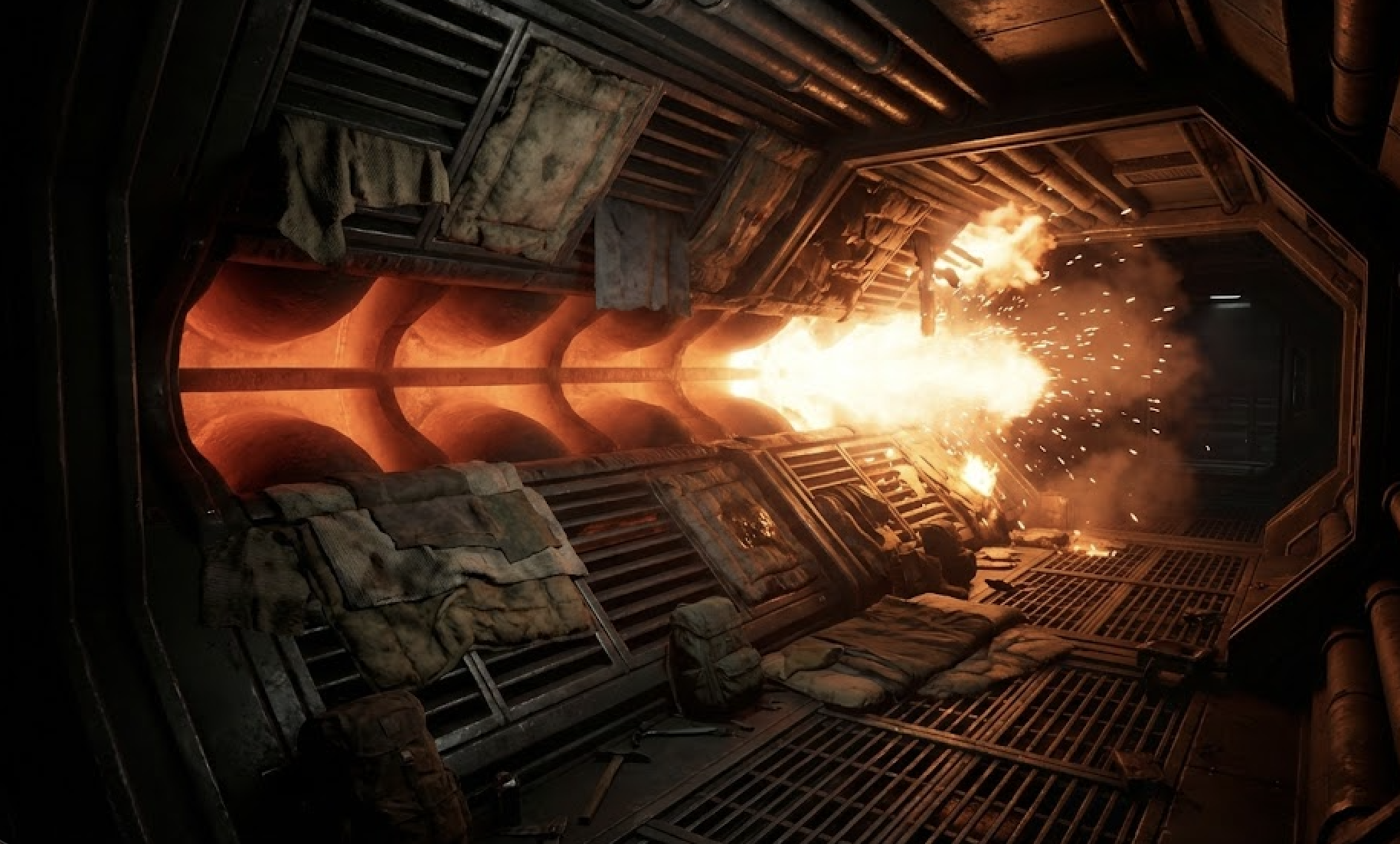
For generations, the Blues had lived in the freezing sub-zero temperatures of the unheated Maintenance Strata (Decks 29–34). Survival depended on heat. Over decades, they migrated toward the ship’s Thermal Exhaust Manifolds—massive ventilation shafts that, during deep-space cruising, emitted a steady, comforting warmth from the engine core.
To the Blues, these shafts meant life. They built their “nests” directly inside the service crawlspaces surrounding the vents. To keep the warmth from escaping, they practiced a habit known as Sealing the Lung. Using scavenged insulation, old clothing, and hardening resin, they meticulously plugged every gap, grate, and louver in their territory, trapping the heat inside their sleeping quarters.
For nearly two centuries, this primitive insulation caused no issues. The ship was coasting. Heat output was low. But on Day Zero, the Last Frontier initiated its atmospheric braking sequence. The main engines fired at maximum thrust—for the first time in over 200 years. The Thermal Exhaust Manifolds were designed to vent the sudden, massive buildup of plasma heat instantly. They couldn’t. The vents were choked with decades of accumulated debris, hardened resin, and nesting material.
Pressure inside the manifolds spiked within seconds. The blockage didn’t merely ignite; it caused a thermal backflow. Superheated plasma, unable to escape outward, burst backward into the ship’s hull. It melted through primary coolant lines and ignited the very nests the Blues were sleeping in.
The Blues died not because they sabotaged the ship, but because they had spent generations trying to make a cold machine feel like a warm home. They never understood that the “drafts” they were sealing were the ship’s only way to breathe.
Tactical Advice for Dungeon Masters
The Blues represent a haunting moral mystery rather than an outright villain faction. Use them to explore ethical tension — survival versus culpability, secrecy versus truth. Encounters with their remnants may involve:
- Interrogating a surviving descendant hiding in a settlement’s understructure.
- Following heat signatures through ruins that mirror the ship’s old architecture.
- Discovering remnants of Blue gear—patched masks, faded polymer fabric, or antique ship markings.
- Choosing whether to expose or protect their legacy when others seek revenge for Day Zero.