Table of Contents
Races | Technology | Buildings & Organizations
NEW KOUROU ROBOTICS SYNDICATE (NKRS)
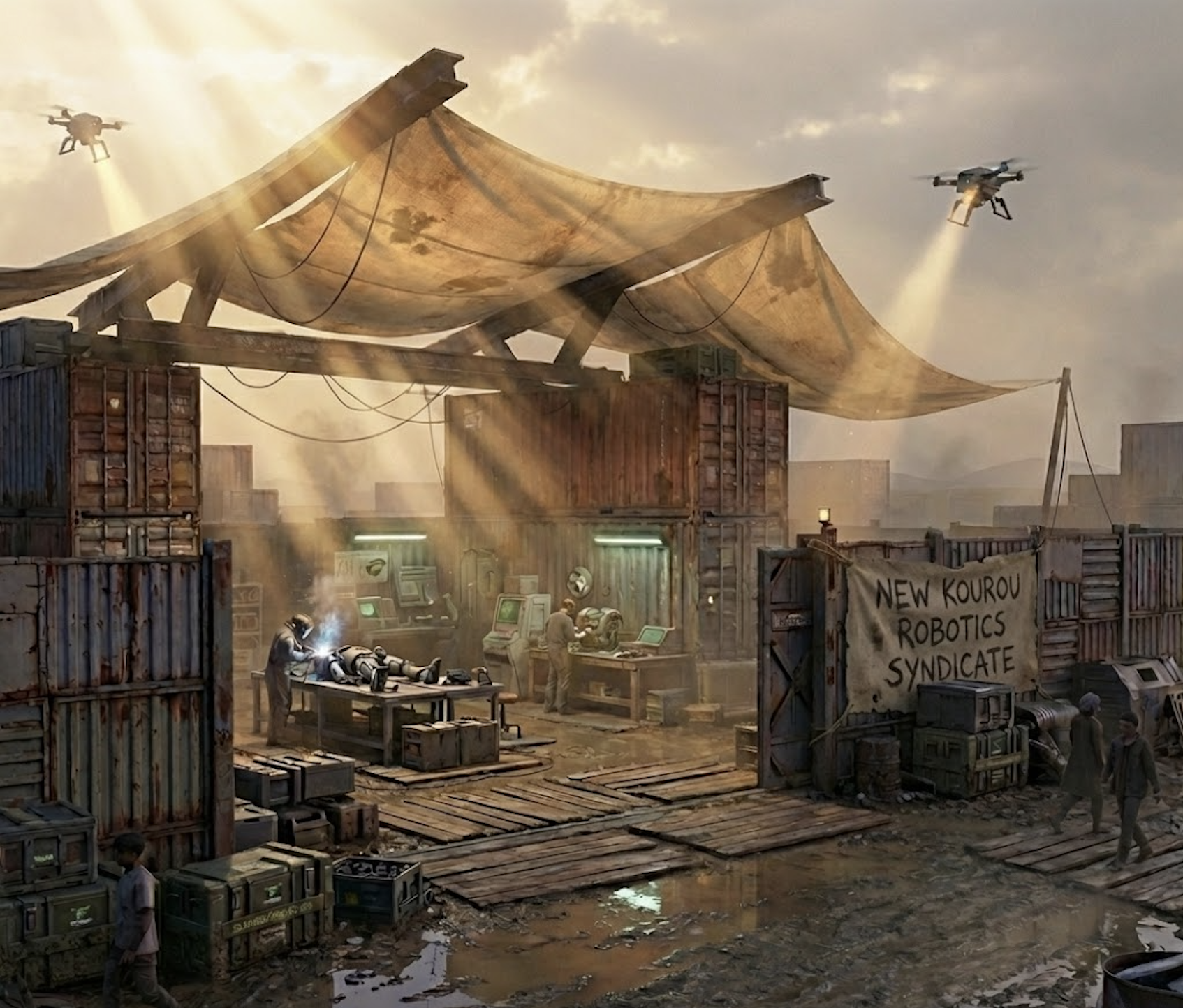
Overview
- Founding Year: 2625
- Founder: Dr. Elora Venn, a former robotics systems supervisor aboard the Last Frontier and a leading authority in adaptive machine learning for autonomous service units.
- Headquarters: Headquarters of the New Kourou Robotics Syndicate, New Kourou
- Original Purpose: To ensure continued access to Service Bots through repair, customization, and rental services under a subscription-based model, tailored to meet settlers’ post-crash needs.
The New Kourou Robotics Syndicate (NKRS) emerged in the immediate aftermath of the crash landing (Day Zero) as a critical institution for Exohuman survival and recovery. With most robotic units destroyed or damaged during the crash, NKRS was founded to restore, maintain, and manage the remaining Service Bots — including agricultural, manual labor, and domestic models. Unlike the military-focused Guarding Bots as well as Medical Bots, which were excluded from their purview, NKRS focused on essential civilian robotics.
By offering bots on a rental and maintenance basis, NKRS introduced a subscription-based system to ensure fair access to limited robotic resources while securing control over the highly sought - after Quantum Fusion Batteries (QFBs) required to power them.
History
Origins Aboard the Last Frontier
On the Last Frontier, Service Bots were a standard part of daily life — accessible to all passengers regardless of status. These bots supported manual labor, medical services, housekeeping, room service, and logistical management. The vast majority of physical tasks were handled by bots, freeing Exohumans to focus on education, science, and cultural development.
The Crash Landing and Survival Phase (2624–2625)
The crash devastated the bot fleet: Of the original 520 units, only 263 survived the impact and subsequent fires. These remaining Service Bots became essential tools in the settlers' early survival—used for shelter construction, resource extraction, basic farming, and emergency healthcare.
To stabilize recovery efforts, the newly formed Free State of Settlers declared the surviving Service Bots state property, recognizing them as critical infrastructure. However, the Free State, still in its infancy, lacked the administrative structure to oversee large-scale maintenance, distribution, and technical support.
To solve this, the Free State issued a special operational license to Dr. Elora Venn, allowing her to found the New Kourou Robotics Syndicate (NKRS) in late 2625. The NKRS was officially recognized as the exclusive service and distribution partner of the state for non-military or medical Service Bots.
Dr. Venn built her team by recruiting engineers, surviving AI technicians, and data recovery experts from the crash. Her organization took over maintenance, repair, and subscription-based distribution of Service Bots, ensuring settlers across VOI 700 D had continued access to robotic labor despite the post-crash limitations.
The Beta Age: Limited Supply and Strategic Control
As Exohumans lacked the capacity to manufacture new QFBs, the existing battery supply became a strategic resource. NKRS quickly monopolized access to QFBs for civilian bots, asserting control over distribution and replacement. This led to rising tensions between settlers, especially in fringe settlements who felt neglected.Settlers could only use Service Bots by subscribing to the NKRS, receiving scheduled maintenance, firmware updates, and limited usage quotas based on available energy.
NKRS constructed 100 additional Service Bots using salvaged ship components, repurposing scrap materials to meet planetary needs. These units were hardier, built to withstand planetary conditions such as mud, wind, and temperature fluctuation.
Despite limited resources, NKRS introduced a rotating distribution model — some farms and facilities would receive bot support on weekly cycles, ensuring that labor was spread across multiple settlements. However, disputes over energy allocation and service priority created a black market for bot power cells and off-grid repairs.
The Gamma Age: Ban and Underground Survival
With the formation of the Federal Confederation after the Great War, the use of Service Bots was officially banned under the terms of the Peace Treaty, which placed strict limits on energy consumption to ensure planetary sustainability.
- Nationalization and Shutdown: In 2631, the New Kourou Robotics Syndicate was nationalized by the Federal Confederation and dissolved. Its facilities, schematics, and bot inventory were absorbed into the newly formed Federal Allotment Agency.
- Legal Prohibition: Supreme Councilor Aisha Patel banned all Service Bots — with the sole exception of Medical Bots, which remain active under strict regulation within the Federal Health Care System (FHCS) at the Medical Station in New Kourou.
- Jane Mendoza Gang Heist (2633): In one of the most daring post-war raids, the Jane Mendoza Gang stormed the Federal Technical Recycling Plant, stealing the last remaining stockpile of government-owned Service Bots before they could be decommissioned.
- Black Market Demand: Since the ban, Service Bots have become prized assets in the black-market economy. Firetown in particular has seen a rise in illegal bot ownership, where these units are flaunted as symbols of status, rebellion, and self-sufficiency by radical Individualists and criminal organizations.
- Severe Penalties: Operating or even possessing a Service Bot in the Gamma Age is considered a major offense, with harsh penalties issued by the Federal Sheriff’s Office. However, the functionality and adaptability of these bots make them too valuable to vanish entirely.
Legacy and Impact
- Crisis Response Legacy: NKRS played a decisive role in preserving Exohuman civilization during its most vulnerable years, ensuring bots remained operational for medical care, food production, and construction.
- Technological Recycling Pioneer: By building an entirely new generation of Service Bots using salvaged materials, NKRS set the precedent for sustainable tech adaptation on VOI 700 D.
- Political Lightning Rod: NKRS’s control over QFBs made it both a strategic ally and a target of suspicion. Its nationalization in the Gamma Age reflects shifting attitudes toward tech monopolies in the post-war world.
- Outlaw Mythology: For Individualists and Outlaws, NKRS now symbolizes a lost era of human autonomy, with Dr. Venn often romanticized as a techno-liberator who enabled self-reliance before federal control took over.
- Cultural Echo: Despite the prohibition, old NKRS bots still operate in the shadows, appearing in outlaw safehouses, hidden settlements, and rogue farms—silent reminders of a time when machines served human needs, not just state mandates.
Tactical Advice for Dungeon Masters
- Bot Hunt: Players may be hired to recover a missing NKRS unit carrying critical agricultural AI algorithms lost in the jungle near Hope.
- Black Market Bots (Gamma Age): Players may encounter illegal bot technicians salvaging NKRS units for personal gain — or attempting to power them using unauthorized QFBs.
Related Pages and Further Information
Further information about the respective Service Bot-models: