Table of Contents
Races | Economy | Buildings & Organizations
MORNINGSTAR PRIMARY AND HIGH SCHOOL
Overview
- Location: Educational Ring, Morningstar
- Address: SE Educational Ring Road 1
- Surroundings: Close to the Residential Quarters
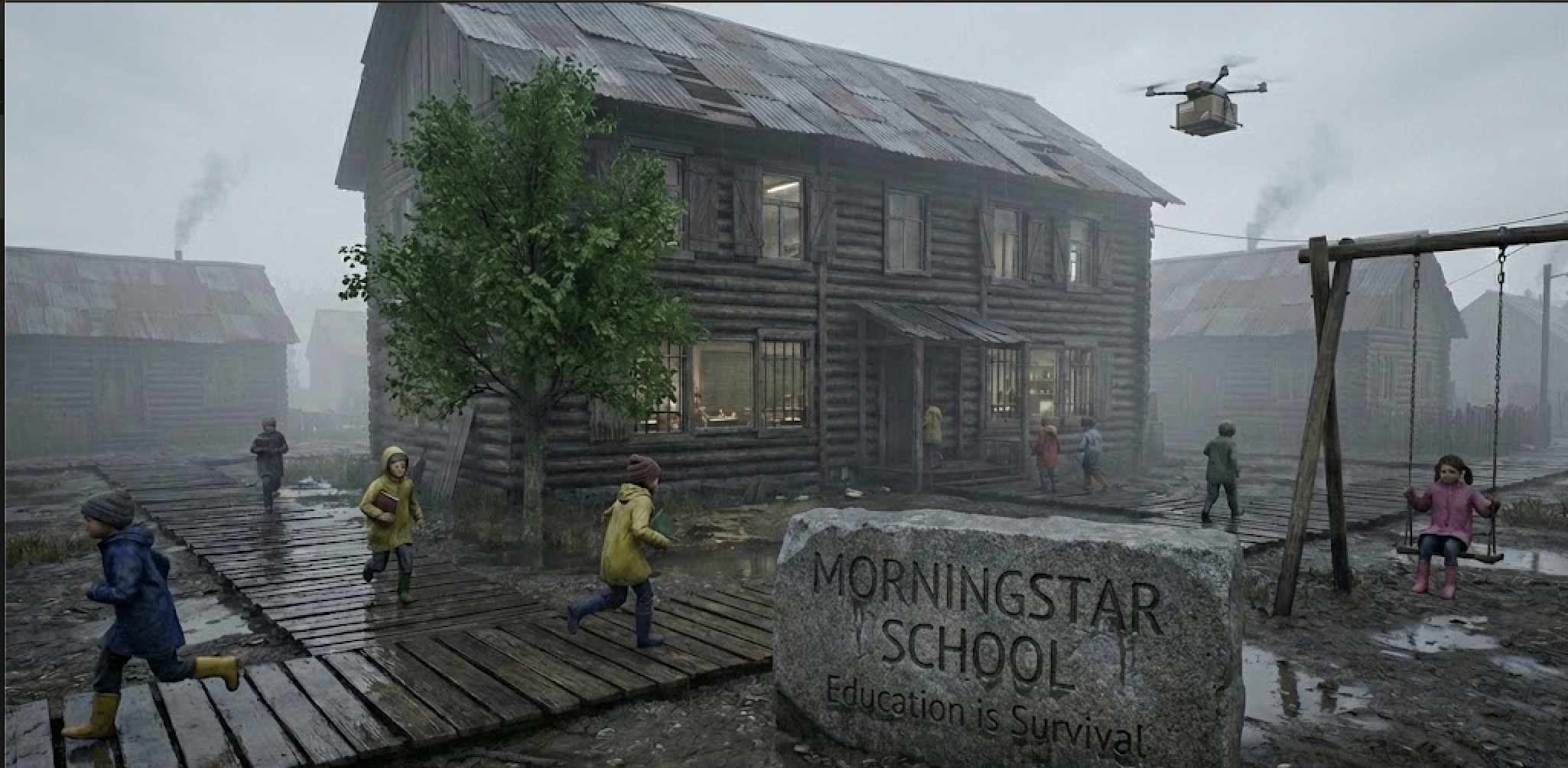
With approximately 240 students enrolled, the Morningstar Primary and High School was the sole educational institution in Morningstar (population ~3,000), serving Class 1 through Class 12 throughout the Beta Age. Due to energy shortages and post‑crash constraints, classes were consolidated: one teacher led all Class 1–5 students, another handled Classes 6–9, and a third covered Classes 10–12.
Curriculum adapted exohuman Alpha Age pedagogy to VOI 700 D realities — reflecting the necessity for a highly advanced civilization, post-crash, to return to fundamental survival and resource management skills. It blended traditional subjects with frontier culture, survival skills, and rudimentary hydro‑agriculture.
After the funding of the Federal Confederation and educational reforms under the supervision of the Alliance of Native Tribes in 2631, the school was replaced by the Morningstar Elementary School. Education for older pupils got centralized in New Kourou.
Architectural Significance
- Materials: Locally milled cerasteel‑reinforced wood, insulated polymer windows, recycled composite roof panels
- Floors: 2
- Design: Simple rectangular footprint with multipurpose hall; large windows for natural light to conserve power
- Energy Use: Minimal electrics — lighting via hand‑crank dynamos; heating from communal biomass stove
- Intent: Modular classrooms allow flexible partitioning; built for durability, low maintenance, and ease of repair by volunteer builders
Building Structure
Ground Floor – Lower Classes & Multipurpose
- Classroom A: Single room for Classes 1–5; communal tables and chalkboard
- Multipurpose Hall: Assembly, physical education, and community meetings; fold‑away benches
- Sanitation Block: Composting toilets and rainwater hand‑wash stations
- Teacher Lounge: Small kitchenette and workbench for lesson prep and grading
- Restrooms (5): Gender-neutral Restrooms, featuring the AuroraSan-System.
Second Floor – Upper Classes
- Classroom B: Dedicated space for Classes 6–9; integrated projector for holo‑lessons when power available
- Classroom C: Dedicated space for Classes 10–12; lab benches for basic chemistry and hydroponics experiments
- Library Nook:Shelves of salvaged Alpha Age texts and VOI 700 D field guides
- Storage Loft: Supplies of paper, chalk, seed stocks, and spare dynamos
Exterior Grounds
- Play Yard: Gravel courtyard with makeshift goal posts and exercise circuits
- Garden Plots: Student‑run vegetable beds for practical biology lessons and food supplement
- Compost Heap: For organic classroom waste and garden fertilizer
Look and Feel
In perpetual twilight, filtered light seeps through translucent roof panels onto patched wooden floors, casting long, muted shadows The faint scent of woodsmoke from the biomass stove mingles with chalk dust. Student‑made posters of native flora and fauna line the walls. In the quiet classroom, the scratch of chalk on board is punctuated by soft laughter and the hum of dynamos powering a holo‑projector for the day’s lesson.
Outside in the gravel play yard, children dart between worn goal posts and practice climbing on makeshift gyms carved from driftwood. The occasional shout of triumph echoes as they dodge around the Maintenance Bot — which flashes a friendly blue light before resuming its chore of oiling gate hinges and clearing debris. Even here, the hush of perpetual dusk gives every movement an almost dreamlike quality, broken only by the distant whir of dynamos and the rhythmic scrape of boots on gravel.
Roles and Responsibilities
- Headmaster (1): Coordinates school operations, liaises with settlement council
- Teacher 1 (1): Classes 1–5; basic literacy, numeracy, and planetary survival
- Teacher 2 (1): Classes 6–9; history, geology, and community science
- Teacher 3 (1): Classes 10–12; advanced math, applied chemistry, and agritech workshops
- Facility Manager (1): A Maintenance Bot was responsible for the Maintenance of the faciltities
Public Access & Operations
- Access: Open to all Morningstar children; adult learning sessions held evenings
- School Hours: 08:00 – 13:00 (three 90‑min lessons with breaks); community workshops 14:00 – 16:00
- Academic Year: Two semesters (Mar–Jul; Aug–Dec) aligned with agricultural cycles
Security Measures
- Lockdown Shutters: Manual metal shutters for windows during storms or security threats
- External Patrols: Guarding Troopers conducted daily patrols
Curriculum Adaptation
The Morningstar school structured its lessons to match students’ developmental stages, ensuring Classes 1–4 mastered core basics before advancing to frontier‑specific skills:
Classes 1–4 (Foundation Level):
- Literacy: Alphabet mastery, simple reading exercises, and basic storytelling.
- Numeracy: Counting, basic addition/subtraction, and understanding units (time, distance).
- English & Communication: Sentence construction, handwriting, and oral recitation for clear community dialogue.
- Geography (Intro): Recognizing local landmarks, cardinal directions, and simple map reading.
Classes 5–12 (Frontier Curriculum):
- Mathematics: Applied arithmetic, geometry for land plotting, and ration calculations.
- English & Broadcasting: Report writing, exohuman radio protocols, and group presentation skills.
- Physics & Mechanics: Principles of levers, pulleys, energy transfer in dynamos, and basic fluid dynamics for hydro systems.
- Alpha History & Ethics: Lessons from colonial logs and crash records on decision‑making under duress.
- Basic Engineering: Hand‑tool mechanics, improvised circuitry with scavenged parts, and dynamos maintenance.
- Survival & Fieldcraft: Shelter building, foraging techniques, and navigation across VOI 700 D terrains.
- Medicine & First Aid: Field triage, wound care, and use of limited QFB‑powered medical gear alongside herbal remedies.
- Agricultural Basics: Manual irrigation, seed selection, and soil practices without mechanized support.
Player Interaction Possibilities
Legal Interactions
- Apply for Job as Teacher: Seek a teaching position at Morningstar School to help shape the next generation.
- Go to School as Student: Enroll as a student in any class (1–12) to learn frontier skills and core academics.
- Pick Up Your Child from School: Visit during pickup hours to collect your children safely.
- Maintain the Maintenance Bot: Contract with New Kourou Robotics Syndicate as the bot’s overseer and service provider.
Illegal Interactions
- Poison microbial cultures to disrupt school operations and agriculture.
- Jam conversion manifolds to cut power to classrooms and labs.
- Steal school supplies (dynamos, chalk, seed stocks) for black‑market sale.
Tactical Advice for Dungeon Masters
Adventure Hook Example
- Missing Students – A Class 12 excursion to the Dark Side of the Atrana Mountains ended in mystery. The students never returned, and the Guarding Troopers’ rescue mission found no bodies — only the class’s wooden mascot, a carved Zapor named “Skychaser.” The PCs are hired to retrace the students’ route, uncover what befell them, and recover missing clues before more are lost.
Related Pages and Further Information
- Morningstar Elementary School (successor, Gamma Age)
- New Kourou Junior High and High School (successor, Gamma Age)
- New Kourou Elementary School (successor, Gamma Age)
Schools within the Free State of Settlers
- Funkenberg School (Private School)