
This is an old revision of the document!
Table of Contents
102 Pen and Paper Adventure | Beta Age
DRAMATURGIC COCKPIT AND SCENE OVERVIEW OF HUNTING AN UNKNOWN HUNTER
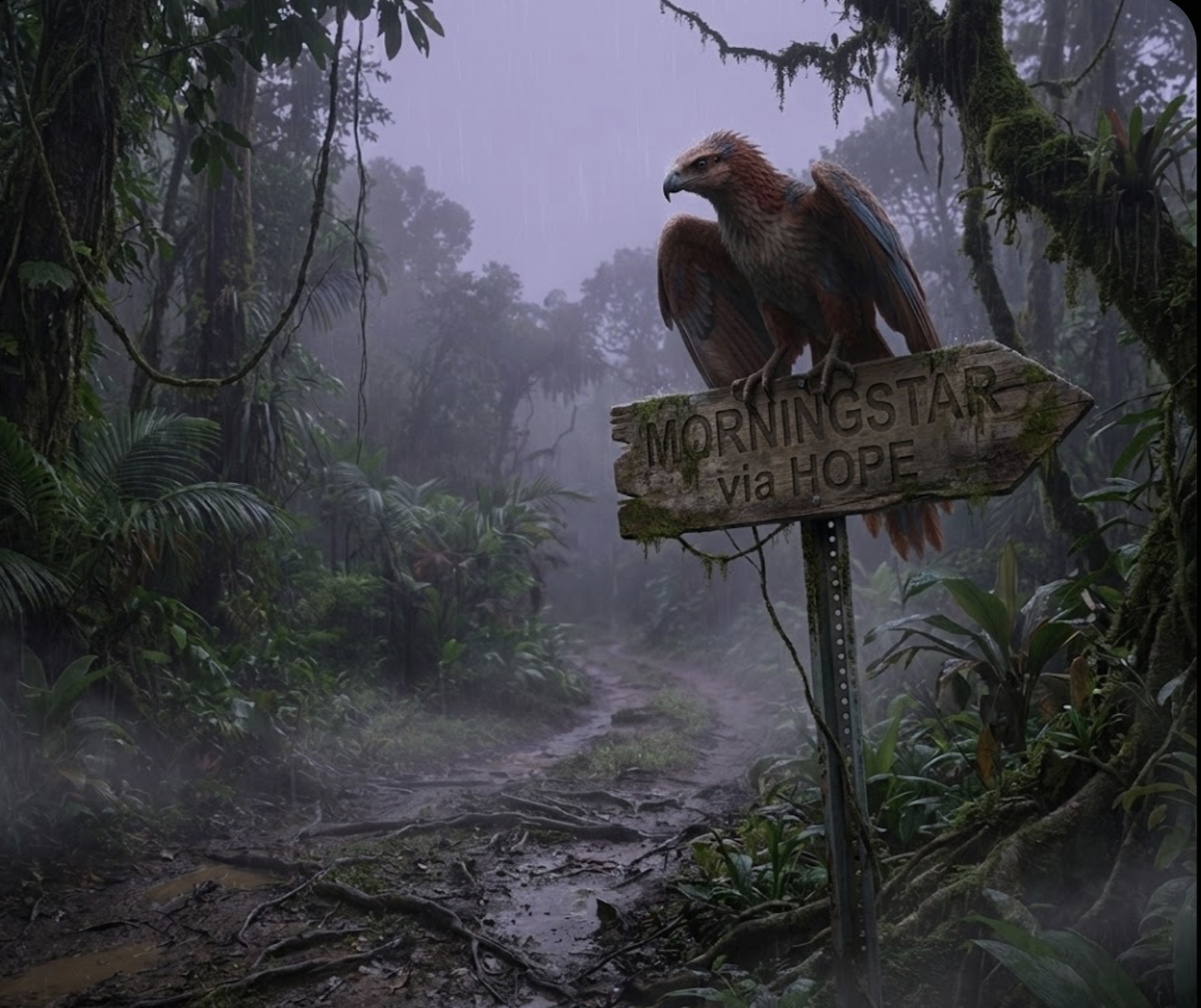
Introduction for Dungeon Masters
Hunting An Unknown Hunter is a consequence-driven continuation of The Man Without A Name.
This adventure is not structured around victory, but around exposure, proof, and aftermath. The PCs are no longer extracting a victim. They are following a pattern — one that leads into controlled territory, layered infrastructure, and a man who does not see himself as a criminal, but as a necessary function.
Most scenes are not mandatory. They are pressure points. Players may investigate, flee, confront, bargain, or be captured. Failure states are narratively valid and often more revealing than success.
What matters is what the PCs learn, what they can prove, and what consequences they carry back to New Kourou and beyond.
Use this page as your cockpit: a navigation layer, a dramaturgic map, and a tool to understand how scenes, factions, and obligations interlock.
The Stages of the Adventure
Hunting An Unknown Hunter unfolds in four stages. The closer the PCs get to the truth, the fewer ways out remain.
Stage I — Briefing & Departure (Intent · Commitment · First Fractures)
This stage begins at the Office for Special Operations in New Kourou. The mission is defined, but the enemy is not.
The PCs leave with a clear order from Ezrah Scherkenstein — find out everything, and make sure it can never happen again — yet without a clear picture of who they are hunting. What exists at this point are only fragments: reports, anomalies, and the unsettling sense that something systematic has been hidden behind routine violence.
Key themes: purpose without clarity, professional confidence, and the illusion of distance.
New Kourou still offers protection, structure, and choice. Mistakes here cost time, money, or comfort — not lives. But the decision to leave already commits the PCs to consequences they cannot yet see.
Stage II — The Pattern Emerges (Travel · Convergence · Rising Unease)
As the PCs travel toward the Atrana Mountains, clues begin to overlap. What once appeared as isolated incidents — traps, missing people, erased witnesses — starts to form a repeatable pattern.
The closer the PCs get geographically, the clearer the structure becomes: identical materials, consistent procedures, recurring economic signals in the fur trade.
At the same time, danger escalates. Authority fragments, cultural rules replace legal ones, and the environment itself becomes complicit. Encounters with Hope and the Honga may introduce moral judgment, suspicion, and demands for accountability that cannot be ignored.
Key themes: recognition, reconstruction, and the realization that violence here is curated — not chaotic.
The PCs are still moving freely, but the hunt has already begun to narrow.
Stage III — Entering the Realm of the Hunter (Territory · Control · Illusion of Agency)
This stage includes Morningstar and everything beyond it.
Here, the pattern gains a center. Morningstar appears functional, pragmatic, even mundane — yet every routine bends subtly toward a single unseen authority. Information must be purchased, proximity is dangerous, and discretion is enforced socially rather than by law.
As the PCs push further, freedom becomes conditional. Unescorted movement is allowed. Exploration is possible. But everything they see confirms the same truth: they are already accounted for.
Capture is not a failure in this stage. It is procedure.
Whether the PCs enter the Hunter’s Realm openly or are taken into it, this stage reframes the entire investigation. The Hunter does not react emotionally. He classifies, records, and judges.
Key themes: asymmetry of power, procedural cruelty, and the collapse of initiative.
Stage IV — Judgment & Return (Consequences · Proof · Aftermath)
This stage begins once the PCs leave the Realm of the Hunter — alive or deadened, escaped or released.
Execution is likely. Escape is possible. Killing the Hunter may occur.
None of these automatically resolve the pattern.
The true resolution happens afterward: in New Kourou, before Ezrah Scherkenstein, and — if applicable — before the Honga, who demand either the perpetrator himself or proof that he was confronted and judged.
This stage answers the final question of the adventure: what did it cost the PCs to uncover the truth — and what are they willing to stand behind?
Key themes: accountability, unfinished systems, and the permanence of consequences.
Leaving the Realm does not reset the world. If the Hunter lives, the system continues. If he dies, something else will rise to take his place.
All Scenes Overview — Hunting an Unknown Hunter
Type Legend - Core – Backbone scenes that define the investigation and outcome - Branch-Critical – Conditional scenes that, once entered, shape obligations or endings - Optional – Skippable scenes that enrich context, risk, or leverage
| Scene No. | Name | Stage | Type | Possible Purpose | Location | Involved NPCs (Main) | Scene Link |
|---|---|---|---|---|---|---|---|
| 1 | The Briefing | Stage I | Core | Establish mission, stakes, and Ezrah’s explicit order | OfSO Headquarters, New Kourou | Ezrah Scherkenstein | Scene 1 |
| 2 | Travel Preparations | Stage I | Core | Plan route, resources, timing, and exposure | Public Services Ring, New Kourou | Vendors, Troopers | Scene 2 |
| 2a | Courier Station | Stage I | Branch-Critical | Missed caravan → force alternative travel decision | New Kourou Courier Station | Courier Clerks | Scene 2a |
| 2b | Mandala’s Mounts | Stage I | Branch-Critical | Acquire fastest travel option; expose scarcity and urgency | Mandala’s Mounts, New Kourou | Rajid Mandala | Scene 2b |
| 2c | Food Market | Stage I | Branch-Critical | Stock supplies; gather rumors; pickpocket risk | New Kourou Food Market | Market Vendors | Scene 2c |
| 2d | Buying a Mortician’s Cart | Stage I | Branch-Critical | Gain unique transport option; foreshadow funerary culture | Schmitz Funeral Home, New Kourou | Schmitz | Scene 2d |
| 3 | Traveling to Morningstar | Stage I | Core | Transition into frontier travel; introduce risk and pacing | Trade Route (NK → Morningstar) | — | Scene 3 |
| 3a | Rest Stop in Hope | Stage I | Optional | Recover, gather rumors, uncover first economic clue | Route Stop of Hope | Kettler Twins | Scene 3a |
| 3b | Prisoners of the Honga | Stage I | Branch-Critical | Cultural judgment; impose moral obligation toward the Honga | Arla River Foothills | Honga Leader | Scene 3b |
| 4 | Arrival in Morningstar | Stage II | Core | Activate settlement hub; convert clues into leads | Morningstar | — | Scene 4 |
| 4a | Django’s Diner | Stage II | Optional | Stabilize, extract recorded evidence, test restraint | Django’s Diner | Kell | Scene 4a |
| 4b | Saw’s End | Stage II | Core | Consolidate rumors; identify J.W. as a real actor | Saw’s End | Sagan Belmont | Scene 4b |
| 4c | Morningstar Food Market | Stage II | Core | Observe trade power; silently identify J.W.’s influence | Food Market, Morningstar | Mustafa “Mu” Metzger | Scene 4c |
| 4d | Medical Station of Morningstar | Stage II | Optional | Treat injuries; manage conditions | Medical Station Morningstar| | Medical Bots | Scene 4d |
| 4e | Hale & Hook Outfitters | Stage II | Core | Confirm material trail linking J.W. to the fur trade | Hale & Hook Outfitters | Garrick Hale | Scene 4e |
| 4f | Local Guarding Troopers Station | Stage II | Optional | Ask procedural questions; risk scrutiny or arrest | GT Station, Morningstar | Troopers | Scene 4f |
| 4g | Escaping Morningstar | Stage II | Branch-Critical | Enforce consequences of failed investigation; transition to wilderness manhunt | Morningstar Streets & Perimeter | Hunting Squads, Guarding Bots, Trappers | Scene 4g |
| 5 | Follow the Errand Runner | Stage II | Branch-Critical | Transition from investigation to pursuit | Morningstar → Atrana Slopes | Mustafa “Mu” Metzger | Scene 5 |
| 6a | In the Realm of the Hunter | Stage III | Branch-Critical | Unescorted exploration; illusion of freedom; exposure to infrastructure | J.W.’s Property | — | Scene 6a |
| 6b | As a Prisoner in the Realm of the Hunter | Stage III | Core | Capture, judgment, classification by J.W. | J.W.’s Property | J.W., Blues | Scene 6b |
| 7 | The Execution | Stage III | Core | Attempted disposal; point of no return | Fire Pits, J.W.’s Property | J.W. | Scene 7 |
| 8a | Return to New Kourou | Stage III | Core | Physical survival; transition back to authority | Trade Route | — | Scene 8a |
| 8b | The Sacrifice | Stage III | Branch-Critical | Fulfill or betray Honga obligation | Honga Territory | Honga Leader | Scene 8b |
| 9 | Final Briefing & Reward | Stage III | Core | Report findings; receive judgment and reward | OfSO Headquarters | Ezrah Scherkenstein | Scene 9 |
| 10 | The End | Stage III | Core | Close narrative; establish long-term consequences | OfSO / World State | — | Scene 10 |
Core NPC Overview
Only NPCs who unlock information, shift power, or force irreversible decisions are listed here. Order reflects first meaningful appearance in the adventure.
| Name | Role | Stage | Function in Story |
|---|---|---|---|
| Ezrah Scherkenstein | Founder of the Office for Special Operations | Stage I & IV | Issues the mandate and defines success. Ezrah is not interested in heroics, survival stories, or intent — only in whether the PCs uncovered the structure behind the violence and acted decisively. Final arbiter of reward, consequences, and political fallout. |
| Elias Kettler | Traveling Fur Trader (“The Spiritual One”) | Stage II | First reliable signal that the violence follows a pattern tied to the fur trade. Elias reframes incidents in reflective, almost ritual language, hinting that something systematic is being maintained rather than improvised. Opens the door to recognizing repetition across regions. |
| Ruben Kettler | Traveling Fur Trader (“The Pessimist”) | Stage II | Grounds Elias’s abstractions in blunt economics and risk management. Confirms that prices, routes, and disappearances align too cleanly to be coincidence. Pushes the PCs toward the conclusion that someone is enforcing order through erasure. |
| Aruṇa Karavashi Tivu’Leisa Nohra | Secular Leader of the Honga | Stage II | Introduces cultural judgment in place of legal authority. Reframes the investigation as a violation of balance rather than law. Withdraws the blood-demand only if the PCs accept an accountability contract: bring the perpetrator or proof of confrontation. This obligation shadows the rest of the adventure. |
| Kellard "Kell" Vance | Off-shift lumberjack | Stage III | A controlled eruption of violence inside Morningstar. Forces the PCs to act under social pressure and reveals how quickly order collapses without visible authority. His robbery incident exposes who can act with impunity — and who cannot. |
| Sagan Belmont | Temporary carpenter · Saw’s End guest | Stage III | A quiet but crucial vector. Confirms J.W. as a real, local figure rather than rumor. Provides the first workable location of the Hunter’s property through second-hand labor knowledge. Bridges town gossip and geographic certainty. |
| Mustafa “Mu” Metzger | Errand Runner · Quiet Enforcer | Stage III | Confirms that the PCs are already being observed. Serves as bait rather than obstacle. His behavior demonstrates the Hunter’s preference for preparation over reaction and leads the PCs directly into the Realm on the Hunter’s terms. |
| J.W. | “The Hunter” | Stage III & IV | Central perpetrator and classifier. J.W. is not driven by rage or cruelty but by order, procedure, and control. He represents a functioning system of violence rather than an aberration. Confronting, killing, or escaping him does not automatically end that system — it only defines how the PCs are judged by those who sent them and those who demand justice. |