Table of Contents
Major Planetary Zones | (Twin) Sections of the Habitual Belt | Regions | Sites
HARVEST REST CEMETERY
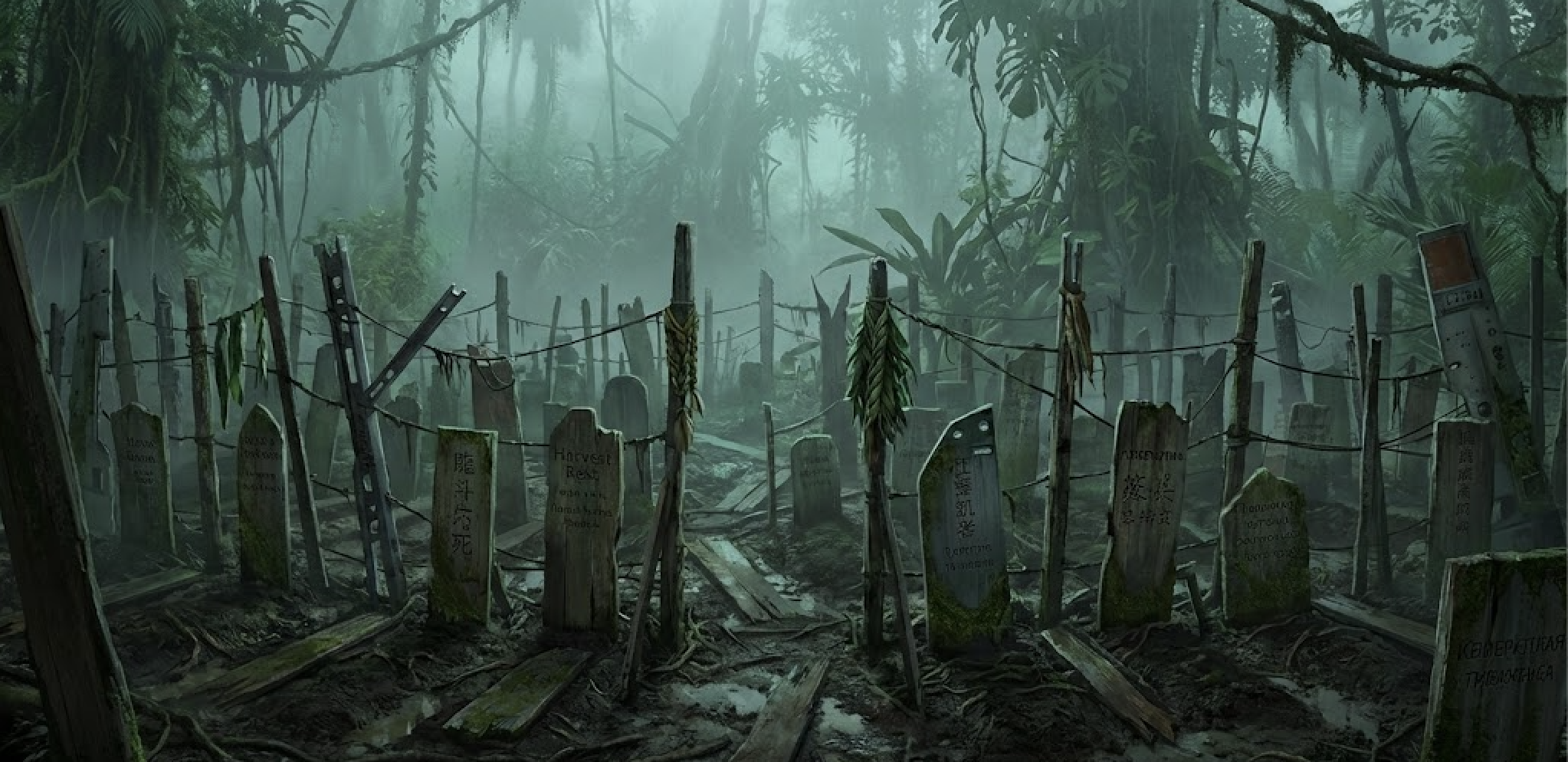
- Type: Site (cemetery)
- Location: 500 m east of Hope, in the Tropical Forest
- Elevation: ≈ 30 m above town level
Overview
By popular petition, the Settler’s Council approved the creation of a soil-burial ground on 1 May 2626. Harvest Rest Cemetery opened on 1 July 2626 as a clearing carved directly from the surrounding tropical forest, rather than a formally landscaped site.
The cemetery was enclosed by a protective fence to shield it from local wildlife and creeping vegetation. Within this boundary, graves were placed pragmatically along the terrain, following roots, slopes, and natural clearings rather than strict rows.
Harvest Rest served Hope’s roughly 4 000 residents until 8 April 2631, when Peace Treaty edicts prohibited terrestrial interments. During its five-year use, the cemetery received 80 graves — 30 Volunteer Army of Man soldiers and 50 civilians — standing as one of the earliest permanent human imprints on the land beyond Hope’s settlement perimeter.
Facts and Figures
- Established: 1 July 2626
- Council Vote: 1 May 2626
- Clearing Work: ≈ 40 hardwood trees and underbrush cleared by two Manual Labor Bots
- Footprint: 1 200 m² (≈ 30 × 40 m)
- Operational Period: 1 Jul 2626 – 8 Apr 2631
- Interments: 80 (30 soldiers, 50 civilians)
- Peak Burials: 20 in 2629 during the Great War
- Status (Gamma Age): Abandoned; saplings and prairie grasses now carpet the grounds
Cultural and Strategic Importance
- First Earth-Return Ceremonies: Cemented Hope’s shift from shipboard composting to sacred soil burials.
- Frontier Solidarity: Soldier graves from wartime years became a focal point for communal remembrance.
- Treaty Landmark: In the Gamma Age “forbidden farmland,” the site symbolizes tensions between Individualist nostalgia and the regulations of the Federal Confederation.
Look and Feel
Beta Age (2626–2631)
Harvest Rest lies in a humid forest clearing under perpetual twilight. Dense tropical vegetation presses in on all sides — broad-leaf plants, hanging vines, and mist-darkened trunks looming just beyond a rough perimeter fence of wooden posts, wire mesh, and salvaged metal struts from the Last Frontier.
Graves are marked primarily by weathered wooden headboards, carved by hand and darkened by moisture and fungal bloom. Some markers are reinforced or replaced with repurposed ship fragments: cut alloy plates, stamped identification panels, or scorched hull shards pressed into the soil. Names are written in a mix of scripts — Latin letters, Cyrillic, and Chinese characters — sometimes uneven, sometimes partially eroded.
Paths between graves are narrow and muddy, occasionally bridged with loose planks. Small memorial offerings — braided leaves, cloth strips, carved symbols — hang from fence posts or rest at grave bases. The air smells of damp earth, resin, and rotting leaves. Insects hum constantly, and the forest never fully quiets.
Gamma Age (post-2631)
Without upkeep, the forest advances. Vines creep through fence gaps, posts rot, and roots buckle grave markers. Wooden headboards tilt or split; metal plates corrode and stain the soil beneath. Moss and lichen obscure inscriptions in every language.
The fence still stands in places, but animals have pushed through weakened sections. Twilight filters through a thickened canopy, casting a green-blue gloom over the clearing. What was once a maintained burial ground is now a contested space between memory and wilderness — avoided officially, but quietly visited by those unwilling to forget.
History / Legacy
- Creation: Designed and laid out by the settlement of Hope
- Closure: Peace Treaty prohibition on burial grounds (April 2631) forced shutdown and reversion to ship-era protocols.
- Rewilding: Tropical Forest edge species reclaimed the site within five years, transforming it into a quiet meadow used only by clandestine mourners.
Tactical Advice for Dungeon Masters
Beta Age Hook
- Mourners’ Masquerade – A notorious fugitive , wanted for homicide, has faked his own death — his kin staged a solemn burial at Harvest Rest only to bury an empty coffin. The Settler's Council deputizes the PCs as detective agents: they must unravel the family’s deception, and track the murderer …
Gamma Age Hook
- Unquiet Grave – Farmers employed by the Federal Food Plant stumbled upon members of the Jane Mendoza Gang attempting to pry open one of Harvest Rest’s newest graves under cover of mist. When alerted, the Outlaws fled into the surrounding fields. Deputized by the Local Sheriff, the PCs must carefully open the undisturbed grave, discover what the gang was searching for — be it hidden contraband, secret letters, or buried loot — and decide how to pursue the culprits across Hope’s farmbelt …
Related Pages and Further Information
Known Sites in the Asari Region: