
This is an old revision of the document!
Table of Contents
102 Pen and Paper Adventure | Beta Age | Hunting an Unknown Hunter
SCENE 3b — PRISONERS OF THE HONGA
1 | Scene Overview
- Location: Forested foothills near the Arla River, Eastern Equatorial Section
- Type: Detention · Cultural Confrontation · Moral Judgment
- Era: Beta Age
- Tone: Quiet authority · restrained tension · rising unease
Atmosphere & Sensory Cues: Filtered twilight beneath dense canopy · damp soil and crushed leaves · distant river flow · controlled stillness ·
2 | Read-Aloud Description
You do not hear them arrive. The forest tightens first. Insects fall silent. The damp air seems to hold its breath. Somewhere behind you, a branch creaks — not from wind, but from weight carefully placed.
Then it happens fast.
Figures step out of the undergrowth on both sides of the road, not charging, not shouting — appearing. Spears snap forward to block retreat. Bows are already drawn. You realize too late that the road ahead and behind you is gone.
Five Honga warriors stand in a wide arc, feet planted, bodies loose and ready. Their weapons are steady.
And then you notice the eyes.
Not ten – fifteen.
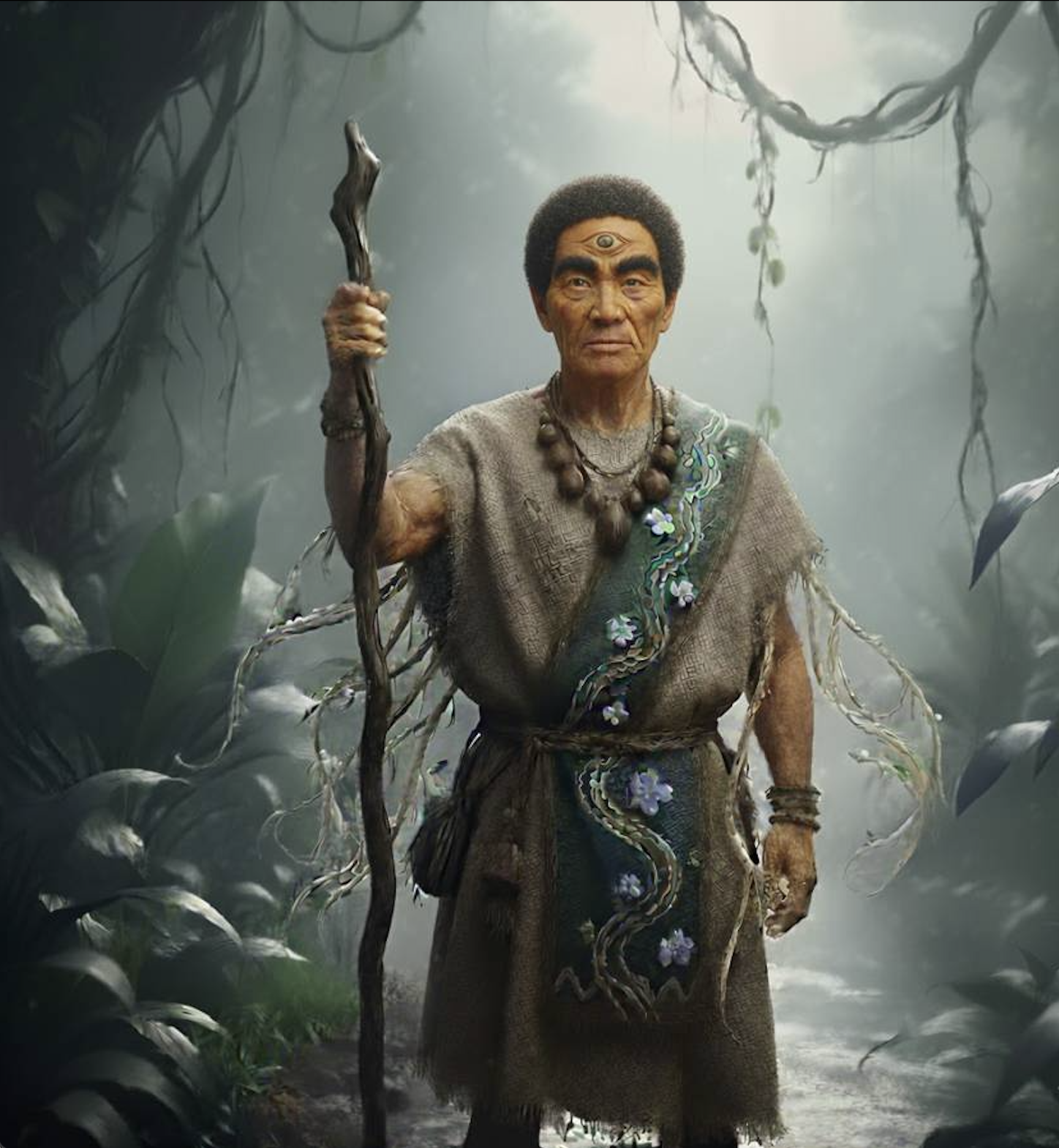
Each warrior watches you with two familiar eyes — and a third, open and unblinking in the center of the forehead, dark and reflective, fixed on you with unsettling focus. You cannot tell if it sees differently — only that it sees enough.
One step closer.
A sharp whistle cuts the air behind you. You feel it before you see it: another presence in the trees, elevated, unseen. A sixth watcher. The pressure of attention deepens. A voice speaks — low, firm, carrying no threat because none is needed.
“Siva.” (Stand. Still.)
A spear tip lowers until it touches the earth at your feet.
“Kumo ara nai shulu.” (Those who carry death will not flee with it.)
Staged Read-Alouds (Progressive Descriptions)
| Trigger / Timing | Read-Aloud or Narrative Insert |
| PCs attempt to speak or explain immediately | The nearest warrior tilts her head slightly. Her third eye narrows — not in anger, but in assessment. “Quro nai.” (Questions come later.) A hand gestures away from the road and into the trees. |
| Detention procedures begin | Movement unfolds on all sides at once. Weapons are taken in practiced silence — blades, firearms, tools — wrapped in woven plant fiber as if carrying residue. At the same time, knives flash not toward you, but toward rope. Harnesses fall away. “Kumo shai, vena shai.” (Life is life, nature is life.) “Shulu no.” (No one serves.) The forest receives the animals without panic. One warrior watches closely as Kelta does not flee. Nothing is said. You are guided away from the road and into denser growth. No bindings. No strikes. Every step is contained by presence alone. When pace falters, a quiet correction follows: “Vai yuvan.” (Flow.) |
| Arrival at the Honga camp | The forest thins gradually, not into a village but into a living passage of color. Light tents of layered, shimmering cloth hang between trees like river-skin caught in branches. Blues, greens, and soft amber hues breathe with the wind. Smoke rises in thin, disciplined threads from low fire pits. You hear water nearby, quiet voices, the wet sound of fruit being cut and shared. No one stares. No one hides. Your arrival feels anticipated, not alarming. From the heart of the moving camp, an older woman steps forward. Her garments carry the colors of river and leaf. The markings on her skin are deeper than the others’, worn smooth by years rather than paint. Her third eye is traced in pale ash, its edges sharp and deliberate. She studies you for a long moment — not counting faces, but weighing presence. “Vena tum.” (Nature is wounded.) At her gesture, a scout approaches, carrying a bundle wrapped in bark-fiber cloth. He kneels and unrolls it at her feet. A crude trap spills onto the ground. Bent metal jaws are bound to a springed branch with wire and vine, the teeth hammered unevenly into place. Dried blood stains the metal dark and tacky. A strip of coarse fur still clings between the jaws, torn free rather than cut. As it settles, the mechanism snaps once — sharp, final, wrong. Two letters are engraved on the left side of the trap: J.W. The woman does not look down at it. She looks at you. “Wuxo kumo.” (Traps for siblings.) Her hand closes slowly. “Asa ara.” (Eating death.) A pause. Long enough for the forest to listen. Then she speaks again, her voice neither raised nor cruel. “Rena vena nai omba.” (Blood has broken the balance.) She gestures toward the trap. “Veyo-zi to.” (Cause follows.) Her third eye fixes on you. “Rena pi ara, rena pi vena. Shai di vai asa ara nai. Nai asa. Rena pi. Nai moru. Gno-sei.” (To restore what was taken, blood must answer blood. One of you will step where death waited. Not to die. To bleed. To remember.) Silence settles, heavy and expectant. “Quro nai.” (Questions come later.) |
3 | Scene Intent
| Scene Type | Player Intents | DM Function / Story Link |
| Detention · Cultural Judgment | Survive capture · explain actions · regain agency through humility or language · understand native values | Establish moral asymmetry · escalate Beta Age tensions · redefine “the hunt” as spiritual crime · foreshadow the inevitability of the Great War |
—-
4 | Key (N)PCs + Dynamic Cues
| Name | Role / Affiliation | Motivation / Goal | Dynamic Cues — How They React in Play | Wiki-Link |
| Aruṋa Karavashi Tivu’Leisa Nohra | Secular Leader of the Honga | Preserve balance; judge violations; protect the tribe without accelerating war | Speaks rarely and with precision. Never raises her voice. Maintains eye contact with her central eyes closed, third eye open when judging truth. Listens longer than expected; once she speaks, discussion narrows. | Honga Tribe |
| Kéhana Talara Orun’Khalé Soluun | Honga Warrior | Protect sacred land; judge intruders | Calm, authoritative, never raises voice. Watches reactions closely. | Honga Tribe |
| Honga Warriors (4–5) | Honga Tribe | Maintain control; prevent violence | Silent, coordinated, always positioned for control rather than attack. | Honga Tribe |
| Sáru Tolurashi Vae’Shinra Narae | Honga Scout | Report imbalance; trigger response | Never speaks during detention. Watches PCs’ restraint and respect. | Honga Tribe |
5 | Triggers, Actions & Consequences
This scene unfolds in three distinct stages. At each stage, PCs may cooperate, resist, observe, deceive, or escalate. Honga responses are calm, coordinated, and proportionate — until they are not. DM Note (The Trust Mechanic): The Honga are evaluating the PCs' spirits, not just their actions. Track “Trust” throughout Stages I and II. For every negative Trust point accumulated, increase the final Persuasion DC with Aruṋa by +1.
Stage I — Capture
| PC Action / Cue | Honga Response (Immediate) | Consequences (incl. checks & outcomes) |
| Cooperate immediately | Weapons and gear are taken efficiently. Mounts are freed. No threats spoken. | No check required. Scene proceeds calmly to escort. PCs gain +1 Trust for later judgment. |
| Attempt to explain verbally | “Quro nai.” (Questions come later.) A hand gestures forward. | CHA (Persuasion or Deception) DC 15: On success, words are remembered → advantage on first social check in Stage III. On failure, no penalty. |
| Scan surroundings | No visible reaction. Third eyes track subtle movement. | WIS (Perception) DC 13: PCs recognize overlapping positions and elevated scouts. DC 18+: Identify a narrow escape corridor (still risky). |
| Attempt to flee | Nets, vines, and coordinated body-blocking cut off movement. | DEX (Athletics or Acrobatics) DC 17: Success grants 10–15 m separation before containment reforms. Failure restrains one PC for 1 round and reduces Trust by 1. |
| Attempt to fight | Non-lethal takedowns, grapples, and blunt strikes. | STR (Athletics) or DEX (Acrobatics) DC 16: Success avoids restraint this round. Failure knocks PC prone or restrained; visible injury occurs. Trust −2. |
| Use Shiver-Thorn Capsule (from the Tinkerer – if still available) | Honga recoil briefly; formation loosens for seconds. | No roll. PCs gain advantage on next escape or reposition attempt. Chemical aggression is noted. Trust −1. |
| Use Spineback Flicker Pod (from the Tinkerer – if still available) | Warriors endure pain and close distance instantly. | DEX DC 12: Success imposes disadvantage on 1–2 Honga next action. Failure results in immediate grapple. Trust −2. |
| Use Rootcoil Strangler Vine (from the Tinkerer – if still available) | Restrained target is cut free as others move in. | STR DC 13: Success restrains one Honga briefly; escalation spikes. Failure restrains the user. Trust −3. |
—
Stage II — Escort through the Forest
| PC Action / Cue | Honga Response (Immediate) | Consequences (incl. checks & outcomes) |
| Walk calmly, follow pace | Escort spacing relaxes slightly. No bindings applied. | No check required. PCs gain situational awareness and +1 Trust carried forward. |
| Attempt quiet conversation (non-Honga) | Ignored completely. No reaction, no hostility. | No penalty. Words are dismissed as noise. |
| Attempt conversation in Honga dialect | One escort answers briefly without breaking stride, eyes forward. | CHA (Persuasion) DC 14: On success, the escort speaks two restrained lines: “Asiru shulu nai. Tiru shai toye.” (Hospitality is not without borders. Home remains open.) and, if not interrupted, “Nosha la Falo-ma. Virek sa Aruṋa.” (The community is concerned. Justice will be spoken by Aruṋa.) → PCs learn this is a hearing, not an execution. Failure has no penalty. |
| Scan environment subtly | No visible reaction; scouts remain unseen. | WIS (Perception) DC 13: Identify river proximity and nomadic movement signs. DC 17+: Estimate camp size and hierarchy markers. |
| Attempt discreet signaling between PCs | Third eyes flick briefly; formation adjusts. | DEX (Sleight of Hand) DC 15: Success allows coordination. Failure tightens escort spacing (disadvantage on future escape attempts). |
| Attempt escape (first attempt) | Physical redirection only. “Vai yuvan.” (Flow.) | DEX (Acrobatics) or STR (Athletics) DC 16: Success gains brief separation but no full escape. Failure applies restraints to one PC. Trust −1. |
| Attempt escape (second attempt) | Immediate restraint by multiple warriors. | No roll. Party is bound. All later social checks suffer disadvantage. Trust −3. |
| Aggressive posture or threats | Weapons (e.g. Sharp stone blades or wooden spears), shift into ready positions. Silence hardens. | No roll. Arrival at camp is framed as detention, not hearing. |
—
Stage III — The Secular Leader
| PC Action / Cue | Honga Response | Consequences / Mechanics |
| PCs request more information about the traps | The Secular Leader nods once. A scout steps forward and lays out further evidence: broken branches, blood-marked paths, multiple trap sites mapped along the forest edge. “Wuxo kumo na. Teru-sa.” (Many traps. Repeated.) | PCs may ask focused questions. CHA (Persuasion) or INT (Investigation) DC 13 reveals: traps were placed recently, repeatedly, and carelessly. Success strongly supports PCs’ innocence and shifts the scene toward proof rather than punishment. |
| PCs scan their surroundings | The Secular Leader does not interrupt. Around you, dozens of Honga have gathered — warriors, scouts, elders. Their faces remain calm. Their third eyes are open. You feel watched from every direction, near and far. | WIS (Perception) DC 12. On success, PCs notice: no execution ground prepared, no weapons aimed at vital points, and deliberate gaps between tents and trees that could be routes outward. Escape would be dangerous, brief, and likely costly — but not impossible. PCs gain advantage on either their next social check or their first escape-related check in this scene. |
| PCs refuse the accusation and plead not guilty | The Leader raises a hand. “Vera sa.” (Speak truth.) She listens, expression unreadable. | PC could use the engraved initials (J.W.) as an argument. CHA (Persuasion or Deception) DC 14. On success, they persuade the leader. On failure, refusal is read as avoidance; the blood-demand remains. |
| PCs persuade the Secular Leader of their innocence | Silence stretches. The Leader studies the PCs’ faces — all three eyes focused. Finally: “Veyo-zi se.” (The balance shifts.) | Requires two cumulative successes from prior checks (Investigation, Insight, Persuasion, or Honga-language use). Outcome: PCs are declared not the trap-makers. The blood-demand is withdrawn. Instead, the leader will ask them to bring the culprit from their “tribe” – so that the perpetrator can make their sacrifice and trap setting can be a thing of the past once and for all. The PCs are asked to leave a valuable pledge with the Honga – as proof of their commitment. |
| PCs fail to persuade the Secular Leader | The Leader closes her eyes — all but the third. Silence stretches until it becomes weight. Then she gestures once toward the trap. “Veyo-zi ara.” (The cause demands answer.) | The blood-demand is enforced. One PC must step into the trap under Honga supervision. No attack roll. The trap is partially disarmed to prevent death, but still brutal. The chosen PC suffers 2d6 piercing damage and gains the condition Crippled: movement speed reduced to 0 and disadvantage on all physical checks involving movement. The wound cannot be stabilized by field medicine alone. Only treatment at a Medical Station or equivalent facility restores mobility. The Honga consider the balance temporarily restored and release the PCs afterward. |
| PCs attempt to escape | For a heartbeat, nothing happens — then the camp flows. No shouts. No panic. The Honga do not chase; they close. | DEX (Acrobatics) or STR (Athletics) DC 15. On success, each PC break formation briefly, reaching the edge of the camp or the treeline . On failure, the PC are swiftly restrained. No lethal force is used, but the Leader’s judgment hardens. |
| PCs start a brawl | The camp stills — then erupts in controlled motion. Non-lethal force overwhelms the PCs within seconds. | Automatic failure unless extreme circumstances apply. PCs are subdued, injured, and bound. Outcome shifts from judgment to punishment; future diplomacy with the Honga is severely damaged. |
6 | DM Notes
- Key Reminder for the DM: The Honga are not villains. They are a people defending balance with a worldview older than the PCs’ civilization. If the players feel unsettled, pressured, or morally strained — the scene has done its job.
- Nature of the Accusation: This is not a legal trial. It is a spiritual and communal judgment. The Honga do not need proof in the human sense; imbalance itself is evidence. The trap is not shown to debate guilt, but to establish responsibility for restoration. Make it clear: innocence must be demonstrated, not asserted.
- The Blood Demand: The demand for blood is not execution, torture, or cruelty. It is symbolic reparation — pain as memory, not death as punishment. Emphasize that the Leader fully expects the accused to survive. The horror lies in the willingness to demand sacrifice, not in sadism. This demand exists to force truth, humility, or decisive action.
- If a PC Steps into the Trap: This is a controlled ritual, not an execution. The Honga partially disarm the trap with practiced precision, ensuring survival while preserving pain and memory. The wounded PC is treated with plant salves to prevent infection but not to restore mobility. The Honga consider the matter temporarily resolved and will release the group without hostility.This outcome should feel heavy but honorable — the PCs leave marked, not condemned. The injury creates a strong narrative push toward a Medical Station and ensures the Honga’s judgment lingers beyond the scene.
- Use of Mechanics: Treat Trust as an invisible but cumulative modifier. Small actions (language use, calm behavior, respectful silence) matter. Dice rolls should feel like moments of interpretation, not binary pass/fail gates.
- Hidden Truth: The Honga are correct in their accusation — but wrong about the perpetrators. The brutal traps found in their sacred territory were not set by the PCs, but by the very individual the PCs are ultimately searching for. The engraved initials J.W. on the side of the trap are his mark — an intentional signature, not carelessness. He leaves traces because he believes himself untouchable. This man is the unseen architect behind the violence: the one who pulled the strings, financed the operation, and sent the killers to the Office for Special Operations. This encounter is the first time the PCs stand directly in the wake of his actions, long before they understand his identity or role. When the truth is revealed later in the campaign, this scene should snap into focus retroactively: the trap, the initials, the blood-demand, and the Honga’s judgment were not a misunderstanding — they were an early warning. The hunter leaves scars long before he leaves names. J.W. was here.
DM Tutorial: How to approach the scene
Short version:
Related Pages and Further Information
- ↑↑ Start: Hunting An Unknown Hunter
- ★ Overview: All Scenes of Hunting An Unknown Hunter
- ☞ Resolution: Case Resolution and discoverable Backstory
- ← Previous Scene: Scene 3 — Traveling to Morningstar
- → Next Scene: Scene 4 — Arrival in Morningstar