
Table of Contents
102 Pen and Paper Adventure | Beta Age | Hunting an Unknown Hunter
SCENE 8b — THE JUDGMENT
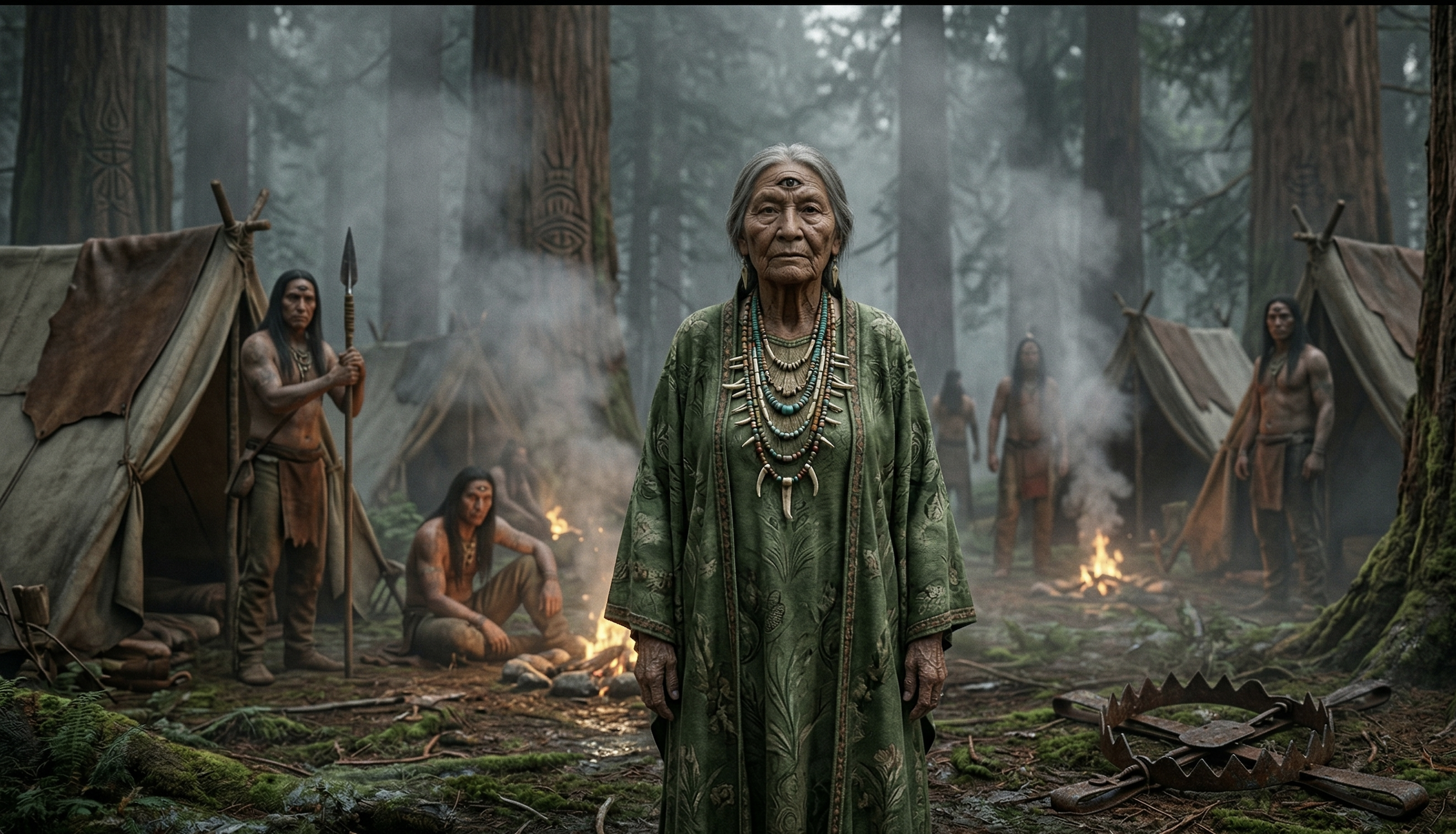
1 | Scene Overview
- Location: A temporary nomadic camp of the Honga Tribe deep within the rainforest of the lower Atrana Mountains
- Type: Cultural Confrontation · Moral Judgment · Negotiation · Conditional Pursuit
- Era: Beta Age
- Tone: Solemn · watchful · spiritually charged · restrained danger
Atmosphere & Sensory Cues: Warm, mist-thickened air · rain dripping from immense leaves · the smell of wet moss, crushed ferns and woodsmoke · colourful layered fabrics moving between ancient trees · quiet Honga voices · the sudden absence of insects and birds · every weapon, injury and spoken promise being silently observed
2 | Read-Aloud Descriptions
Initial Read-Aloud — The Cycle Camp
The Honga scouts do not speak as they guide you away from the place where they stopped you. Within moments, the route by which you arrived disappears behind wet ferns, dense grey mist and ancient timber.
Each scout watches you with two familiar eyes and a third, open and unblinking in the centre of the forehead. You cannot tell whether that eye sees the world differently. You know only that very little escapes its attention.
After a long passage beneath the canopy, the forest opens into a temporary settlement woven between the trees.
Light tents made from layered blue, green and amber fabrics hang from branches and living timber frames. Smoke rises in narrow threads from low fire pits. Tools, baskets and bundles have been arranged so that the entire camp could disappear into the forest without leaving more than flattened moss behind.
Honga of every age pause to watch your arrival. Their attention moves across your weapons, injuries, companions and anything else you have brought into their territory.
The scouts indicate a sheltered tent near the centre of the camp.
Whether you have been welcomed as guests, summoned as witnesses or detained as suspects remains unclear.
Someone here intends to hear what happened.
Staged Read-Alouds
| Trigger / Timing | Read-Aloud / Narrative Insert |
| J.W. is brought into the camp | The Honga watch the masked captive pass between the tents. Their expressions reveal neither recognition nor surprise, but several gazes settle upon his boots, his restraints and the tools carried by the scouts. J.W. studies the camp in silence, measuring distances and possible exits. |
| The PCs arrive without J.W. | The scouts exchange several quiet words. Their attention returns to the empty path behind you, then to whatever evidence, injuries or explanation you have brought in place of the man they expected. |
| Aruṋa enters the gathering | The assembled Honga part without being ordered. An older woman steps through them, her garments carrying the colours of river, leaf and wet earth. Pale ash traces the open third eye above her brow. She studies each person in turn before looking toward the object placed at the centre of the gathering. |
| The marked trap is revealed | A scout kneels and unfolds a length of bark-fibre cloth. A crude jaw-trap falls onto the wet ground. Bent metal teeth surround a powerful spring, and a strip of coarse fur remains caught between them. Dark stains mark the rusted jaws. Two letters have been cut into the metal: J.W. |
| The trap ritual is accepted | The Honga place the rusted mechanism upon bare earth. Warriors hold J.W. firmly while a healer waits nearby with broad leaves, clean bindings and a bowl of pungent ointment. Aruṋa raises one hand. The gathering falls completely silent. |
| A pursuing force reaches the camp boundary | A warning passes through the camp without anyone raising their voice. Honga warriors turn toward the surrounding forest. Beyond the tents, something moves among the ferns and mist—close enough to have found the hidden paths, but not yet willing to cross the boundary openly. |
| The PCs leave the Honga camp | The layered tents disappear behind trees and drifting mist. A scout guides you along a concealed path until the sounds of the camp have vanished. Ahead, the rainforest opens toward the territory surrounding Morningstar and the remaining journey to New Kourou. |
3 | Scene Intent
| Scene Type | Player Intents | DM Function / Story Link |
| Judgment, Negotiation and Consequence | Explain what happened at the compound · present evidence · fulfil or address an earlier promise · decide J.W.'s fate · preserve relations with the Honga · survive any pursuing threat | Resolves the Honga's claim to accountability without prescribing a single punishment. The PCs may support the judgment, argue for a formal trial, offer restitution, surrender J.W. or reject the Honga's authority. |
4 | Key (N)PCs
| Name / Role | Motivation / Function | Dynamic Cues — How They React in Play | Wiki Link |
| Aruṋa — Honga Leader and Judge | Restore balance · determine responsibility · protect her people and the forest | Calm, attentive and difficult to deceive. She is neither vindictive nor needlessly cruel. She listens to evidence and testimony, but regards accountability as an obligation rather than a matter of convenience. | Honga Tribe |
| J.W. — “The Hunter” | Avoid punishment · escape custody · divide the PCs from the Honga | Present only if brought to the camp alive. He may deny responsibility, question the Honga's authority, offer the PCs a deal or insist that New Kourou will arrest them. He does not automatically panic, confess or beg. | Jareth Wyrick |
| Honga Scouts and Warriors | Escort · observe · protect the camp · enforce Aruṋa's decision | Their treatment of the PCs follows the established Honga Relationship and Pact State. They do not automatically bind respectful visitors, nor do they attack without warning. | Honga Tribe |
| Honga Healer | Prevent unnecessary death · treat the consequences of judgment | The healer prepares before any physical ritual and intervenes immediately afterward. The purpose of the judgment is accountability and memory, not execution. | Honga Tribe |
| Conditional Pursuers | Recover J.W. · detain the PCs · reclaim evidence · follow the distress signal | May consist of Guarding Trooper drones, ground responders, surviving Hands or previously established named enemies. Their presence depends entirely on the Pursuit State carried from Scene 8a. | Guarding Troopers |
5 | Triggers, Clues & Consequences
Entry Conditions & Carried State
Before beginning the scene, record why the Honga intercepted the group and what the PCs brought into their territory.
- Mission State: J.W. Captured Alive · J.W. Not Captured · J.W. Dead · J.W.'s Fate Unknown
- J.W.'s Condition: If present, record whether he is Conscious, Sedated/Unconscious, Injured and Properly Restrained.
- Honga Relationship: Trusted · Uncertain · Hostile
- Pact State: No Pact · Promise Unfulfilled · Promise Fulfilled · Promise Broken
- Pursuit State: Preserve No Confirmed Pursuit, Distant Pursuit or Close Pursuit from Scene 8a.
- Transport and Companions: Record the Mortician's Cart, freight wagon, Hoos, Veyras, Bii and any other resources waiting outside or accompanying the group.
- Evidence: Preserve recordings, documents, pelts, traps, testimony and other proof recovered during the investigation.
- Other Consequences: Preserve injuries, missing equipment, wanted status, the fate of Sagan and any crimes committed during the return journey.
Entering the concealed Honga paths normally reduces the Pursuit State by one step. Spending a long period resting, arguing, interrogating J.W. or attempting repeated negotiations may advance it again.
Phase I — Reception at the Camp
The Honga's treatment of the PCs depends on their established relationship. Do not automatically describe the group as prisoners.
| Honga Standing | Reception | Effect in Play |
| Trusted or Promise Fulfilled | The PCs are escorted into the camp as witnesses or pact-keepers. They are expected to lower their weapons but are not automatically disarmed or bound. | The PCs gain Advantage on their first respectful attempt to address Aruṋa. J.W., if present, remains restrained and closely guarded. |
| Uncertain or No Prior Meeting | The scouts keep the group together and request that visible weapons be lowered. They watch closely while Aruṋa is summoned. | The PCs retain freedom of movement within the assigned shelter but cannot wander through the camp without an escort. |
| Promise Unfulfilled | The Honga ask why J.W. has not been brought to them or why the earlier agreement remains incomplete. | The PCs must explain what happened. An honest account preserves the current relationship. Evasion or obvious dishonesty may change it to Hostile. |
| Hostile or Promise Broken | The scouts disarm the PCs and may bind them if they refuse instructions or previously attacked the Honga. | The PCs are treated as suspects. Restoring an Uncertain relationship requires credible evidence, restitution or a CHA (Persuasion) probe against DC 16. |
| Trigger / Cue | Immediate Reaction | Clue / Consequence / Mechanic |
| ENTERING THE CAMP | ||
|---|---|---|
| The PCs cooperate with the scouts | They are led to a sheltered tent or waiting area near the centre of the camp. | Consequence: The group receives water and basic treatment for immediate life-threatening injuries. Their transport and animals remain at the camp's edge unless Aruṋa permits otherwise. |
| J.W. remains sedated or unconscious | The Honga confirm that he is alive before assigning warriors to watch him. | Consequence: The judgment may wait until he can understand the accusation. A WIS (Medicine) probe (DC 11) determines when he is likely to wake. |
| J.W. is conscious | He observes the camp and listens carefully to every exchange. | Consequence: He does not automatically speak. He waits until denial, negotiation or division offers him a useful advantage. |
| The PCs request to leave immediately | The scouts refer the request to Aruṋa rather than simply blocking the group. | Consequence: If no pact, accusation or captive requires judgment, Aruṋa may permit them to leave. If an unresolved claim exists, she first demands that it be heard. |
| The PCs attempt to flee or wander without permission | Warriors close the surrounding paths and issue a warning. | Mechanic: A group DEX (Stealth), WIS (Survival) or coordinated escape probe (DC 15). Success leaves the camp but changes the Honga Relationship to Hostile and advances the Pursuit State. Failure results in disarmament and formal detention before Aruṋa. |
| The PCs attack a Honga | The camp responds immediately to defend its people. | Consequence: Set the Honga Relationship to Hostile. The PCs must surrender, flee or face a coordinated response from warriors familiar with every path through the surrounding forest. |
Phase II — Evidence, Testimony and Bargaining
Aruṋa seeks responsibility rather than a predetermined confession. Strong evidence should speak for itself; do not hide obvious conclusions behind unnecessary probes.
| Trigger / Cue | Immediate Reaction | Clue / Consequence / Mechanic |
| ESTABLISHING RESPONSIBILITY | ||
|---|---|---|
| Aruṋa reveals the marked jaw-trap | The initials J.W. are visible on the rusted mechanism beside blood and trapped fur. | Consequence: Read “The marked trap is revealed.” Aruṋa states: “Vena tum.” Nature is wounded. She asks who created the traps and who ordered their use. |
| The PCs previously promised to bring J.W. and have done so | Aruṋa looks from the captive to the marked trap. | Consequence: She acknowledges the fulfilled promise: “Kato-zi.” The pact is kept. Set Pact State to Promise Fulfilled. |
| The PCs present strong evidence against J.W. | The Honga examine the trap, documents, pelts, recordings or testimony without interrupting. | Consequence: If the evidence clearly identifies J.W.'s operation, no Persuasion probe is required. Aruṋa accepts that he bears responsibility and proceeds to Phase III. |
| The evidence is incomplete or ambiguous | Aruṋa asks short questions about where the objects were found and who witnessed the events. | Mechanic: An INT (Investigation), CHA (Persuasion) or appropriate knowledge probe (DC 14). Success establishes a coherent chain of responsibility. Failure leaves the Honga uncertain and allows J.W. to challenge the account. |
| The PCs have no physical evidence | Their account becomes the principal basis of the judgment. | Mechanic: Previous honesty or a Trusted relationship may be sufficient. Otherwise, use CHA (Persuasion), WIS (Insight) or a suitable cultural probe (DC 15). |
| J.W.'S RESPONSE | ||
|---|---|---|
| J.W. denies responsibility | He argues that initials on a trap prove nothing or claims that others acted without his knowledge. | Consequence: Contradictory documents, recordings or testimony undermine the denial automatically. Without such evidence, a WIS (Insight) probe (DC 14) reveals that he is selecting his words carefully rather than offering a complete account. |
| J.W. offers the PCs a deal | He promises money, protection or information if they reject the Honga's judgment and leave with him. | Consequence: The PCs may hear him out, reject him or pretend to cooperate. A prolonged exchange advances the Pursuit State. |
| The PCs manipulate J.W. into discussing his operation | He attempts to reveal only enough information to protect himself. | Mechanic: A CHA (Deception/Persuasion), WIS (Insight) or coordinated probe (DC 15). Success produces one meaningful admission based on the Case Resolution. A functioning Bii or another recorder may preserve it as evidence. |
| The PCs demand unlimited answers | J.W. refuses to surrender every secret while he still believes he has bargaining power. | Consequence: Allow one focused exchange rather than a complete exposition of the case. Additional information requires new leverage, evidence or consequences during the judgment. |
| J.W. is absent | Aruṋa directs her questions to the PCs and examines what they brought in his place. | Consequence: Continue with the relevant rows below. Do not invent a confession, captive or ritual involving J.W. |
| J.W. IS NOT PRESENT | ||
|---|---|---|
| The PCs explain that they never found or captured J.W. | Aruṋa asks what they learned and whether the traps remain in use. | Consequence: Evidence that the PCs opposed his operation prevents them from being treated as responsible merely because they failed to capture him. |
| The PCs killed J.W. | Aruṋa asks how and why he died. | Consequence: His death does not automatically restore balance. The Honga judge the purpose and circumstances of the killing, along with whether his traps and wider operation remain. |
| J.W. escaped or was abandoned | Aruṋa regards the threat as unresolved. | Consequence: A previous promise normally remains Unfulfilled rather than automatically becoming Broken. Deliberate betrayal or deception may set it to Promise Broken. |
| The PCs present evidence without J.W. | The Honga examine the proof and listen to the group's account. | Consequence: Aruṋa may allow the PCs to carry the evidence to New Kourou while requesting that they return with proof of what follows. |
Phase III — Aruṋa's Judgment
The judgment concerns responsibility, restoration and memory. The marked trap ritual remains one possible outcome, but it is not the only acceptable resolution.
| Trigger / Choice | Aruṋa's Response | Consequence / Mechanic |
| J.W. IS PRESENT AND RESPONSIBLE | ||
|---|---|---|
| Aruṋa declares J.W. responsible | She gestures toward the trap and states: “Rena vena nai omba.” Blood has broken the balance. “Veyo-zi to.” Cause follows. | Consequence: Aruṋa demands a meaningful act of accountability. The PCs may accept the trap ritual, argue for another form of judgment or surrender J.W. to Honga custody. |
| The PCs allow the marked-trap ritual | Warriors restrain J.W. while the healer prepares to intervene. The trap is placed upon bare earth. | Consequence: Read “The trap ritual is accepted.” The trap closes around J.W.'s lower leg. He suffers Heavy Piercing Damage and gains the Crippled condition, but the Honga immediately release, clean and bind the injury. The ritual is not intended to kill him. |
| The PCs argue that J.W. must face trial in New Kourou | Aruṋa asks how a distant institution will restore what was harmed here. | Mechanic: Presenting credible OfSO authority, decisive evidence and a concrete promise of public accountability requires CHA (Persuasion) or a suitable legal/cultural probe (DC 15). A Trusted relationship or Fulfilled Pact grants Advantage. Success defers physical judgment and allows the PCs to retain custody. |
| The PCs offer an alternative form of restitution | Aruṋa considers whether the proposal addresses the traps, the dead animals and the continuing danger. | Mechanic: The offer must carry real cost or obligation. Destroying the remaining trap network, exposing the operation, returning stolen resources or accepting a binding future duty may qualify. Resolve uncertain proposals with CHA (Persuasion) or WIS (Insight) against DC 15. |
| The PCs surrender J.W. to Honga custody | Honga warriors take responsibility for guarding him while Aruṋa accepts the consequences of that decision. | Consequence: The PCs leave without their captive. Set Mission State to J.W. Not Captured and Honga Judgment to J.W. Taken by the Honga. Preserve whatever evidence the PCs retain. |
| J.W. offers wealth or trade goods as restitution | Aruṋa rejects payment that does not address the harm or prevent its continuation. | Consequence: Money alone cannot settle the judgment. His offer may nevertheless expose further resources, allies or hidden parts of his operation. |
| The PCs reject every form of Honga judgment | The gathering becomes quiet while warriors close the obvious paths. | Consequence: Aruṋa permits one final explanation. A successful CHA (Persuasion) or suitable cultural probe (DC 16) negotiates departure with the debt unresolved. Failure requires surrender, escape or conflict and changes the Honga Relationship to Hostile. |
| J.W. IS ABSENT | ||
|---|---|---|
| The PCs acted against J.W. and present a truthful account | Aruṋa accepts that they are witnesses or opponents rather than the cause of the trap network. | Consequence: No blood sacrifice is demanded merely because J.W. is absent. The Honga may request future proof that the operation has been exposed or dismantled. |
| The PCs bear responsibility for harm against the Honga or forest | Aruṋa turns the judgment toward their own actions. | Consequence: The PCs must offer restitution appropriate to the specific harm. Do not substitute a generic punishment unrelated to what they did. |
| A previous promise remains unfulfilled | Aruṋa asks whether the PCs still intend to honour it. | Consequence: An honest commitment preserves the pact. Refusing it openly ends the pact without immediate violence unless the PCs previously used it to deceive or endanger the Honga. |
| No meaningful judgment remains | The PCs have no captive, committed no offence and made no relevant promise. | Consequence: Aruṋa may offer a warning, request information or permit the group to continue. Proceed to Phase IV only if a pursuing force reaches the camp. Otherwise resolve the Scene Outcome. |
At the end of Phase III, record one Honga Judgment state:
- Balance Answered: The trap ritual or another accepted restitution occurred.
- Judgment Deferred: The PCs retain J.W. under a credible promise to deliver him for formal trial.
- J.W. Taken by the Honga: The Honga retain custody.
- Debt Unresolved: The parties separate without agreement.
- PCs Judged Responsible: The judgment concerns harm caused by the player characters.
- No Judgment Required: The Honga accept that no claim against the PCs remains.
Phase IV — Conditional Pursuit at the Camp Boundary
Use this phase only if the Pursuit State is Close or earlier events established that a pursuing force followed the PCs into Honga territory. There is no automatic ambush by Valen, Mustafa or any other named character.
| Trigger / Situation | Immediate Reaction | Consequence / Mechanic |
| No pursuing force reaches the camp | The surrounding forest remains quiet while the Honga prepare a concealed departure path. | Consequence: The PCs leave without another confrontation. Reduce the Pursuit State to No Confirmed Pursuit or Distant Pursuit, depending on unresolved external searches. |
| Guarding Trooper drones locate the camp boundary | Searchlights move across the canopy while loudspeakers order the fugitives or suspected kidnappers to emerge. | Consequence: The Honga regard the surveillance as an intrusion but do not automatically attack legitimate law enforcement. The PCs may communicate, present evidence, remain concealed or leave by another path. |
| Guarding Troopers enter Honga territory without permission | Warriors block their advance and issue a warning. | Consequence: The Honga defend their boundary if the warning is ignored. They do so to protect their people and territory, not because they have joined the PCs' mission. |
| Surviving Hands approach the camp secretly | Armed figures wait beyond the tents for an opportunity to recover J.W. or attack the PCs. | Consequence: A WIS (Perception/Survival) probe (DC 14) notices disturbed vegetation or an unnatural silence. Success allows the PCs and Honga to prepare. Failure grants the pursuers Advantage on their opening action. |
| The pursuers attack into the camp | Honga warriors respond immediately to violence within their protected space. | Consequence: The Honga engage the intruders while directing non-combatants away. Their defence creates an escape opportunity but does not make them permanent allies of the PCs. |
| A previously established named enemy leads the pursuit | The character behaves according to their injuries, equipment and motive established in earlier scenes. | Consequence: Use that character only if their survival and ability to follow are plausible. Do not restore a defeated enemy or create an unrecorded mounted posse. |
| The PCs deliberately lure pursuers into the camp | Aruṋa recognizes that the PCs knowingly endangered the settlement. | Consequence: Unless this plan was agreed with the Honga, reduce the Honga Relationship by one step. The Honga may complete the immediate defence but hold the PCs responsible afterward. |
| The pursuers are defeated, misdirected or avoided | The Honga open a concealed route leading away from the camp. | Consequence: Read “The PCs leave the Honga camp.” Return to Scene 8a with the updated Pursuit State. |
| The Hands capture the PCs and recover J.W. | Surviving Hands disarm the group and transport them back toward the compound. | Consequence: Proceed to Scene 6b — As a Prisoner in the Realm of the Hunter. |
| Guarding Troopers detain the group | The PCs, evidence and captive are placed under lawful restraint while the competing accounts are investigated. | Consequence: This is not automatic return to J.W.'s compound. Continue through the legal and evidence consequences described in Scene 8a. |
Scene Outcome & Transition
| Outcome | Carried Consequence | Transition |
| The PCs leave with a living J.W. | Record whether he is unharmed, injured or Crippled and whether the Honga deferred judgment or accepted restitution. | Return to Scene 8a, beginning with Phase IV — Choosing the Route Around Morningstar. |
| The Honga retain J.W. | The PCs continue without a captive but retain any evidence not surrendered with him. | Return to Scene 8a, Phase IV, with Mission State J.W. Not Captured. |
| The PCs arrived without J.W. and are permitted to leave | Their evidence, pact status and explanation determine their continuing relationship with the Honga. | Return to Scene 8a, Phase IV. |
| The PCs escape or depart with the Honga hostile | The group leaves without guidance and may expose its trail to existing pursuers. | Return to Scene 8a, Phase IV. Set Honga Relationship to Hostile and advance the Pursuit State by one step. |
| The PCs are taken by J.W.'s Hands | The Hands return them to the compound. | Proceed to Scene 6b — As a Prisoner in the Realm of the Hunter. |
| The PCs are detained by Guarding Troopers | Their evidence, OfSO connection, wanted status and J.W.'s testimony become central. | Return to the appropriate legal-intervention section of Scene 8a rather than Scene 6b. |
Before returning to Scene 8a, record:
- Mission State: J.W. Captured Alive · J.W. Not Captured · J.W. Dead · J.W.'s Fate Unknown
- J.W.'s Condition: Conscious · Sedated/Unconscious · Injured · Crippled
- Honga Relationship: Trusted · Uncertain · Hostile
- Pact State: No Pact · Promise Unfulfilled · Promise Fulfilled · Promise Broken
- Honga Judgment: Balance Answered · Judgment Deferred · J.W. Taken by the Honga · Debt Unresolved · PCs Judged Responsible · No Judgment Required
- Pursuit State: No Confirmed Pursuit · Distant Pursuit · Close Pursuit
- Carried Resources: Evidence · recordings · equipment · injuries · companions and transport
6 | DM Notes
- The Camp Is Not Beside the Trade Route: The Honga may intercept the PCs on an overgrown trail, within their territory or after following them through concealed forest paths. The opening deliberately avoids fixing the encounter to a particular road.
- Do Not Automatically Imprison the PCs: Trusted visitors and pact-keepers are treated differently from unknown or hostile intruders. Determine their reception from the carried relationship.
- Judgment Is Not Predetermined: The marked-trap ritual remains available, but the PCs may argue for formal prosecution, offer meaningful restitution or surrender J.W. to Honga custody.
- Portray Aruṋa as Deliberate: She does not seek suffering for entertainment. She wants responsibility acknowledged, harm addressed and future damage prevented.
- Respect Strong Evidence: Documents, recordings and physical proof should establish facts without unnecessary Persuasion probes. Use probes when the interpretation or credibility remains uncertain.
- The Honga Are Not a Rescue Force: They may defend their territory against pursuers, but they do not automatically join the PCs or attack legitimate officials.
- Pursuit Is Conditional: Introduce only the forces supported by Scene 8a's Pursuit State and the survival of established enemies.
- Avoid the Mandatory Boss Fight: A confrontation at the camp boundary is one possible consequence, not the required climax of the scene.
- The Ritual Is Not an Execution: If the trap judgment occurs, Honga healers immediately prevent avoidable death. Its purpose is injury, memory and accountability.
- Return to the Correct Phase: After the judgment, continue with Scene 8a, Phase IV, where the players choose their route around Morningstar.
DM Tutorial: How to approach the scene
Related Pages and Further Information
- ↑↑ Start: Hunting An Unknown Hunter
- ★ Overview: All Scenes of Hunting An Unknown Hunter
- ☞ Resolution: Case Resolution and Discoverable Backstory
- ← Previous Scene: Scene 8a — Return to New Kourou, Phase III
- → Next Scene: Return to Scene 8a — Return to New Kourou, beginning with Phase IV — Choosing the Route Around Morningstar
- If the PCs are recovered by J.W.'s Hands: Proceed to Scene 6b — As a Prisoner in the Realm of the Hunter