Table of Contents
Races | Culture | Institutions | Buildings & Organizations
NEW HORIZON FUNERAL SERVICES
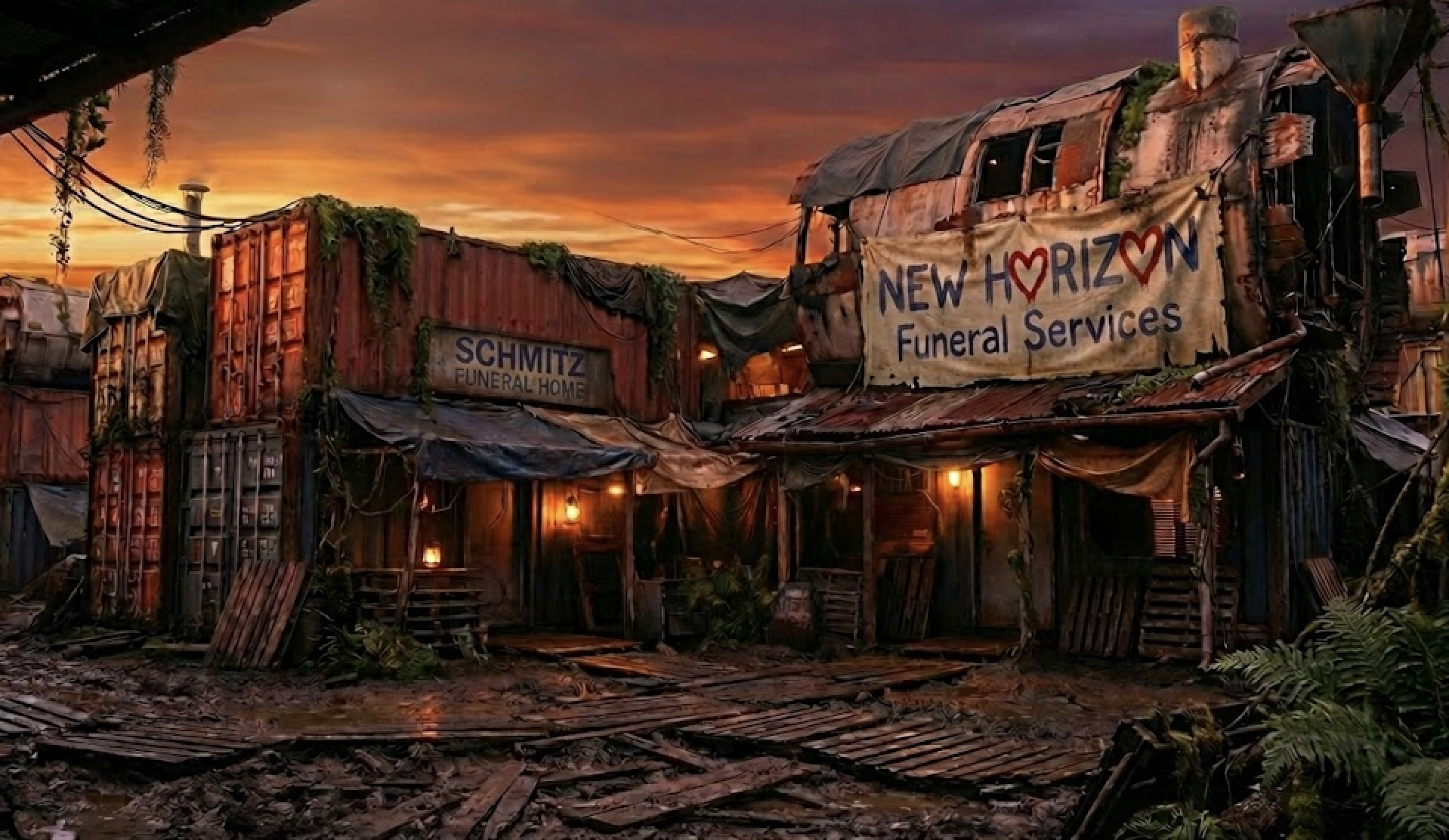
Overview
- Location: Public Services Ring, New Kourou
- Address: NE Public Services Ring Road 5
- Surroundings: Adjacent to Schmitz Funeral Home
New Horizon Funeral Services was founded in mid-2626 by Joe Schmitz, the younger of the Schmitz twins. Originally, Joe and his brother Ernest had established the first funeral parlor on VOI 700 D together: the business that would later become Ernest’s Schmitz Funeral Home. But the partnership lasted only a short time. The twins clashed over almost every detail — architectural style, burial philosophy, interior atmosphere, and even how to speak to grieving families. Ernest wanted a somber, wood-and-metal sanctuary rooted in memory of the crash; Joe envisioned light, renewal, and a hopeful forward gaze.
The tension escalated until Joe made his declaration of independence: he cleared the old Hoo stable on the right-hand side of the property and moved in to open his own funeral home.
What he lacked in resources, he compensated with sincerity. His services emphasized calm tribute, shipboard memories, lavender scent, and a quiet belief in new beginnings — a direct contrast to Ernest’s darker, wood-scented rituals next door. Both brothers developed loyal followings, each aligned with their respective philosophies of remembrance.
Inside, skilled staff craft pale coffins from Morningstar wood and guide mourners through candle-lit spoken tributes that weave shipboard memories into each farewell ceremony. When services conclude, a silver-painted coffin cart — drawn by two docile white Veyras — carries the deceased along the short processional lane to New Horizon’s Rest Cemetery, completing a burial tradition that grounds Beta Age settlers in the soil of their new world.
Architectural Significance
- Construction Material: Built from repurposed containers and salvaged parts of the spaceship Last Frontier
- Floors: 2
- Design Purpose: Distinct from the more conservative aesthetic of the competitor Schmitz Funeral Home.
The façade is dominated by Joe’s distinctive white-painted signage.
Building Structure
Ground Floor (Main Level)
- Reception Nook: A compact front counter operated by a Butler Bot; handles check-ins, scheduling, and printing memorial badges.
- Memory Room: A single multi-purpose ceremony space for intimate gatherings of up to 6 mourners. Features white alloy walls, soft diffused ceiling light, collapsible benches, and a simple elevated lectern for tributes. This room replaces the function normally split between viewing and memorial areas in larger funeral parlors.
- Body-Prep Corner: A partitioned, utilitarian workspace with a wash bench, cooling rack, simple embalming tools, and salvaged medical lighting. Compact but sanitary.
Upper Floor (Second Level)
- Coffin Studio: A tight workshop where Joe crafts pale Morningstar wood coffins and uses a small laser-etching unit for soft line motifs. Sawdust extraction vents lead directly outside.
- Storage Loft: Shelving for coffin lids, linen rolls, candles, lavender oil, and scanner cleaning kits.
- Staff Nook: A small desk alcove containing ceremonial notes, personal records, and a modest shrine to the Last Frontier.
Rear Exterior
Look and Feel
Although the building was opened in a former Hoo stable made of old spaceship parts and containers, New Horizon Funeral Service somehow feels inviting — even despite the fact that no one would actually want to be a customer or subject of treatment here if they had a choice.
A faint scent of lavender hangs in the air—Joe's personal touch—masking the sharp smell of sterilized metal and polished Morningstar wood that wafts up from the casket studio upstairs.
The Memory Room, the heart of the building, feels almost like a small star chapel: a quiet, bright room where grief is softened by light rather than shadow. The benches fold neatly against the wall when not in use, leaving the room open for intimate ceremonies.
Roles and Responsibilities
Human staff:
- Joe Schmitz (Owner / Celebrant): Leads services and quietly competes with his twin’s craftsmanship.
- Body Specialist (1 /Freelancer): Preps remains; applies facial soft-tissue nanogel for lifelike repose.
- Veyra Handler / Driver (1/ Freelancer): Guides the silver hearse cart to Horizon’s Rest.
Automated staff:
- Butler Bot (1): Welcoming customers
- Cleaning Bot (1): Sanitation sweep during closing times.
Public Access, Operating Hours and Operational Rhythm
Public Access: By appointment; walk-ins accepted for emergencies 8 AM – 8 PM.
Service Windows:
- 8 AM – 12 PM: Body preparation & coffin carpentry
- 12 PM – 6 PM: Viewings in Laying-Out Rooms
- 6 PM – 8 PM: Procession to New Horizon’s Rest Cemetery
Security Measures
- Key-Lock Doors: Front and side doors lock after 7 PM; keys held by Joe.
- Guarding Trooper Patrols: A Public-Services-Ring patrol of the Guarding Troopers passes the parlor regulary, checking doors and perimeter for signs of tampering.
Player Interaction Possibilities
Legal interactions:
- Attend a memorial service or offer condolences to NPC mourners.
- Act as pall-bearers or procession guards during an escort to Horizon’s Rest.
- Broker peace between feuding families who disagree over burial rites or costs.
- Volunteer to handle the Veyras and cart when Joe’s driver falls ill.
Illegal interactions:
- Swap coffin ID tags to fake a death..
- Vandalize the whithe facade to stoke the twin rivalry.
Tactical Advice for Dungeon Masters
- A lighting fault causes the photo‑board backlights to flicker, revealing an old star‑map scribbled with hidden crash coordinates.
- Rival saboteurs try to disgrace Joe by vandalising the pristine facade; players might trace them back to Ernest’s jealous apprentice (or a third party).
- A rare white Hoo is stolen on burial morning—time-sensitive chase through the Ring ensues.