Table of Contents
Races | Technology | Institutions | Buildings & Organizations
HEADQUARTERS OF DRONES OF HOPE INC.
Overview
- Location: Hope
- Address: West Central Crossroad 1
- Surroundings: Nearby the Hope Quantum Fusion Recalibration Station (QFRS).
Drones of Hope Inc. was founded in 2625 by Teyla Grant, a former drone fleet operator and systems engineer from the Last Frontier. The organization emerged from a grassroots effort to salvage and repurpose aerial drone technology after the crash, establishing itself as the leading drone logistics and restoration entity in the Hope Region.
The HQ became the main operations, repair, and coordination center for drone activity in Hope, overseeing Courier Drones, Seed Drones, and limited Combat Drone relics. The facility integrated repair docks, hangars, pilot interface rooms, and tactical terminals, functioning as a hybrid between an airport control center and an advanced robotics depot. Drones of Hope ensured sustained agricultural and drone-based logistical continuity during the turbulent early Beta Age.
Following the Peace Treaty, all operations were discontinued.
Architectural Significance
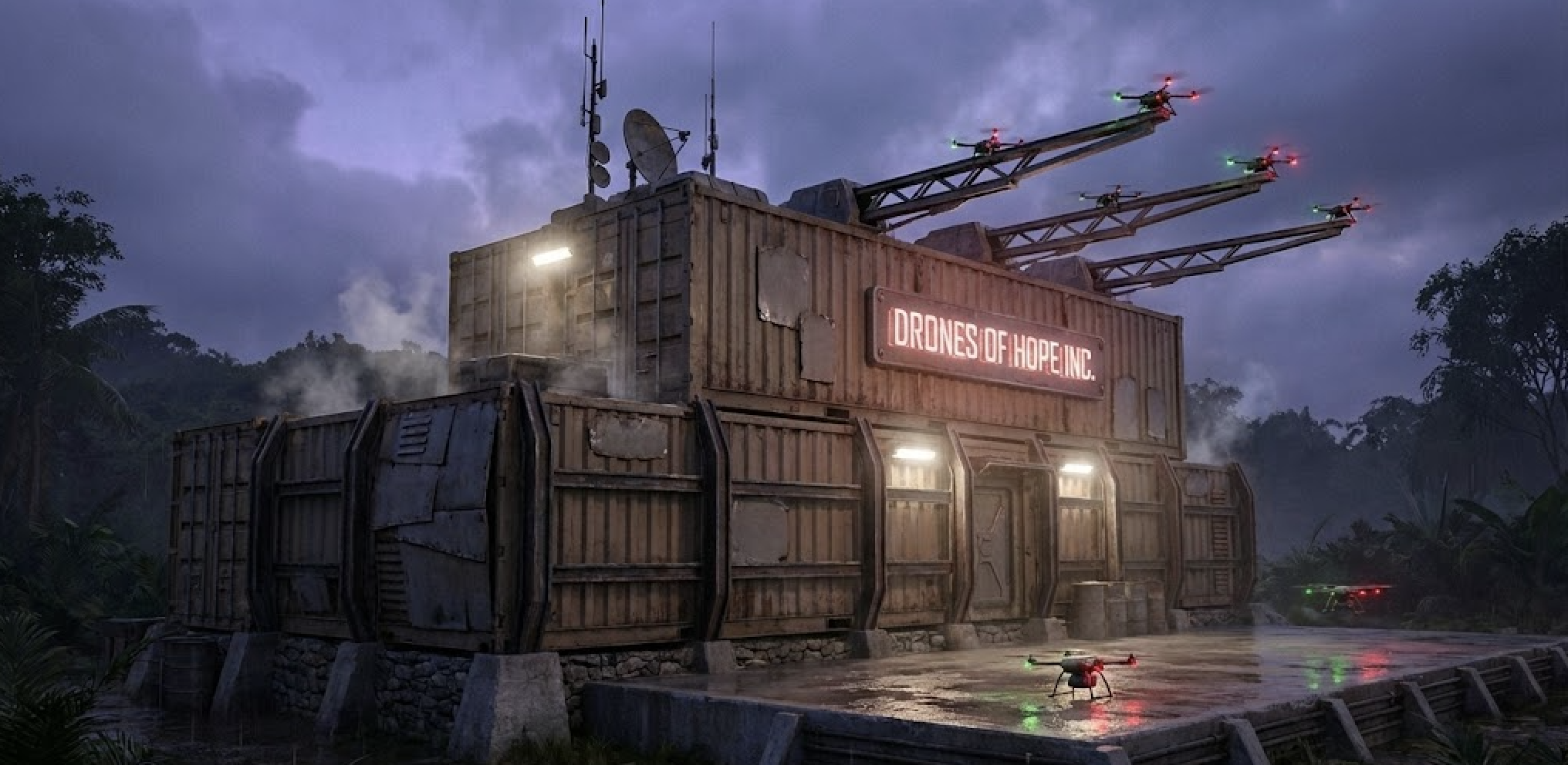
- Construction Material: Three stacked and interlocked cargo containers salvaged from the Last Frontier, reinforced with external steel ribs, patch-welded plates, and anchored on a low poured-stone foundation.
- Floors: 2 above ground + partial underground tech pit
- Façade: Weathered container hulls. A neon signage reading DRONES OF HOPE INC. is bolted to the upper container.
- Roof Structures: Retractable drone launch rails, beacon mast, and antenna clusters tied into the Exohuman Shortwave Radio Network.
- Design Purpose: Vertical, modular drone handling — optimized for quick launch, recovery, and repair rather than comfort or aesthetics.
Building Structure
Ground Level (Container 1)
- Open Launch Apron: Reinforced concrete-and-steel pad directly in front of the building for vertical drone takeoff and recovery.
- Hangar Bays (x4): Sliding container doors open into magnetized docking frames with QFB quick-connects.
- Public Counter: Narrow service window cut into the container wall for scheduling repairs, reporting losses, or requesting drone support.
- Drone Recovery Nook: First-pass diagnostics, hull inspection, and manual shutdown stations.
Upper Level (Container 2 & 3)
- Flight Control Room: Cramped command space packed with stacked monitors, route maps, and signal repeaters.
- Battery Handling Cage: Reinforced steel mesh room for temporary QFB storage and cooldown.
- Teyla Grant’s Office: A glass-partitioned corner filled with handwritten notes, flight logs, and salvaged circuit boards.
- Archivist Racks: Physical and digital storage of blackbox data and mission records.
Sub-Level Tech Pit
- Repair Chamber: Hydraulic lift pit with spider-arm welding rigs and parts printers.
- Sealed Combat Drone Vault: Armored container section welded shut after the Peace Treaty; signage warns of treaty violations.
Look and Feel
Under Hope’s perpetual twilight, hard white task lights spill from open container seams and launch rails, reflecting off wet ground after tropical rain. The sky glows faintly violet-blue, clouds still heavy with moisture, while the metal hulls steam softly as they cool.
Rotors whine, clamps hiss, and warning lights blink irregularly. Antennas sway slightly in the breeze. The air smells of damp steel, ozone, and warm electronics. Everything looks functional, stressed, and alive — a place built to keep things moving, not to last forever.
Roles and Responsibilities
- Mireille Yanto (Founder and Chief Engineer): Oversaw drone programming, battery integrity, and field mission success rates
- Maintenance Bots (5): The Maintenance Bots repaired rotors, sensors, and hull integrity; upgraded onboard software
- QFB Engineers (3): Managed power cell replacements and cooldown cycles
- Flight Dispatchers (4): Scheduled drone activity, managed routing, logged cargo manifests
- Flight Test Operators (2): Supervised testing and re-certification of recovered drones
- Archivists (2): Maintained flight logs, blackbox data, and usage reports for review
- Cleaning Bots (2): The Cleaning Bots maintained cleanliness of public access areas and critical technical workspaces
- Guarding Bots (2): The Guarding Bots guarded the Entry and the Test Flight-Area
Public Access, Operating Hours and Operational Rhythm
Public Access:
Restricted to the front lobby, all other areas were drone-restricted or technical clearance only
Operating Hours:
- Dispatch Operations: 6 am – 10 pm daily
- Maintenance Bay: 8 am – 6 pm, Monday through Saturday
- Outdoor Test Flights: 10 am – 4 pm, weather and wind permitting
Operational Rhythm:
- Mornings emphasized battery checks and courier routing
- Midday windows prioritized agricultural seeding missions
- Afternoons allowed for blackbox recovery, test flights, and drone recall
Security Measures
- High-Security Fence: Electrified alloy-mesh fencing surrounded all exterior operations
- Guarding Bot–Secured Entry: A stationary Guarding Bot scanned credentials and stood watch at the facility entrance, equipped with reinforced shielding and a Guarding Troopers Stun Gun
- Guarding Bot on Outdoor Testing Track: A second Guarding Bot monitored the launch area, preventing unauthorized test runs
- Guarding Trooper Patrols: Local Guarding Trooper units rotated every 6 hours
Player Interaction Possibilities (Legal and Illegal)
Legal Interactions:
- Apply for a job
- Purchase a Seed Drone or Courier Drone for your farm or company
- Request a Repair of a Seed Drone or Courier Drone
- Request drone support for remote delivery missions
Illegal Interactions:
- Attempt to steal a courier drone for contraband transport
- Hack into the drone dispatch terminal to reroute supplies
- Bribe a technician for access to restricted drone footage
- Sabotage a Seed Drone in an act of eco-terrorism
Tactical Advice for Dungeon Masters
The Headquarters can serve as a dynamic mission hub, sabotage target, or discovery site:
- The Broken Wing: A Combat Drone crashes during a test flight on the outskirts of Hope. Players must find it before it falls into the wrong hands…
- Seeds of Desperation: A broke farmer hires the players to steal a Seed Drone from the facility, unable to afford one through legal channels. The heist reveals deeper questions of equity and survival in the post-crash economy.