
Table of Contents
Races | Culture | Language
SHANG TELU
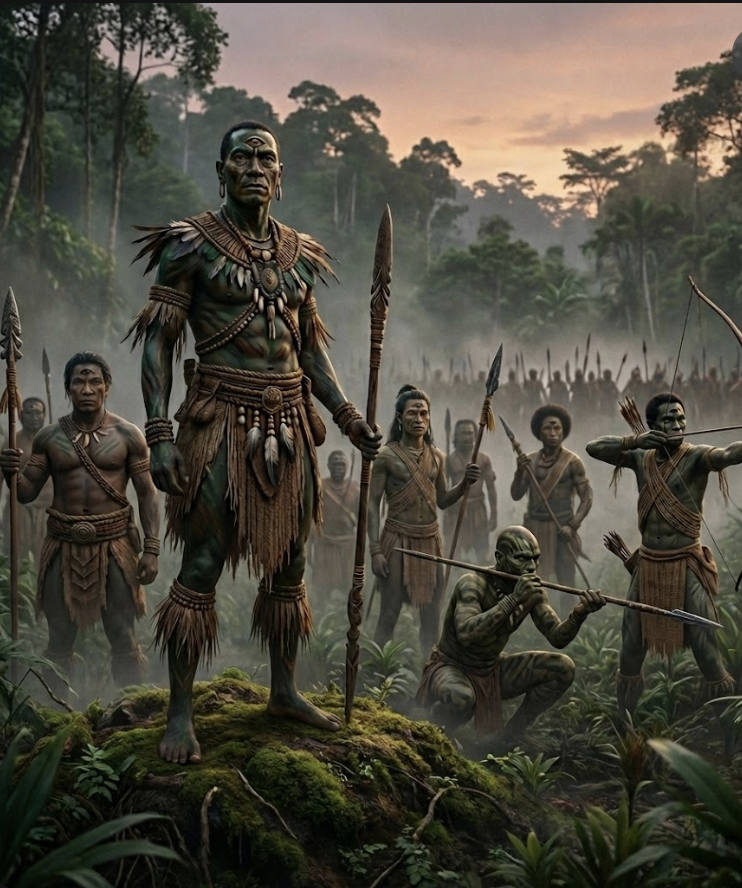
The Shang Telu language is the native tongue of all Native Tribes residing on the planet VOI 700 D, locally known as Shang-Gha-Lea. This complex and poetic language, deeply rooted in the natural environment of the planet, serves as a unifying linguistic thread among the diverse tribes, each with its own dialect and cultural nuances.
Phonetics
Consonants
- Plosives (“P,” “T”): Mimic natural sounds like water droplets and breaking twigs, serving as sentence anchors.
- Fricatives (“S,” “V”): Echo softer sounds such as wind through trees or flowing water, often used in words describing movement or transition.
- Nasals (“M”): Resemble natural hums, bringing a musical quality to the language.
Unique Features
- Aspiration: Consonants can be aspirated to mimic natural phenomena like wind gusts or splashing water.
- Glottal Stops: Used to mark a full stop in phrases, resembling natural sounds like snapping twigs.
Vowels
- Front Vowels (“E,” “I”): Indicate proximity or urgency.
- Back Vowels (“O,” “U”): Used for historical, distant, or abstract concepts.
Unique Features
- Diphthongs: Represent complex emotions or abstract ideas.
- Vowel Harmony: Ensures that vowels within a word conform to a pattern, often established by the first vowel.
Syntax and Grammar
Sentence Structure: Remarkably flexible, relying heavily on context. Pronouns and determiners exist but are used sparingly, reflecting the collective focus of the tribes.
Basic Pronouns
- Maro: We, Us
- Taro: They, Them
- Siro: It, This, That
- Verbless Sentences: Commonly used, with “being” often implied and not explicitly stated.
- Negation and Questions: Framed using tone, pitch, or auxiliary particles.
- Pronouns and Possession: Used sparingly; possession is usually implied.
Subject-Verb-Object (SVO)
Although the word order is generally loose, SVO is the most straightforward sentence structure. However, due to the fluid nature of the language, this isn't strictly observed.
Verbless Sentences
Shang Telu frequently uses verbless sentences. Much like Arabic or Russian on Earth, “being” is often implied and not explicitly stated. Therefore, a sentence like “Maro Vai” doesn't need a verb to convey the relationship between the subject and the object.
Negation and Questions
Negation and questions are usually framed using tone, pitch, or auxiliary particles to avoid ambiguity, since individual words carry multiple meanings.
Pronouns and Possession
Personal pronouns exist but are used sparingly. Possession is rarely stated outright but rather implied through the context.
Numerical System
The numerical system in Shang Telu is uniquely tailored to the environmental and cultural realities of the tribes on Shang-Gha-Lea. While it is distinct from Earth-based systems, it reflects the tribes' deep connection with their natural surroundings and their philosophical understanding of the universe.
Key Features:
- Base System: The Shang Telu numerical system may be based on a different numerical base that resonates with the tribes' observations of their environment and their spiritual beliefs.
- Contextual Numbers: Numerical expressions in Shang Telu often carry context-dependent meanings, reflecting the tribes' holistic view of the world.
- Expressive Counting: Counting in Shang Telu might not strictly focus on precision but rather on expressing a sense of quantity in relation to the natural world, such as “a gathering of fruits” or “a multitude of stars.”
Cultural Integration:
- Rituals and Symbolism: Numbers in Shang Telu often hold symbolic significance and are integral to various tribal rituals and ceremonies.
- Oral Tradition: The numerical system is deeply interwoven with the tribes' oral traditions, where storytelling and spoken word play a crucial role in passing down knowledge.
Writing System
Employing approximately 200 hieroglyphs, each symbol in the Shang Telu script reflects aspects of nature and tribal philosophy. The writing is mostly used for spiritual texts, historical accounts, and critical tribal directives.
Materials and Tools
Predominantly written on durable, large, flat leaves using luminescent dyes derived from local plants like “Shika Me La.”Writing implements include small, sharpened bones for standard writing and sturdier bones for permanent inscriptions.
Cultural Significance
Shang Telu is more than a language; it is an embodiment of the tribes' collective memory, spirituality, and philosophy. The structure and vocabulary of Shang Telu are deeply influenced by the tribes' profound connection to their environment, and the concept of “Shai Zaong” plays a central role in their cultural expressions.
Linguistic Unity and Origins in Creation Myth
Mysterious Universality:
Shang Telu's pervasiveness among all tribes on Shang-Gha-Lea, regardless of their contact with each other, is a linguistic phenomenon that perplexes human linguists. This universal language, with its varied regional dialects, suggests a deep-rooted connection among the tribes that transcends geographical and cultural boundaries.
Lack of Historical Records:
- No Common Migration Myths: Interestingly, the tribes do not possess myths or traditional histories that indicate a shared contiguous area in the past. The absence of such migration or unification legends in their oral histories adds to the enigma surrounding the language's widespread nature.
- Divine Origin Theory: The tribes unanimously attribute the origin of Shang Telu to their creation story, wherein they were all crafted by the same gods. This spiritual explanation is deeply ingrained in the tribal consciousness and is often cited as the reason for their shared language.
- Sacred Language: Given its believed divine origin, Shang Telu is not just a tool for communication but also a sacred element that binds the tribes to their gods and to each other. Its preservation is thus a matter of both cultural pride and spiritual duty.
- Linguistic Evolution:
Despite the lack of historical migration narratives, Shang Telu has evolved to accommodate the unique experiences and environments of each tribe, resulting in the rich tapestry of dialects observed today. This evolution is ongoing, as tribes adapt the language to new challenges and discoveries, ensuring that Shang Telu remains a living, dynamic language.