
Table of Contents
Races | Economy | Buildings & Organizations
KARABULUT GARMENT MANUFACTORY (KGM)

Overview
- Founding Year: 2625
- Founder: Jeremy Karabulut
- Headquarters: Plant of the Karabulut Garment Manufactory, New Kourou
- Original Purpose: To create and provide practical, durable garments for the New Frontier.
The Karabulut Garment Manufactory (KGM) was the first large-scale textile production facility on VOI 700 D. It played a key role in transitioning ExoHuman society from repurposed Last Frontier space suits to newly manufactured clothing, fueling the growth of individual fashion and textile production in the Beta Age.
The KGM’s rise was fueled by both necessity and innovation, supplying settlers with practical, durable garments suited for the harsh frontier environment of VOI 700 D. Its fabrics became the standard for ExoHuman settlers, and its success led to expansion into agricultural production, particularly the cultivation of Hekana (“Alien Cotton”) in the Hope Region.
However, KGM’s rapid expansion and resource demands created tensions with Native Tribes, contributing to land disputes that foreshadowed the Great War of 2629.
Under the first Federal Confederation government, led by Aisha Patel, the KGM was nationalized in 2632 as part of the transition to Communardism. It was replaced by the Federal Garment Manufactory (FGM), which remains the sole textile provider in the Gamma Age.
Foundation & Early Success
At the time of the crash-landing in 2625, every ExoHuman wore a standard-issue Last Frontier space suit. These suits were durable but impractical for planetary survival. Settlers modified their suits into functional garments, but textile shortages limited options.
The pioneer of this movement was Jeremy Karabulut, a former engineer who opened the first sewing shop in New Kourou in April 2625. Karabulut specialized in:
- Reinforced jackets & pants for settlers working in rough terrain.
- Layered garments for better temperature control.
- Flexible, breathable fabrics for improved mobility.
His methods became so popular that by the end of 2625, six other sewing shops had opened in New Kourou, and by 2627, 24 independent sewing shops operated across all four ExoHuman settlements. However, space suit refurbishment had limitations—materials were scarce, and there was no color variety or ability to create new shapes.
To solve this, Karabulut expanded his operations in 2628, founding the Karabulut Garment Manufactory (KGM) in New Kourou.
Growth & Expansion
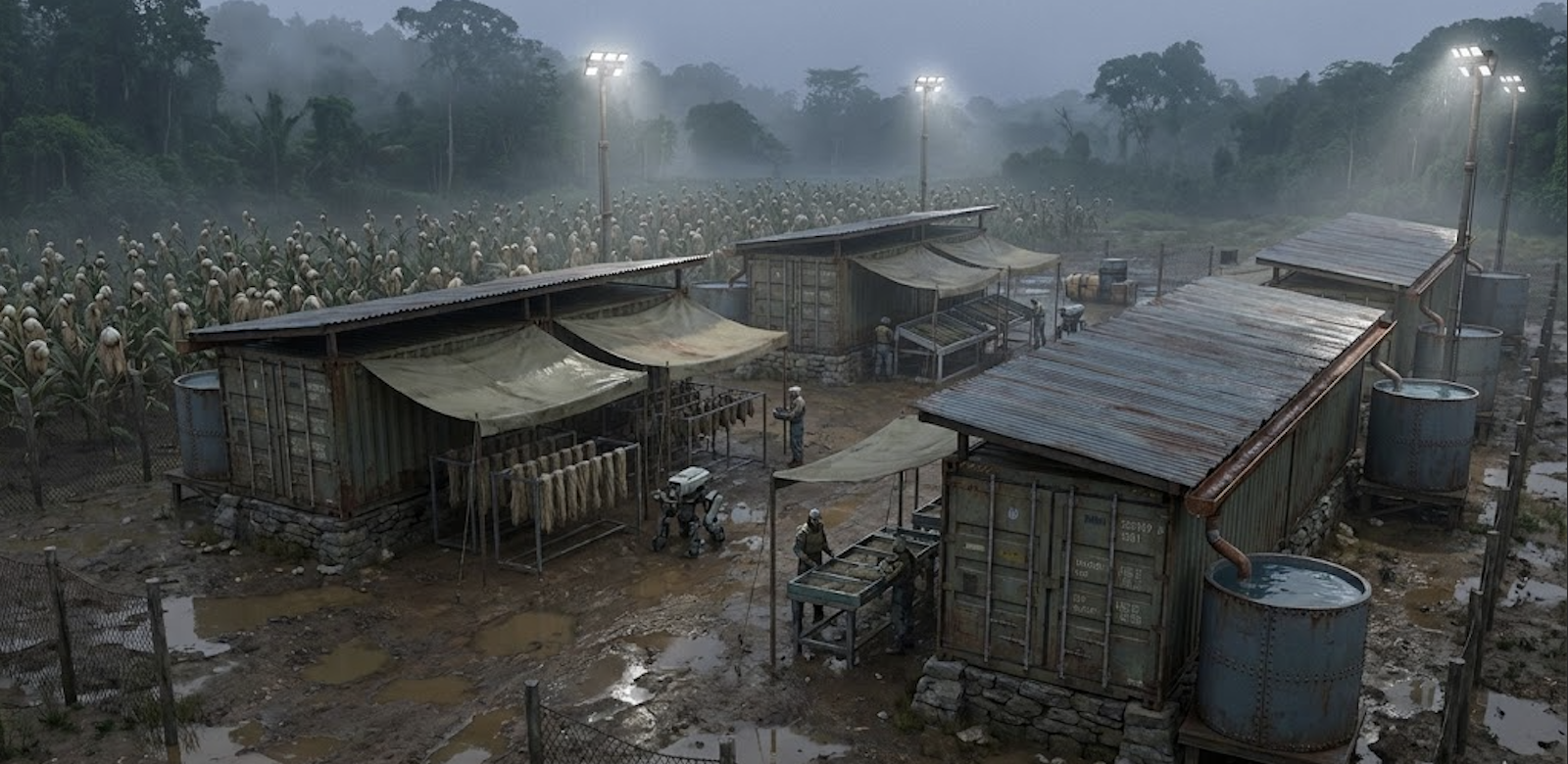
The Karabulut Garment Manufactory revolutionized clothing production on VOI 700 D by introducing:
- New fabrics that were more durable and breathable than repurposed space suits.
- A variety of colors and designs, moving away from the monochrome aesthetic of the Last Frontier.
- Mass production, making clothing more affordable and widely available.
Within two years, KGM became on of the largest employers in New Kourou, with:
- 320 workers, including tailors, textile engineers, and agricultural specialists.
- 12 Agricultural Bots operating 5 Hekana fields in the Hope Region.
KGM produced:
- Workwear for settlers, including reinforced jackets, boots, and gloves.
- Casual clothing, inspired by Wild West aesthetics and frontier practicality.
- Specialized garments for miners, loggers, and riders, designed for rough terrain and extreme weather.
KGM’s textiles quickly spread to Firetown, where settlers embraced customized coats, heat-retaining boots, and practical riding gear, suited for a frontier society without roads.
However, this expansion led to conflicts with Native Tribes.
The Hekana Controversy & Land Disputes
KGM’s success was heavily reliant on Hekana (“Alien Cotton”), a fibrous plant native to the Asari Region, which:
- Resisted temperature extremes, making it ideal for both Habitual Belt and Dark Side clothing.
- Was naturally water-repellent, requiring no chemical treatment.
- Grew quickly and in dense clusters, making it efficient for large-scale farming.
To meet textile demand, KGM expanded Hekana farms in the Hope Region. However, many Native Tribes objected, arguing that:
- The cotton fields were being planted on sacred Native lands.
- ExoHuman settlers were overharvesting a resource critical to Native survival.
- The expansion of textile farms was a violation of early settlement agreements.
The tensions over land use escalated into territorial disputes, increasing distrust between ExoHumans and the Native Tribes. Although Hekana farming was not the sole cause of the Great War of 2629, it symbolized the broader economic and territorial conflicts that led to open conflict.
Nationalization & The Birth of the Federal Garment Manufactory
Following the Great War, the newly established Federal Confederation, led by Aisha Patel, nationalized KGM in 2632, citing:
- The need to control textile resources under the Communard economy.
- Eliminating private profit-driven expansion, which had led to land conflicts.
- The need for uniform clothing production, reducing fashion waste.
The KGM was officially shut down, and its operations were transferred to the Federal Garment Manufactory (FGM), which remains the sole textile provider in the Gamma Age.
The two remaining Hekana fields in the Hope Region were placed under strict sustainability policies, managed by the FGM instead of the Federal Food Plant. Today, Karabulut’s legacy remains, but the era of independent clothing production has long ended.
Tactical Advice for Dungeon Masters
The rise and fall of KGM offers rich storytelling opportunities for Beta Age campaigns.
- “The Textile Boom” – KGM needs to transport a shipment of new fabrics to Firetown. The players are hired as guards — but bandits may be planning to steal it.
- “The Hekana Dispute” – A Native tribe refuses to let settlers harvest a key Hekana field. Can the players negotiate peace or will conflict erupt?
- “The Factory Riots” – Unhappy workers at KGM demand better conditions. Players must prevent a strike — or help expose corruption.