
Table of Contents
Races | Economy | Buildings & Organizations
HOPE MILLS INC. FACILITY (HMI)
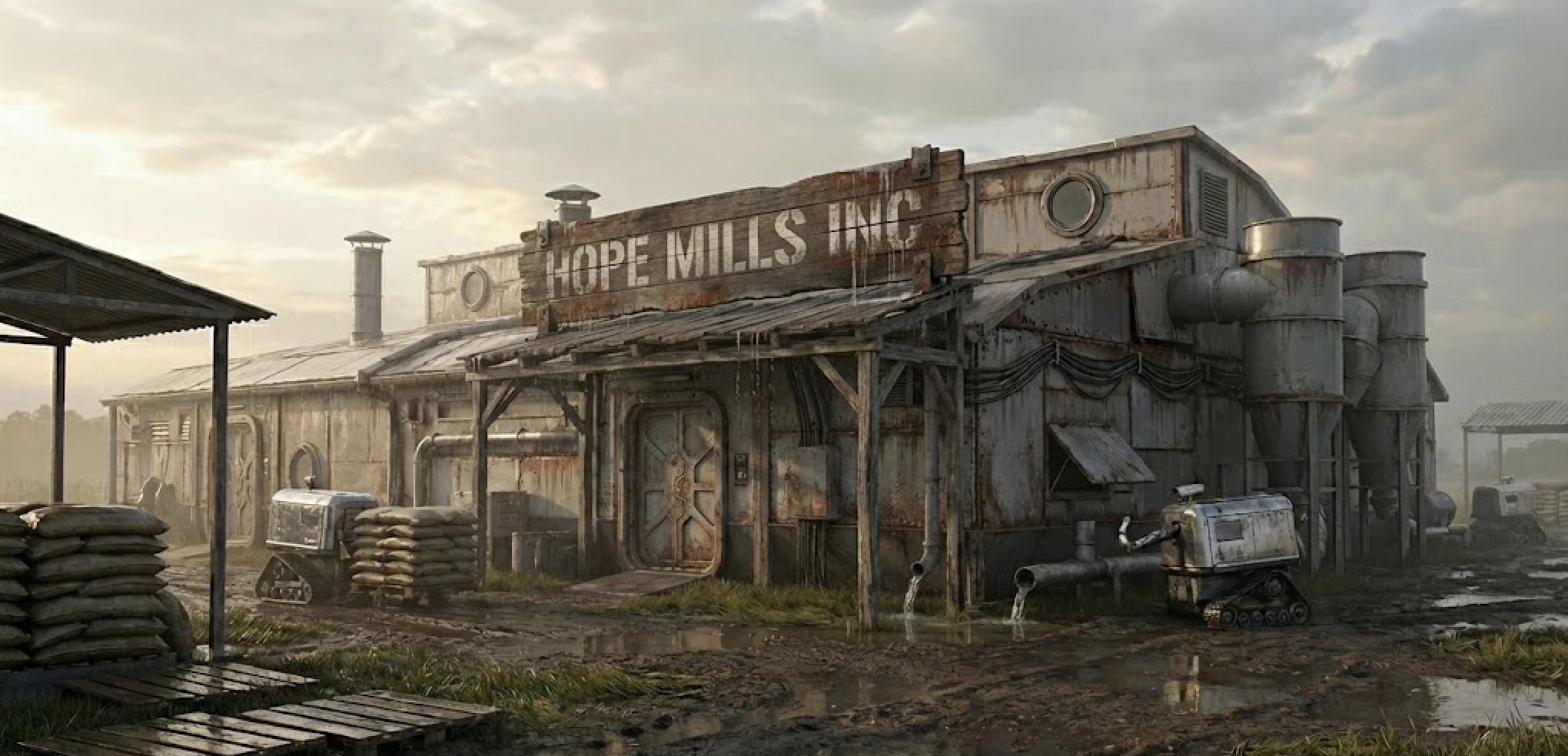
Overview
- Location: Hope Region
- Address: Farmbelt
- Surroundings: Situated in Hope's farmbelt, adjacent to local farms and farmland.
Founded in 2626 by Darth Makenfeld, a former engineer of the spaceship Last Frontier, Hope Mills Inc. processed regional grain for private bakeries and grocers across the Hope Region. The plant ran three electric-powered mills on Quantum Fusion Batteries and relied heavily on bots: Maintenance Bots, Manual Labor Bots (haulage), and front-desk Service Bots. In 2632, following the founding of the Federal Confederation and the introduction of Communardism, the Federal Council closed the company. Under Peace Treaty sustainability rules, the site was stripped and recycled; production was replaced by two water-powered mills at the FMF on the Arla River in Hope’s town center.
Architectural Significance
A compact Beta Age industrial facility assembled from salvaged Last Frontier ship modules, designed for fast electrified throughput at the edge of Hope’s agricultural frontier rather than urban permanence.
- Materials: Reused hull plates and composite deck panels from the Last Frontier; pressure doors repurposed as service hatches; salvaged portholes adapted into clerestory windows.
- Lighting: Harsh electric high-bays and strip lighting (QFB-backed), optimized for bot-readable work zones rather than human comfort.
- Ventilation & Acoustics: Ship-style ducting with powered roof extractors; baffle panels and rubberized floors to dampen bot traffic.
- Energy Use: Direct Quantum Fusion Battery feeds to mill motors, conveyors, lifts, and bot charging cradles; automated load-shedding during peak cycles.
Building Structure
Operations Block (Milling & Packaging)
- Main Milling Hall (×3 Electric Mills): Hammer/roller assemblies, enclosed conveyors, dust control.
- Grain Intake Hall: Sacks received, weighed, and routed to labeled bins (Lunor, Zelor, Rizon, Helik; Bilax batch chute).
- Packaging Room: Bagging line, seal crimpers, labelers (pre-federal standards).
- Flour Storage Loft: Sacks filled, sealed, and staged by grain/root type for carrier collection.
- Quality Control Booth: Moisture meters, sieve sets, rapid test plates; sample ledgers.
Operator House (Admin & Exohuman Spaces)
- Control Room: Battery panels, production counters.
- Admin Office & Reception: Ledger desks, contract files; Service Bot counter.
- Break Nook: Kettle bench, lockers (pre-Federal Kitchen era).
- Restroom (1): AuroraSan stall for exohuman supervisors.
Bot Hangar & Power
- Bot Bays (Recharging): Charging cradles, tool racks, firmware station for Maintenance/Manual Labor/Service Bots.
- Power Interface Room: Quantum Fusion Battery arrays, cooling manifold, lockout bar.
Yard & Logistics
- Loading Dock: Canopy bay for private carriers.
Look and Feel
The mill squats low against the farmbelt, its riveted hull plates sun-faded and streaked with grain dust. Stenciled bulkhead numbers, warning chevrons, and sealed pressure doors betray its origin as starship salvage rather than civic architecture.
Inside, electric high-bays flood the milling hall with white light as conveyors thrum and mills grind in steady cycles. Bots glide along rubberized lanes, lifting sacks, sealing flour, and docking briefly at charging cradles before returning to their routes. Status panels tick through quotas and battery draw, indifferent to the warm air drifting in from surrounding fields.
Outside, carrier wagons wait under a simple canopy while grain fields ripple in the late light — the boundary where agriculture ends and machine logic takes over.
Roles and Responsibilities
Staff (3 exohumans + bots):
- Mill Operators (3): One per shift (3×8 h) overseeing all plant functions from the control room; authorize start/stop cycles, sign lot releases, and respond to alarms.
- Bots (plant-wide labor):
- Manual Labor Bots: Haulage, palletizing, dock movements.
- Maintenance Bots: Routine servicing of mills, conveyors, and battery panels.
- Service Bots: Reception, intake desk, visitor sign-in, and status notifications.
- *Note:* All milling, intake, packaging, and internal transport were executed by bots; exohumans supervised only.
Public Access, Operating Hours and Operational Rhythm
- Operating Model (Beta Age): Private industrial site; no public walk-ins.
- Shifts: 3 × 8 h rotation for Exohumans; bots ran continuous cycles with staggered recharge.
- Carrier Windows: Private dispatches at 09:00 and 16:00 (pre-federal: NKCS / FCS–Firetown contracts where applicable).
- Decommissioning (2632): Structured salvage; machinery logged and diverted to the water-powered FMF build-out.
Services / Operations
| Program/Stream | What Enters | Primary Handling | Outputs | Mandated Destination / Use |
| Milling (Electric) | Lunor, Zelor, Rizon, Helik; Bilax (batch) | Automated feed, electric rolling/hammer milling | Flours & meals by type/grade | Private bakeries/grocers (Beta Age) |
| Intake & Weighing | Farmer-delivered sacks | Scale-in, binning by grain/root | Intake ledgers; lot IDs | Accounts & carrier schedule |
| Packaging | Empty sacks; label stock | Fill, weigh, seal, label | Palletized sacks by lot | Private carriers; regional depots |
| Quality Control | Lot samples | Moisture/sieve tests; rapid checks | Pass/hold/rework slips | Plant records; client copies |
| Bot Logistics | Bots, parts, battery time | Recharge, maintenance, firmware | Operational bot shifts | Internal plant operations |
Security Measures
- High-Security Fence: Electrified alloy-mesh fencing surrounded all exterior operations
- Locked Gate: Access was only possible through a locked gate in the fence. Unlocking was only possible with an analog key or buzzer.
- Chain-of-Custody: Lot labels and seal slips reconciled to intake weights and dock manifests.
- High-Security Fence: Electrified alloy-mesh fencing surrounded all exterior operations
- Guarding Trooper Patrols: Local Guarding Trooper units rotated every 6 hours
Player Interaction Possibilities (Legal and Illegal)
Legal interactions:
- Apply for and serve a Mill Operator shift (oversee bot cycles, sign lot releases, respond to interlocks).
- Deliver grain as a contracted farmer/co-op rep to the Intake Hall (scale, binning, lot ticket).
- Collect processed flour on behalf of a bakery/grocer (manifest check, seal verification, dock handover).
Illegal interactions:
- Forge lot labels to pass Zelor as Lunor in outbound sacks.
- Tamper with bot firmware to reroute pallets or spoof interlock logs.
- Lift battery control relays or spare parts for black-market rigs.
Tactical Advice for Dungeon Masters
- Adventure Hook — The Flour That Bled: A midnight QC pull on the Zelor line flags organic fragments; minutes later, the bagging spiral jams and reveals exohuman skin and shredded tissue. Emergency stop halts all three mills. The Guarding Troopers Station of Hope contract the PCs via the Service Bot to investigate and contain panic …
Related Pages and Further Information
- Predecessor carriers: New Kourou Courier Service · Firetown Courier Service